
Unit economics is the test of whether a dating business genuinely works. This guide explains the concepts in operator-friendly terms and shows how they fit together.
What unit economics means
Unit economics is the economics of a single unit of a business, and for a dating app the unit is a member. Unit economics asks a simple, fundamental question: what is an average member worth, set against what it costs to get them.
It is worth being clear about why this single question matters so much. A dating business, like any business, has revenue and costs, and it works financially only if, over time, the revenue exceeds the costs. Unit economics breaks that whole question down to the level of a single member, because the member is the unit on which a dating business is built: the business acquires members, members generate revenue, and the business works if the revenue from members exceeds the cost of acquiring and serving them.
If the unit economics work, if an average member is genuinely worth more than it costs to acquire and serve them, then the business has a sound foundation: every member acquired adds value, and acquiring more members grows the business soundly. If the unit economics do not work, if an average member costs more than they are worth, then the business is, at the level of its fundamental unit, losing money, and acquiring more members makes things worse, not better. No amount of growth fixes broken unit economics; it amplifies the problem.
This is why unit economics is, as the opening capsule says, the test of whether a dating business genuinely works. The analytics guidance names lifetime value against acquisition cost as the ultimate test of viability; unit economics is the formal name for that test and the framework around it.
The framework has a few key measures, which the next sections take in turn: , the revenue per member; , the lifetime value of a member; and CAC, the cost to acquire a member. And it has a central relationship, LTV against CAC, and a key timing measure, the payback period. Together these are the unit economics of a dating app.
For an operator, the starting point is to understand unit economics as the economics of a single member, and the test of whether the business genuinely works: is an average member worth more than they cost.
ARPU: average revenue per user
The first measure to understand is ARPU, average revenue per user, and it is the most basic measure of what a member is worth.
ARPU is, as the name says, the average revenue a user, a member, generates, over some defined period. It answers the question: across all the members, how much revenue does an average one produce.
ARPU is a useful measure because it summarises, in one number, the revenue side of the member at a given moment. A dating business has a base of members, some paying, some not, the pricing guidance describes the freemium, paid and hybrid models, and ARPU averages across them to give a single figure for what an average member, paying or not, contributes in revenue over the period.
ARPU connects to the things the monetisation guidance describes. It is shaped by the payer conversion rate, the share of members who pay, and by what paying members pay, the pricing, the tiers, the purchases. A business with strong conversion and sound pricing has a healthier ARPU than one with weak conversion or thin pricing.
It is worth a measured note. Specific ARPU figures, what ARPU is for the industry, for particular companies, in a particular period, are current data that changes and that an operator should not take from a guide. What this guide explains is what ARPU is and how it fits into the unit economics, which is durable. An operator should understand the concept, and check any specific benchmark figures against current sources.
ARPU on its own, though, is a snapshot of revenue per member over a period; it does not capture the whole value of a member, because a member is not worth only one period's revenue. A member who stays generates revenue over many periods. To capture the whole value of a member, unit economics uses LTV, which the next section describes, and ARPU is best understood as a building block toward LTV.
For an operator, ARPU is the basic revenue-per-member measure: useful as a summary of the revenue side, shaped by conversion and pricing, and a building block toward the fuller measure of a member's whole worth, the lifetime value.
LTV: lifetime value
The most important measure of what a member is worth is LTV, lifetime value, and an operator should understand it well, because it is one side of the central test.
LTV, the lifetime value of a member, is the total revenue an average member generates over their whole time on the app, their whole lifetime as a member. Where ARPU captures revenue per member over one period, LTV captures the whole of it: everything a member is worth, summed across their entire time as a member, from when they join to when they eventually leave.
LTV is the more meaningful measure of a member's worth, because a member's value is not one period's revenue; it is the whole stream of revenue they generate over their lifetime. A member who pays a subscription and stays for a long time is worth far more than one period's ARPU would suggest, because they keep generating revenue period after period. LTV captures that whole accumulated worth.
LTV is shaped by two things above all: how much a member generates per period, the ARPU-type revenue, shaped by conversion and pricing, and how long the member stays, the retention the analytics guidance describes. A member who generates good revenue per period and stays a long time has a high LTV; a member who generates little or leaves quickly has a low one. This is why retention matters so much to the economics: retention directly drives LTV, because every additional period a member stays adds to their lifetime value. The retention guidance's point that small retention improvements compound into large revenue improvements is, in unit-economics terms, the point that retention drives LTV.
As with ARPU, a measured note: specific LTV figures are current data that an operator should check against current sources, not take from a guide. The concept, what LTV is and what shapes it, is durable.
LTV is one side of the central test of unit economics. It is what a member is worth. The other side is what a member costs to acquire, the CAC, which the next section describes, and the test is LTV against CAC.
For an operator, LTV is the key measure of a member's worth: the whole revenue a member generates over their lifetime, driven by revenue per period and by retention, and one side of the central unit-economics test.
CAC: the cost to acquire a member
The other side of the central test is CAC, the cost to acquire a member, and an operator should understand it as carefully as LTV.
CAC, customer acquisition cost, sometimes cost of acquisition, is what it costs, on average, to acquire a member. A dating business spends money to bring members in, the marketing, the advertising, the acquisition effort the getting-started and monetisation guidance describe, and CAC is that spend divided across the members it produces: the average cost of getting one member.
CAC matters because acquiring members is not free, and often not cheap. As the acquisition guidance describes, a dating business spends real money on the channels that bring members in, and that spend is a genuine, major cost. CAC measures it at the level of the unit, the member, so it can be set against what a member is worth.
CAC is shaped by the things the acquisition and conversion guidance describe. It is shaped by which channels a business uses and how efficient they are, the acquisition guidance's point about cost per channel, and crucially cost per paying member rather than per signup. It is shaped by how well the business converts the traffic it pays for, since, as the onboarding, landing-page and conversion guidance describe, better conversion means more members from the same spend and so a lower CAC. A business with efficient channels and good conversion has a lower CAC than one with wasteful channels and poor conversion.
As with ARPU and LTV, specific CAC figures are current data to check against current sources; the concept is durable.
There is a subtlety in CAC worth noting, which the acquisition guidance also stresses: it matters whether CAC is measured per member or per paying member. A business might have a low cost per signup but, if few of those signups ever pay, a high cost per genuinely valuable, paying member. For unit economics, what matters is the cost of acquiring members measured against the value those members genuinely generate, which connects CAC properly to LTV.
For an operator, CAC is the cost side of the central test: what it costs to acquire a member, shaped by channel efficiency and by conversion, and the figure that LTV must be set against.
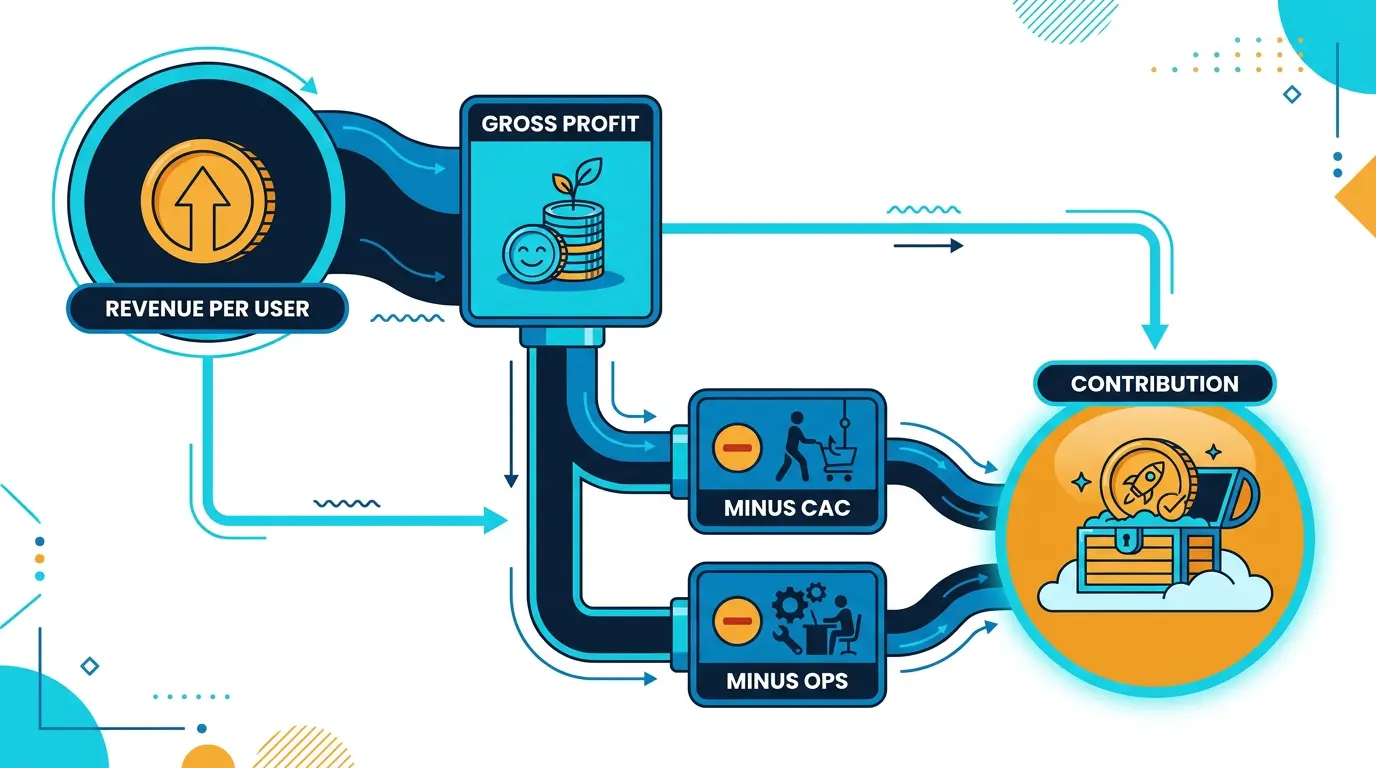
The core relationship: LTV against CAC
With LTV and CAC understood, the heart of unit economics is the relationship between them, and an operator should understand this as the central test of whether a dating business genuinely works.
The core relationship is simply LTV set against CAC: what an average member is worth, the LTV, compared with what an average member costs to acquire, the CAC.
The fundamental requirement is that LTV must exceed CAC. If an average member is worth more, over their lifetime, than it cost to acquire them, then every member acquired adds net value, and the business has, at the level of its fundamental unit, sound economics. If LTV is less than CAC, if an average member costs more to acquire than they are ever worth, then the business loses money on every member, and, as the what-it-means section stressed, no amount of growth fixes that; growth amplifies the loss.
But LTV merely exceeding CAC is not, on its own, enough. LTV must exceed CAC by a sufficient margin. This is because CAC is not the only cost. A dating business has other costs beyond acquiring members: the cost of serving and running the business, which, for an operator, includes the revenue share the section describes, and the operator's other operating costs. LTV has to cover CAC and those other costs and leave a genuine margin, for the business to be soundly profitable. So the test is not just "is LTV bigger than CAC" but "is LTV bigger than CAC by enough to cover the other costs and leave a real margin."
This LTV-against-CAC relationship is, as the analytics guidance says, the ultimate test of viability. It is the formal version of the question every dating business must answer: do the members, over their lifetimes, generate genuinely more than it costs to acquire and serve them. A business that can answer yes, by a healthy margin, has sound unit economics and a genuine foundation. A business that cannot does not, however good other things look.
For an operator, the core relationship is the test to hold above all others: LTV must exceed CAC, and by a sufficient margin to cover the other costs and leave a genuine margin. That is what sound unit economics means, and it is what makes a dating business genuinely work.
The payback period
Alongside the LTV-against-CAC relationship, there is a second key measure an operator should understand: the payback period, which adds the dimension of time.
The payback period is how long it takes for a member to generate enough revenue to recover the cost of acquiring them, the CAC. It answers the question: having spent the CAC to acquire a member, how long until that member has paid that cost back.
The payback period matters because the LTV-against-CAC test, on its own, is about the whole lifetime, but a business also has to survive in the meantime. A business spends the CAC up front, to acquire a member, and then recovers it over time as the member generates revenue. The longer the payback period, the longer the business is, in effect, out of pocket on each member before recovering the cost. This connects directly to the cash-flow point the scaling guidance describes for affiliates: spending up front and recovering over time creates a cash-flow gap, and the payback period measures that gap at the level of the member.
A business with a short payback period recovers its acquisition costs quickly, which is healthier for cash flow and lower-risk: the business is not out of pocket for long, and it gets clear evidence quickly that its members are recovering their cost. A business with a long payback period waits longer to recover each member's CAC, which strains cash flow and means the business is carrying more risk and more uncertainty before each member proves their worth.
So the payback period and the LTV-against-CAC relationship are two complementary measures. LTV against CAC asks whether a member is worth more than they cost over their whole lifetime, the test of fundamental viability. The payback period asks how fast the acquisition cost is recovered, the test of cash-flow health and risk. A genuinely sound dating business wants both: LTV comfortably exceeding CAC, and a payback period short enough that the business's cash flow and risk are manageable.
For an operator, the payback period is the timing measure of unit economics: how fast each member recovers their acquisition cost, important for cash flow and risk, and a necessary complement to the LTV-against-CAC test.
The dating-specific factors
Unit economics is a general framework, but dating has some specific factors that shape it, and an operator should understand them.
The first dating-specific factor is the recurring subscription model. As the pricing and revenue-share guidance describe, dating is largely a subscription business, and recurring subscriptions are exactly what builds a meaningful LTV over time. A member paying a recurring subscription generates revenue period after period, and that recurring stream is the raw material of a healthy lifetime value. Dating's subscription model is favourable for LTV.
The second dating-specific factor is retention, and its particular dating twist. Retention drives LTV, as the LTV section explained. But dating has the specific dynamic the analytics, conversion and gamification guidance all describe: a dating member who succeeds, finds a partner, and leaves is a success, not a failure. This means dating's retention, and therefore its LTV, has a natural limit that does not exist in a business where customers ideally stay forever. A dating member's lifetime is, in part, bounded by the app working for them. This is not a flaw; it is the nature of the product. But it means an operator should understand that dating LTV is shaped by a member's genuine journey, and that the honest, member-aligned approach the gamification guidance describes, helping members succeed rather than trapping them, is the right approach even though it bounds LTV. The answer to a bounded individual LTV is a healthy flow of new members and genuine word-of-mouth from members who succeeded, not trapping members to extend their LTV unnaturally.
The third dating-specific factor is the cost and difficulty of acquisition. As the advertising-compliance and acquisition guidance describe, dating acquisition operates under particular rules and in a competitive, scrutinised environment, which shapes CAC.
The fourth dating-specific factor is the balance and health of the member base. As the analytics health-metrics guidance describes, dating depends on a reasonably balanced, healthy member base, and the health of the base affects whether members genuinely succeed, stay appropriately, and generate the LTV the economics need.
For an operator, the dating-specific factors mean unit economics in dating should be understood with dating's nature in mind: a favourable subscription model for LTV, a retention that is genuine but naturally bounded by members succeeding, an acquisition shaped by dating's particular environment, and a dependence on a healthy member base.
How white label affects the unit economics
The white label model significantly shapes an operator's unit economics, and an operator should understand how, because it affects both sides of the test.
On the cost side, the white label model fundamentally changes the picture by removing the enormous cost of building and running a platform. As the build-buy-white-label and white label guidance describe, an operator on white label does not bear the cost of building the technology, the trust-and-safety operation, the whole platform; the provider does. This is a major favourable factor in the operator's economics: a huge category of cost that an independent platform builder would carry simply is not on the operator's side of the ledger.
In place of that build cost, the white label model puts the revenue share. The provider takes a share of revenue, with the operator keeping the majority, typically the larger share, as the white label guidance describes. This revenue share is a genuine cost in the operator's unit economics: it means the operator's effective revenue per member, and so their effective LTV, is their share, not the whole. An operator calculating their unit economics should do so on their actual share of revenue, with a clear understanding of how the revenue share works, as the contracts and white label guidance advise.
The white label model also affects the operator's CAC indirectly. The , which means a branded site is populated from day one, changes the operator's situation compared with an independent site facing the cold start, and the operator's acquisition is of members onto an already-functioning, populated service.
The net effect is a particular shape of operator unit economics. The operator does not carry the platform build cost, which is hugely favourable. The operator does carry the revenue share, which reduces their effective revenue per member. The operator carries their own CAC, their marketing spend, and their own operating costs. And the test is the same: the operator's effective LTV, their share of a member's lifetime revenue, must exceed their CAC and other costs by a genuine margin.
For an operator, the lesson is to understand and calculate their unit economics specifically for the white label model: on their actual share of revenue after the revenue share, recognising that the absence of platform build cost is a major favourable factor, and applying the same LTV-against-CAC test to their real, white-label-shaped numbers.

Reading and improving the unit economics
Understanding unit economics is only useful if an operator reads and acts on it, and an operator should know how to do both.
Reading the unit economics means genuinely calculating and watching the measures: the operator's effective ARPU and LTV on their actual share of revenue, their CAC, the LTV-against-CAC relationship, and the payback period. This connects to the analytics discipline: an operator should measure these as part of running the business by the numbers, and read them honestly, including when they show that the economics are not yet sound.
Improving the unit economics means working on the things that drive the measures, and unit economics shows clearly what those are. To improve LTV, an operator works on the things that drive it: better payer conversion, the conversion guidance describes how; sound pricing, the pricing and premium-tier guidance describe how; and, above all, retention, since retention compounds into LTV. To improve CAC, an operator works on acquisition efficiency, choosing and optimising channels, the acquisition guidance describes, and on conversion, since better conversion means more members from the same spend and so a lower CAC. To improve the payback period, the operator works on the same things, faster and stronger early revenue from members shortens payback.
The encouraging point is that improving the unit economics does not require a single dramatic move; it is the cumulative effect of the operator doing well the things the rest of this guidance describes, good onboarding and activation, good conversion, sound pricing, good retention, efficient acquisition. Unit economics is, in a sense, the scoreboard on which all that work shows up. An operator who does the operator's job well, across the guidance, is improving their unit economics, and the unit-economics measures are how they see it.
Improving the unit economics also has the disciplines the analytics guidance describes: change things deliberately, watch the effect, be patient with the timescale, since LTV and retention in particular take time to reveal themselves.
For an operator, the guidance is to genuinely measure and read the unit economics, on their real white-label-shaped numbers, and to improve them by doing well the things that drive LTV and CAC, conversion, pricing, retention, acquisition efficiency, recognising that the unit economics are the scoreboard for the whole operator's job.
Common mistakes
The defining mistake is not understanding or not measuring the unit economics at all, running a dating business without knowing whether an average member is genuinely worth more than they cost, which means running it without knowing whether it genuinely works.
The second is judging the business by growth or by ARPU alone, when growth on broken unit economics amplifies losses, and ARPU alone does not capture a member's whole worth or set it against cost.
The third is testing only whether LTV exceeds CAC at all, rather than whether it exceeds CAC by enough to cover the revenue share, the operator's other costs, and a genuine margin.
The fourth is ignoring the payback period, watching only the whole-lifetime test and missing the cash-flow and risk dimension of how fast acquisition costs are recovered. The fifth, for a white label operator, is calculating the economics on the whole revenue rather than on the operator's actual share after the revenue share, producing a falsely flattering picture. Measure the real numbers, apply the full test, and improve the drivers.
What to read next
For the metrics behind the economics, read dating app analytics: what to measure. For the drivers, see dating payer conversion optimisation and how to price a new dating site. For the revenue share, read dating revenue share explained. And to understand the economics of a white label dating business, DatingPartners.com can walk through it.
DatingIndustryInsights publishes quarterly unit economics. Subscribe for the data.
Visit DatingPartners.com →