
Mergers and acquisitions are a constant feature of the dating industry. This guide analyses why, what the landscape looks like, and what it means for an operator.
What the dating M&A landscape is
The dating M&A landscape is the ongoing pattern of mergers and acquisitions in the online dating industry: the buying, selling and combining of dating companies and dating brands.
Mergers and acquisitions, usually shortened to M&A, are the transactions through which businesses change ownership and combine: one company buying another, companies merging, brands being sold from one owner to another. M&A happens in every industry, but it is a particularly prominent and constant feature of dating, and the dating M&A landscape is the overall picture of that activity.
It is worth being clear at the start about what this guide is and is not. This guide is an analysis of the dating M&A landscape: why M&A is so prominent in dating, what the pattern looks like, why companies buy and sell dating businesses, and what it all means for an operator. It is not a live, deal-by-deal tracker of current transactions. Specific deals, who bought whom this quarter, what changed hands recently, are exactly the kind of information that is current and fast-changing, and an operator wanting that live detail should consult current industry sources and news. What this guide offers is the durable understanding: the dynamics and the patterns, which change far more slowly than the individual deals and which are what genuinely help an operator make sense of the landscape.
The reason an operator should understand the M&A landscape is that it is not a remote, corporate-finance matter irrelevant to an ordinary operator. As later sections explain, M&A shapes the competitive environment an operator works in, it can change the ownership of platforms and providers an operator depends on, and it is, potentially, part of an operator's own future, since an operator's business may one day be a buyer or a seller.
For an operator, the starting point is to see the dating M&A landscape as the constant pattern of dating businesses being bought, sold and combined, to understand this guide as an analysis of that pattern's dynamics rather than a live deal list, and to recognise that the landscape genuinely matters to an operator.
Why dating sees so much M&A
Dating is an industry with a great deal of M&A activity, and an operator should understand why, because the reasons explain the whole landscape.
The first reason is the structure of the market. As the niche guidance and the Match Group analysis both describe, the dating market is not one market but many: many niches, many audiences, many segments. A market made of many segments naturally produces many businesses, businesses serving particular niches, and many businesses is the raw material of M&A: lots of companies and brands that can be bought, sold and combined.
The second reason is the maturity of the market. As the Match Group and Bumble analyses describe, the core dating market in developed regions is mature, and growth is genuinely hard. In a mature market, one of the most effective ways for a company to grow is not to build something new but to buy something that already exists, an existing brand, an existing user base, an existing niche presence. Acquisition becomes a primary growth strategy when organic growth is hard, and that drives M&A.
The third reason is the value of what dating businesses have. A dating business that works has genuine, valuable assets: a member base, a recognised brand, a presence in a niche, the recurring revenue the monetisation guidance describes. Valuable assets are acquisition targets; companies want to buy them.
The fourth reason is the consolidation dynamic the next section describes: once an industry begins to consolidate, with large players acquiring, the process tends to continue, because scale enables more acquisition.
The fifth reason is the cycle of success and difficulty. Dating is a demanding industry, the dating-industry-failures analysis describes how brands rise and struggle, and an industry where some businesses succeed and want to grow by buying, while others struggle and need to sell, is an industry with a constant flow of both buyers and sellers.
For an operator, the lesson is that dating's heavy M&A activity is not random; it flows from the structure of the market, its maturity, the value of dating assets, the consolidation dynamic, and the cycle of success and difficulty. M&A is a structural, enduring feature of the industry.
The pattern of consolidation
A defining feature of the dating M&A landscape, over the industry's history, is consolidation, and an operator should understand the pattern.
Consolidation means an industry, over time, coming to be dominated by a smaller number of larger companies, often through those companies acquiring others. The dating industry has, over its history, consolidated significantly.
The clearest illustration is the Match Group analysis. Match Group became the dominant company in dating substantially through acquisition: over its history it brought a great many dating brands under its ownership, building its portfolio partly by buying. The Match Group portfolio is, in large part, the product of consolidation, of many once-independent dating brands being acquired into one dominant company.
The pattern of consolidation has a logic. Large companies have the resources to acquire. Acquiring brings them more brands, more users, more niche presence, and more scale, and that greater scale gives them still more resources and reach to acquire further. Consolidation tends, in this way, to be somewhat self-reinforcing: scale enables acquisition, and acquisition builds scale.
It is worth being measured and balanced about this. Consolidation is a real and significant feature of the dating industry's history, but it is not the whole story, and an operator should not conclude that consolidation has closed the industry. Even in a consolidated industry, new dating businesses continue to be founded, niches continue to be served by independent operators, and, crucially, the model exists precisely to let independent operators run dating businesses without needing the scale of the consolidated giants. The industry has consolidated at the top while remaining genuinely open to operators at the level of niches and brands.
For an operator, the lesson is to understand consolidation as a real, defining pattern of the dating M&A landscape, exemplified by how Match Group was built, and at the same time to understand that consolidation at the top has not closed the industry to operators serving niches, which the for-operators section develops.
Why companies acquire dating businesses
To understand the M&A landscape, an operator should understand the motivations on the buying side: why companies acquire dating businesses.
One motivation is to enter a niche. A company that wants a presence in a particular dating niche, an age group, a community, a style of dating, it does not currently serve can acquire a business that already serves that niche, rather than building a new brand from scratch. Buying an existing niche presence is often faster and more certain than building one. This is the portfolio strategy the Match Group analysis describes, executed through acquisition: extending the portfolio into new segments by buying brands that serve them.
A second motivation is to gain users and members. A dating business's member base is a genuine, valuable asset, and a company can grow its overall user base by acquiring a business that brings members with it. In a mature market where organic user growth is hard, acquiring users is an attractive route.
A third motivation is to gain brands. A recognised dating brand is a valuable asset, carrying recognition and trust that are hard and expensive to build. A company can acquire a brand to add it to a portfolio.
A fourth motivation is to grow in a market where building is hard. As the why-so-much section noted, in a mature market acquisition is often a more effective growth route than building, so companies seeking growth turn to acquisition.
A fifth motivation is to acquire capability, technology, expertise or particular assets that an acquirer wants.
A sixth motivation can be to remove or absorb a competitor, or to acquire something at attractive value, particularly in the distressed-sale situations the distressed section describes.
For an operator, understanding the buying-side motivations is useful in two ways. It explains the landscape, why acquisitions happen. And it is relevant to an operator's own future: an operator who builds a genuinely valuable dating business, a real niche presence, a real member base, a recognised brand, has built exactly the kind of asset that, for these reasons, acquirers value, which the for-operators section returns to.

Why dating businesses are sold
The other side of M&A is the selling side, and an operator should understand why dating businesses are sold, because the reasons are varied and they range from the very positive to the very difficult.
At the positive end, a dating business is sold as a successful exit. An operator or company that has built a genuinely valuable dating business may choose to sell it, to an acquirer who values it, as a way of realising the value they have built. A successful sale is, for many who build businesses, a genuine and positive goal: the reward for having built something valuable. A dating business sold as a successful exit is a success story, not a failure.
In the middle are strategic sales. A company may sell a dating business, or a brand within its portfolio, because it no longer fits the company's strategy, because the company wants to focus elsewhere, or because the company judges the business is worth more to another owner. These are ordinary strategic decisions, neither triumphs nor failures.
At the difficult end is the distressed sale. A dating business in serious difficulty, struggling, unable to continue as it is, may be sold out of necessity, often for a low value, and sometimes through a formal insolvency process such as the administration the Venntro case study describes. A distressed sale is the difficult end of the spectrum: a business sold because it has failed or is failing, rather than because its owner chose to realise built value.
This spectrum, from successful exit, through strategic sale, to distressed sale, is important for an operator to hold, because it means that "a dating business was sold" is not, by itself, a story of either success or failure. It could be any point on that spectrum, and an operator reading M&A news should not assume, which the how-to-read section develops.
For an operator, the lesson is that dating businesses are sold for a wide range of reasons, from the very positive exit to the very difficult distressed sale, and that the sale of a business should not be read as automatically good or bad without understanding which kind of sale it was.
Distressed sales and administration
The difficult end of the selling spectrum, the distressed sale, deserves its own attention, because it is a real and significant part of the dating M&A landscape and it connects directly to the Venntro case study.
A distressed sale, as the previous section noted, is the sale of a business in serious difficulty, out of necessity rather than choice. In its most formal version, a distressed sale happens through an insolvency process. As the Venntro administration case study explains in depth, when a company enters administration, the administrator typically deals with the business by selling its viable assets to new owners. That sale of assets out of an administration is a distressed sale, and it is a route through which dating businesses and brands change hands.
This means a meaningful part of dating M&A is not the cheerful kind, companies confidently buying and selling thriving businesses, but the difficult kind: assets passing to new owners because the original company failed. The dating-industry-failures analysis describes how genuinely demanding the dating industry is and how brands struggle and fail; the distressed-sale part of the M&A landscape is the M&A consequence of that difficulty.
Distressed sales have particular features. The price is often low, because the business is being sold from a position of weakness. The process can be driven by the insolvency timeline and the administrator rather than by a willing seller. And, as the Venntro case study describes from the operator's point of view, a distressed sale through administration can involve genuine uncertainty and disruption for the operators, partners and others connected to the failed business.
For an operator, the distressed-sale part of the landscape carries two lessons. One is realism: the dating M&A landscape includes the difficult, distressed end, not just the confident end, because the industry is genuinely demanding and some businesses fail. The other connects to the Venntro lessons: because providers and platforms can themselves be subject to distressed sale through administration, the protections the Venntro case study describes, assessing provider stability, securing data rights, understanding the dependence, matter. The distressed-sale landscape is part of why those protections are not theoretical.
What M&A means for operators
The central question for an operator is what the dating M&A landscape actually means for them, and it matters in several genuine ways.
It shapes the competitive environment. M&A and consolidation determine the shape of the industry an operator competes in: which companies are large, which brands are owned by whom, how the competitive landscape is arranged. An operator should understand the landscape they operate within, and M&A is constantly reshaping it.
It can change the ownership of platforms and providers an operator depends on. This is the most direct and important way M&A touches a white label operator. As the Venntro case study describes, the provider and the platform an operator depends on can change ownership, including through distressed sale in an administration. An operator's foundation can pass to new owners through M&A. This is exactly why the Venntro lessons, provider stability, data rights, understanding the dependence, matter, and why an operator should understand that M&A is the mechanism through which their provider's ownership could change.
It is potentially part of an operator's own future as a buyer. An operator who grows, particularly one pursuing the multi-brand portfolio strategy the monetisation guidance describes, may at some point consider acquiring a dating business or brand, rather than only building. M&A is, potentially, a growth tool an operator could one day use.
It is potentially part of an operator's own future as a seller. An operator who builds a genuinely valuable dating business has built the kind of asset, as the why-acquire section explained, that acquirers value. An operator may, one day, have the option of a successful exit, selling the business they built as the realisation of its value. For many operators, that possibility, building something genuinely valuable and one day having the option to sell it well, is a genuine and positive part of why they are building at all.
For an operator, the lesson is that the M&A landscape is genuinely relevant to them: it shapes their competitive environment, it can change the ownership of what they depend on, and it is potentially part of their own future as either a buyer or a seller. M&A is not a remote corporate matter; it touches the operator's business in real ways.
How to read dating M&A news
Since the M&A landscape matters, an operator will encounter dating M&A news, and it is worth knowing how to read it sensibly.
The first principle is to understand which kind of sale a piece of M&A news represents. As the why-sold section explained, a sale could be a successful exit, a strategic sale, or a distressed sale, and these mean very different things. An operator reading that a dating business changed hands should ask which kind it was, rather than assuming. A successful exit is a success story; a distressed sale through administration is a difficulty story; the headline "company sold" does not, by itself, tell an operator which.
The second principle is to read past the headline for what actually changed. M&A news often focuses on the transaction, who bought whom, for how much. What matters more to an operator is the substance: what the deal means for the brands, the platforms, the users, and, if relevant, for operators who depend on the businesses involved.
The third principle is to attend particularly to M&A news that touches an operator's own provider or platform. Most dating M&A news is, for a given operator, simply industry context. But M&A news concerning the operator's own provider, the company whose platform their business runs on, is not mere context; it is directly relevant, for all the reasons the Venntro case study and the for-operators section describe. An operator should pay particular attention to anything that concerns their own provider's ownership or situation.
The fourth principle is measured interpretation. M&A news, like all industry news, can be reported with more drama or more spin than the substance warrants. An operator should read it measuredly, distinguish what is genuinely known from what is speculation, and avoid both over-reaction and complacency.
The fifth principle is to use current sources for current detail. As the what-it-is section noted, this guide is an analysis of the landscape, not a live tracker. For the actual current deals and the live state of the landscape, an operator should consult current industry sources, reading them with the understanding this guide provides.
For an operator, the guidance on reading M&A news is: identify which kind of sale it is, read past the headline for substance, pay particular attention to anything touching your own provider, interpret measuredly, and use current sources for current detail.
A living landscape
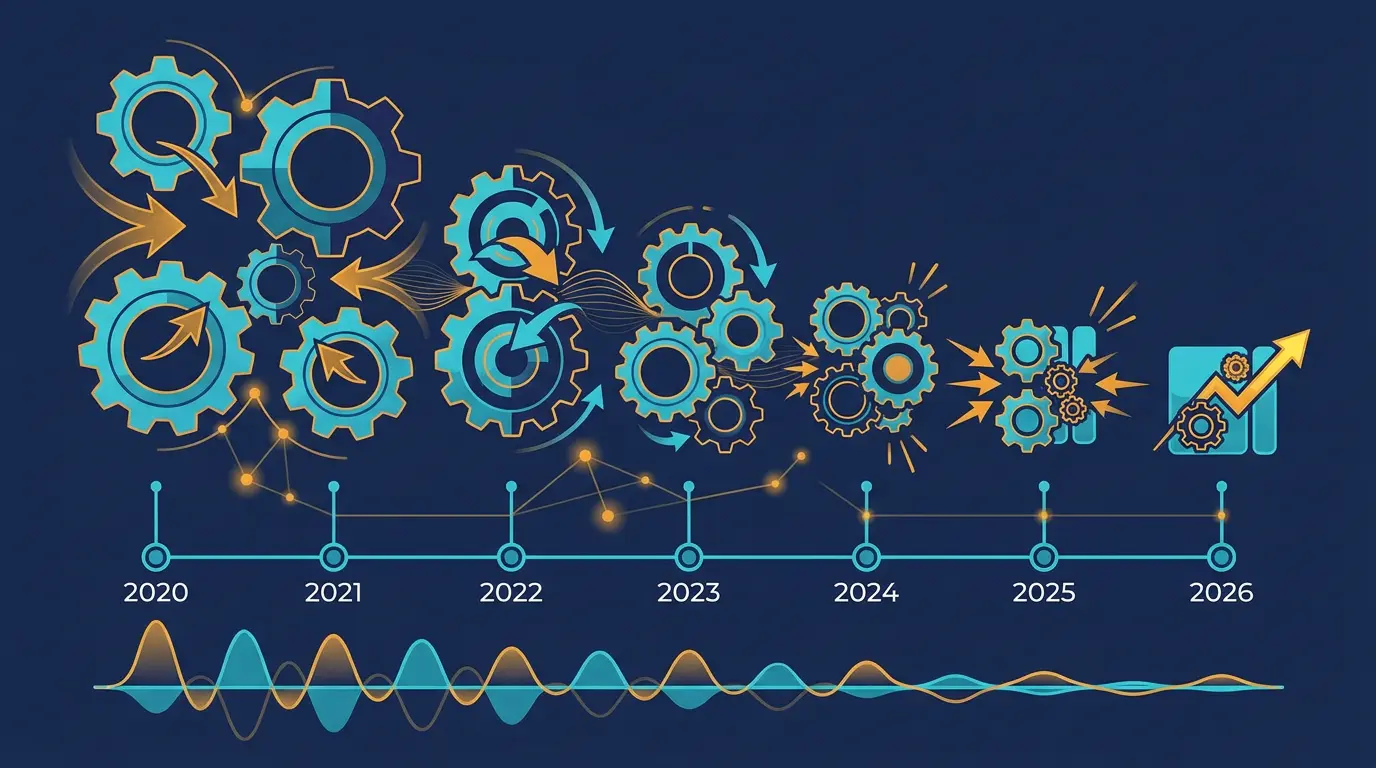
It is worth emphasising directly that the dating M&A landscape is a living, constantly-changing landscape, and an operator should hold that understanding.
The specific state of the landscape, which deals have happened recently, which companies are currently buying or selling, who currently owns which brand, is in constant motion. The dating industry's M&A activity does not pause; deals happen continually, and the map of who owns what is always being redrawn.
This is precisely why this guide has been an analysis of the landscape's dynamics rather than a snapshot of its current state. A snapshot of specific current deals would be out of date quickly. The dynamics, why dating sees so much M&A, the consolidation pattern, why companies buy and sell, what it means for operators, change far more slowly, and they are what genuinely equip an operator to understand whatever the current state happens to be.
The living nature of the landscape has a practical implication for an operator. It means an operator should not learn the landscape once and consider it known. The understanding of the dynamics, this guide's subject, is durable and worth learning once. But the current state, the live detail, is something an operator should expect to keep up with, through current sources, as an ongoing matter, particularly where it touches their own provider.
It also means an operator should hold the landscape with a degree of equanimity. A constantly-changing M&A landscape is the normal condition of the dating industry, not a sign of crisis. Deals happening, ownership changing, the map being redrawn, this is simply what a healthy, active, valuable industry looks like. An operator should follow the landscape, attend particularly to what touches them, and not be alarmed by the mere fact of constant change.
For an operator, the takeaway is that the dating M&A landscape is permanently in motion, that this guide's analysis of the durable dynamics is what equips an operator to understand it, that the current detail must be followed through current sources as an ongoing matter, and that constant change is the industry's normal condition rather than a cause for alarm.
Common misconceptions
A few common misconceptions about the dating M&A landscape are worth correcting.
The first misconception is that a dating business being sold is automatically a sign of failure. It is not; a sale could be a successful exit, a strategic sale, or a distressed sale, and these mean very different things.
The second misconception is that consolidation has closed the dating industry to new operators. It has not; the industry has consolidated at the top while remaining genuinely open to operators serving niches, particularly through the white label model.
The third misconception is that M&A is a remote corporate matter irrelevant to an ordinary operator. It is not; M&A shapes the operator's competitive environment, can change the ownership of platforms and providers they depend on, and is potentially part of the operator's own future.
The fourth misconception is that an operator can learn the M&A landscape once. The landscape is living and constantly changing; the durable dynamics can be learned once, but the current state must be followed as an ongoing matter.
The fifth misconception is that M&A in dating is mostly the confident buying and selling of thriving businesses. A real part of it is the difficult, distressed end, assets passing to new owners because a company failed, as the Venntro case study illustrates.
For an operator, seeing past these misconceptions means seeing the M&A landscape accurately: a constant, structural feature of the industry, ranging from successful exits to distressed sales, consolidated at the top but open to niche operators, genuinely relevant to an operator, and permanently in motion.
What to read next
For the consolidation exemplar, read Match Group: business model deep dive. For the distressed end of the landscape, see Venntro administration 2024: case study and dating industry failures. For the operator's own portfolio path, read dating multi-brand portfolio strategy. And to understand building a valuable dating business, DatingPartners.com can walk through the white label model.
Subscribe to DatingIndustryInsights for monthly M&A tracker emails.
Visit DatingPartners.com →