
Understanding where the dating industry came from helps an operator understand where it is and where it is going. This guide traces the history and draws out what endures.
Why the history matters
It might seem that the history of the dating industry is of academic interest only, something for the curious rather than something useful to a working operator. That is not so, and it is worth saying why the history genuinely matters.
The history matters because it reveals what changes and what endures. Across the dating industry's history, the technology has changed enormously, from print, to the early web, to websites, to mobile, to artificial intelligence. But beneath that changing technology, certain things have stayed remarkably constant. Seeing the history laid out is what lets an operator tell the two apart: what is a passing feature of one era's technology, and what is a durable fundamental of the industry itself. That distinction is genuinely useful, because an operator should build on the fundamentals and hold the technology more lightly.
The history matters because it gives perspective on change. An operator working today, in an era of rapid change, can find the pace of change unsettling. The history shows that the dating industry has always been an industry of change, era succeeding era, and that it has, through all of it, endured and remained a real, valuable industry. That perspective is steadying: change is the industry's normal condition, not a sign of crisis.
The history matters because it explains the present. The shape of the industry today, the dominance of large portfolio companies, the swipe-influenced products, the current dynamics, is the product of this history. Understanding how the industry got here helps an operator understand where it is.
And the history matters because it teaches durable lessons, which the lessons section draws together.
For an operator, the history is worth understanding not as trivia but as a source of genuine perspective and genuine lessons: it reveals what endures, it gives steadying perspective on change, and it explains the present.
The era of newspaper personals
The dating industry did not begin with the internet. Long before online dating, there was a real industry of helping people connect, and its most recognisable form was the newspaper personal advertisement.
For a long time, in the era before the internet, one of the established ways people sought romantic connection beyond their immediate social circle was the personal advertisement: a short notice, placed in a newspaper or magazine, in which a person described themselves and what they were looking for, and invited responses. Alongside personal ads sat other pre-internet forms of organised matchmaking and introduction.
It is worth pausing on what this era shows, because it is genuinely instructive. The personals era demonstrates that the fundamental need the dating industry serves, the need of people to find romantic connection beyond the people they happen to already know, is not a creation of the internet. It long predates online dating. There was a genuine industry serving that need before the web existed, because the need itself is old and genuine.
The personals era also shows, in embryo, several things that would carry through the whole history. A personal ad was, in effect, a profile: a self-description offered to potential matches. The act of placing and answering ads was a primitive form of the discovery and connection that online dating would later make instant. And even then there were questions of trust and honesty, of whether people were who they said they were.
The personals era was, of course, limited by its technology. Print was slow, reach was limited, and the process was cumbersome compared with what would come. But the era matters because it establishes the deepest point of this whole history: the dating industry exists to serve a genuine, enduring human need, and that need, and an industry serving it, existed before the internet and would survive every technological era that followed.
For an operator, the personals era is worth knowing because it is the proof that the foundation of the industry is a real, old, durable human need, not a passing product of any particular technology.
The arrival of online dating
The next era began with the arrival of the internet, and the dating industry was, in fact, one of the activities that moved online relatively early.
When the internet and the web arrived and began to spread, the activity of seeking romantic connection was a natural candidate to move into the new medium. The need was genuine and pre-existing, the personals era had shown there was an industry serving it, and the internet offered something the personals era could not: speed, reach, and a far richer way to present oneself and to search.
The early online dating of this arrival era was, by later standards, primitive, shaped by the early state of the web. But the essential move had been made: the genuine, old need for connection, previously served by print personals and matchmaking, now had a home on the internet, and the online dating industry had begun.
This arrival era is instructive for an operator in a particular way. It shows the pattern that would repeat through the whole subsequent history: a new technology arrives, and the dating industry moves onto it, because the underlying need is constant and seeks out whatever medium can best serve it. The need did not change when dating moved online; the medium changed, and the need followed the better medium. That same pattern, a constant need following improving technology, would recur with mobile and would recur again with AI.
The arrival era also began the long process by which online dating moved from being unusual to being mainstream. In the early days, meeting a partner online was, for many, novel or even faintly stigmatised. Over the eras that followed, that would change completely, until online dating became simply a normal, mainstream way that people meet, but the arrival era is where that long journey to the mainstream began.
For an operator, the arrival era marks the beginning of the industry as we know it, and it establishes the recurring pattern of the whole history: a constant human need moving onto, and following, improving technology.
The website era
As the internet matured, online dating settled into what can be called the website era, the era of the dating website built around detailed profiles, and this era lasted a long time and shaped the industry deeply.
In the website era, online dating largely meant a dating website that a person used, typically on a computer. The defining feature of the experience was the detailed profile. A member would create a rich, detailed profile, often answering many questions about themselves, their lives, their interests, and what they sought. They would then browse the detailed profiles of others, and search and filter through them, in a relatively considered, deliberate way. Connection followed from that considered browsing.
This was a substantial advance on the personals era. The profiles were far richer, the searching far more powerful, the reach far greater. The website era is when online dating became a genuine, substantial industry, when many of the long-established dating brands were built, and when, gradually, online dating moved further toward the mainstream.
The website era also established much of the underlying model that endures. The detailed profile, the searching and matching, the move toward subscription monetisation, the growing importance of trust and safety as the industry grew, much of the foundation that the rest of this guidance describes was laid in the website era.
It is worth noting the character of website-era dating, because the next era would define itself against it. Website-era dating was relatively considered, deliberate and slow: rich profiles, careful browsing, a computer-based, somewhat effortful activity. That character was a strength in some ways and a limitation in others, and it was precisely the limitation, the slowness and effort, that the mobile and swipe revolution would target.
For an operator, the website era matters because it is when online dating became a genuine, substantial, increasingly mainstream industry, and when much of the enduring underlying model was established. It is the era the industry's foundations were largely built in.
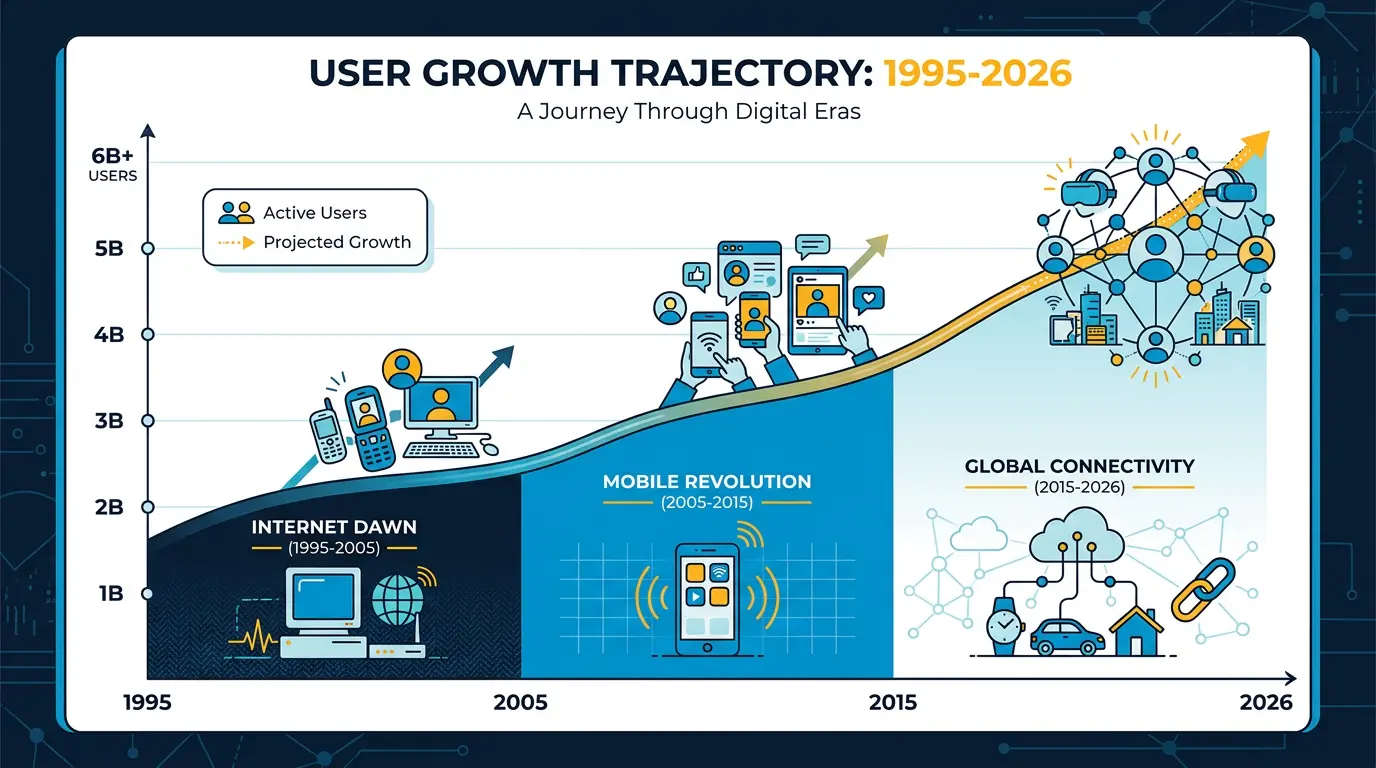
The mobile and swipe revolution
The next era is the one that most dramatically reshaped the industry: the mobile and swipe revolution, and the Tinder analysis describes its central product in detail.
This era was driven by two linked changes. The first was the rise of the smartphone: the move of people's digital lives from the computer to the phone, a device that was always present, always connected, personal, and built around a touchscreen. The second, enabled by the first, was the swipe: the fast, simple, mobile-native, mutual-interest matching mechanic that Tinder popularised, which the Tinder analysis examines.
Together, these changes transformed dating. Where website-era dating was considered, deliberate and computer-based, mobile-and-swipe dating was fast, easy, visual, game-like and on the phone, something done in spare moments anywhere. The whole tempo and character of the activity changed.
The effects, which the Tinder analysis details, were enormous. The pace of dating changed. Expectations changed, with the swipe experience becoming the benchmark. Online dating became more mainstream than ever, especially among younger people. The visual, photo-centric emphasis intensified. And much of the industry adopted swipe-influenced mechanics in response.
This era is the clearest single illustration of the recurring pattern this history keeps returning to: a new technology, the smartphone, arrived, and the dating industry moved onto it, with the swipe being the form the move took. The underlying need did not change; the medium changed, dramatically, and the industry followed it.
The mobile and swipe revolution is also the era that shaped the industry as it largely is today. The dominance of mobile, the swipe-influenced products, the fast and visual character of mainstream dating, the largest brands as we know them, much of the present-day industry is the legacy of this era.
For an operator, the mobile and swipe revolution matters because it is the era that produced the industry's current form, and because it is the most vivid example of the constant-need-following-changing-technology pattern, a pattern an operator should expect to see continue.
The consolidation era
Alongside and following the mobile revolution, the dating industry went through, and in many ways is still in, an era of consolidation, which the Match Group and acquisition-landscape analyses describe in depth.
As the industry matured, it consolidated: it came to be dominated, at the top, by a smaller number of large companies, built substantially through acquisition. Match Group is the defining example, becoming the dominant company in dating substantially by acquiring many brands into one large portfolio, as the Match Group analysis describes. Bumble emerged as the major challenger. The acquisition-landscape analysis describes the broader pattern of M&A and consolidation that characterises this era.
The consolidation era is, in a sense, the maturing of the industry. An industry in its early eras is typically fragmented, many small players, much experimentation. An industry that has matured tends to consolidate, larger players, dominant companies, the pattern the acquisition-landscape analysis explains. The dating industry's consolidation is the mark of an industry that has grown up into a large, established, mature industry.
This era also brought the dynamics the Match Group and Bumble analyses describe: the portfolio strategy, the challenge of growth at scale in a mature market, the competitive shape of an industry with giants in it.
But, as the consolidation section of the acquisition-landscape analysis stresses, the consolidation era did not close the industry. The industry consolidated at the top while remaining genuinely open, at the level of niches and brands, to operators, particularly through the model. The consolidation era is the era of the giants, but it is also the era in which the white label model lets independent operators run real dating businesses in the niches the giants do not perfectly serve.
For an operator, the consolidation era matters because it produced the industry's current competitive structure, the giants at the top, and because it is important to understand that this structure, while real, leaves genuine room for operators serving niches well.
The current era: AI and beyond
The dating industry is now in a further era, one shaped by artificial intelligence, and an operator should understand it, while this guide is measured about exactly where it is going.
Artificial intelligence has become a significant force across technology, and dating is among the activities it touches. AI is relevant to dating in a range of ways: in how matching can work, drawing on more signals more intelligently; in trust and safety, where AI assists the detection of fraud, fake profiles and harmful content the trust-and-safety guidance describes; in aspects of the member experience; and in the broader possibilities AI opens for how dating products might work.
It is worth being genuinely measured about the AI era, more so than about the settled history. The earlier eras, personals, the website era, the mobile revolution, can be described with confidence because they have happened and their shape is known. The AI era is unfolding now, and exactly how AI will reshape dating, which possibilities will prove genuinely valuable, how the industry and the experience will settle, is still being determined. A guide written at one moment cannot state with confidence how the AI era will turn out, and this one does not try to. An operator wanting the current state of AI in dating should follow current sources.
What can be said with confidence is the pattern. The AI era is, once again, the recurring pattern of this whole history: a powerful new technology has arrived, and the dating industry is moving onto it and adapting to it, because the underlying need is constant and follows improving technology. AI is, in that sense, the latest medium the constant need is flowing toward, just as the web, the website, and the smartphone were before it.
What can also be said is that, as the constants section argues next, the deepest fundamentals of the industry are unlikely to be changed by AI, even as AI changes a great deal of the technology and the experience. The need AI serves in dating is the same old need; the trust and safety AI assists with is the same old imperative; the value of a real member base is unchanged.
For an operator, the AI era matters as the current chapter of the industry's history, and the honest guidance is to engage with it, to follow how it genuinely develops through current sources, to expect it to change much of the technology and experience, and at the same time to hold to the durable fundamentals that, as the next section argues, endure through every era including this one.
The constants through every era
The most valuable thing this history offers an operator is the recognition of what has stayed constant through every era, because the constants are the genuine fundamentals an operator should build on.
Through the personals era, the arrival of online dating, the website era, the mobile revolution, the consolidation era and into the AI era, several things have not changed.
The genuine human need has not changed. Through every era, the industry has existed to serve the same fundamental need: people seeking romantic connection beyond the people they already know. The technology serving that need has changed completely; the need itself has not. It is the deepest constant of all.
The importance of a real member base has not changed. In every era, a dating service has been useless without other people on it. The personals page needed enough ads; the website needed members; the app needs a populated experience. The cold-start problem and the value of a real member base, which the fundamentals guidance describes, are not features of one era's technology; they are constants of the whole industry, which is precisely why the white label model's is so valuable.
The demands of trust and safety have not changed in their essence. Every era has had its versions of the questions of honesty, of whether people are who they say they are, of protecting members from harm. The technology of trust and safety has advanced enormously, but the underlying imperative, that a service connecting people for intimate relationships must keep them safe and be trustworthy, is a constant.
The fundamental model has, broadly, held. The industry has, across its eras, largely been a business of monetising members directly, the subscription and purchases model the monetisation guidance describes. The eras changed the product; the fundamental model endured.
And the industry's durability has been constant. Through every era, including eras of dramatic change and the failure of many individual companies, the industry itself has endured and remained a real, valuable industry, because the need it serves endures.
For an operator, the constants are the most important takeaway of the whole history: the genuine need, the importance of a real member base, the imperative of trust and safety, the fundamental model, and the industry's durability. These are the fundamentals, and they are what an operator should build on, holding the ever-changing technology more lightly.
What the history teaches operators
Pulling the history together, an operator can draw several genuine, durable lessons.
The first lesson is to build on the fundamentals and hold the technology lightly. The history shows clearly which is which: the fundamentals, the genuine need, the member base, trust and safety, the model, endure through every era; the technology changes completely. An operator should ground their business in the enduring fundamentals and treat the current technology as the current medium, not the permanent foundation.
The second lesson is that change is the industry's normal condition. The history is era succeeding era, constant change. An operator should expect change, not be unsettled by it, and should build a business and an attitude that can adapt as the technology continues to evolve, as the AI era and whatever follows it unfold.
The third lesson is the durability of the industry. The history shows an industry that has endured through every era and remained real and valuable, because the need it serves is real and enduring. An operator can take genuine reassurance from this: they are building in a durable industry, one that has survived every technological upheaval because the human need beneath it does not go away.
The fourth lesson is the recurring pattern: a constant need following improving technology. An operator who understands this pattern understands the shape of the industry's future as well as its past: new technology will keep arriving, the industry will keep moving onto it, and the underlying need will keep being served. The operator should expect, and be ready to ride, that pattern.
The fifth lesson is that there has always been room for those who serve the need well. Through every era, alongside the dominant players, there has been room for businesses that genuinely served people's need for connection well. The consolidation era did not end that, and the white label model, in the current eras, is precisely what lets an operator serve the enduring need well without needing the giants' scale.
For an operator, the history's lessons are durable and steadying: build on the fundamentals, expect change, trust the industry's durability, understand the recurring pattern, and know that serving the genuine need well has always had a place.
Common misconceptions
A few common misconceptions about the dating industry's history are worth correcting.
The first misconception is that the dating industry began with the internet. It did not; the genuine need it serves is old, and an industry serving it, through personals and matchmaking, existed before the web.
The second misconception is that each era's technology is the permanent shape of dating. It is not; the history shows that every era's technology was, in time, succeeded. The current technology, including AI, is the current medium, not the permanent foundation.
The third misconception is that the constant change means the industry is unstable or unreliable. The opposite is true: the industry has endured through every era of change precisely because the need beneath it is durable. Change is normal; the industry is durable.
The fourth misconception is that consolidation has been the end of the industry's story, leaving no room for operators. The history, and the consolidation era specifically, shows an industry that consolidated at the top while remaining open to those who serve niches well.
The fifth misconception is that the AI era can be confidently described in advance. It cannot; the AI era is unfolding now, its outcome is still being determined, and an operator should be measured about it and follow current sources, while trusting that the deep fundamentals will endure through it as through every prior era.
For an operator, seeing past these misconceptions means seeing the history accurately: an old need served before the internet, a succession of technological eras none of which was permanent, an industry made durable by the enduring need beneath it, still open to good operators, and now in an AI era best approached measuredly.
What to read next
For the era-defining product, read Tinder business model and algorithm history. For the consolidation era, see Match Group: business model deep dive and the dating acquisition landscape. For the enduring fundamentals, read the fundamentals pillar guides. And to serve the enduring need well today, DatingPartners.com can walk through the white label model.
The dating industry encyclopedia. DatingIndustryInsights.com.
Visit DatingPartners.com →