
Tinder reshaped online dating more than any other single product. This guide analyses its business model and the history of its matching algorithm, and draws out what an operator can learn.
What Tinder is
Tinder is a dating app, launched in the early 2010s, that became one of the most recognised and most used dating products in the world, and in doing so reshaped the entire online dating industry.
Tinder is the swipe-based app: the product that introduced, or at least popularised to a degree no one else had, the swipe mechanic for browsing potential matches. That mechanic, examined in the next section, is the heart of what Tinder is and the reason it matters.
Tinder is part of Match Group's portfolio, and, as the Match Group analysis describes, it has historically been the largest single brand in that portfolio, a brand whose scale made it central to the dominant company in dating.
But Tinder's significance is larger than its place in one company's portfolio. Tinder changed what online dating is. Before Tinder, online dating was, broadly, a different kind of experience, more like browsing detailed profiles on a website. Tinder made dating fast, mobile, visual and game-like, and in doing so it did not just create a successful product; it set a template that much of the industry followed.
This is why Tinder is worth studying in its own right, separately from the Match Group analysis. Match Group is a study in the portfolio strategy. Tinder is a study in something different and, in its way, even more striking: how a single, simple interaction design can reshape an entire industry.
For an operator, the starting point is to see Tinder for what it is: not just a successful dating app, but the product whose one founding innovation redefined modern online dating, and therefore a genuinely instructive case study in the power of interaction design.
The swipe: the founding mechanic
The heart of Tinder, the innovation everything else flows from, is the swipe, and an operator should understand exactly what it is and why it was so powerful.
The swipe mechanic works like this. The member is shown one potential match at a time, presented primarily as a photo and a small amount of profile information. The member makes a quick, simple, binary decision: interested, or not. The gesture, swiping the card one way or the other, is fast and physical. The member then sees the next person, and the next, in a quick, continuous flow. When two people have each indicated interest in the other, a match is created, and they can then message.
Several things made this mechanic genuinely powerful.
It was fast. A member could move through many potential matches very quickly, each decision taking a moment. This made browsing for matches feel quick and effortless rather than slow and effortful.
It was simple. The decision was binary and the gesture was intuitive. There was almost nothing to learn; anyone could use it immediately.
It was mobile-native. The swipe was designed for the phone, for the touchscreen, for quick use anywhere. It fitted the device people increasingly lived on.
It was built on mutual interest. Because a match required both people to have indicated interest, a member was only ever connected to people who had also chosen them. This changed the dynamic, particularly reducing the experience of unwanted contact from people one had not chosen.
And it was game-like. The quick loop of decisions, with the intermittent reward of a match, had a structure close to a simple game, which made the experience engaging in a way detailed-profile browsing was not. The dating-gamification guidance discusses both the appeal and the risks of this game-like quality.
For an operator, the swipe is the central lesson of Tinder: a single, simple, well-designed interaction, fast, intuitive, mobile-native, built on mutual interest, engaging, that was powerful enough to build one of the world's most-used products and reshape an industry.
How the swipe changed dating
The swipe did not just make Tinder successful; it changed online dating as a whole, and an operator should understand the scale of that change.
Before Tinder, online dating was, for most people, a relatively considered, website-based activity: creating a detailed profile, browsing detailed profiles of others, a slower and more deliberate experience. Tinder replaced that, for a huge part of the market, with something fast, visual, mobile and game-like.
This changed several things across the industry.
It changed the pace and feel of dating. Dating became something quick, done in spare moments on a phone, a stream of fast decisions rather than a considered browse. The whole tempo of the activity shifted.
It changed expectations. Once a large part of the market had experienced the speed and ease of the swipe, that became the expectation. Other dating products were, in effect, judged against the swipe experience, and much of the industry adopted swipe-style or swipe-influenced mechanics in response.
It changed who used online dating. The speed, ease, mobile-nativeness and game-like quality of the swipe helped make online dating more mainstream and more widely used, particularly among younger people, than the earlier website-based experience had.
It changed the visual emphasis. The swipe, presenting people primarily as a photo, intensified the visual, photo-centric nature of dating, with all the implications for profiles and imagery the rest of this guidance describes.
The scale of this change is the genuinely striking thing. One product, with one founding interaction design, did not just win market share; it reset the template for an entire industry. Much of what modern online dating is, fast, mobile, visual, swipe-influenced, traces to Tinder's one innovation.
For an operator, the lesson is the sheer leverage of interaction design. Tinder shows that the design of the core interaction, how members actually browse and connect, is not a detail; it can be the single most consequential thing about a dating product, powerful enough to reshape an industry. It is a reminder that the core experience matters profoundly.
How Tinder makes money
Tinder's business model, how it actually earns, is, like the rest of the major dating companies, the industry-standard model, applied at Tinder's scale.
Tinder makes its money from its users, through the now-familiar two forms the Match Group and Bumble analyses describe.
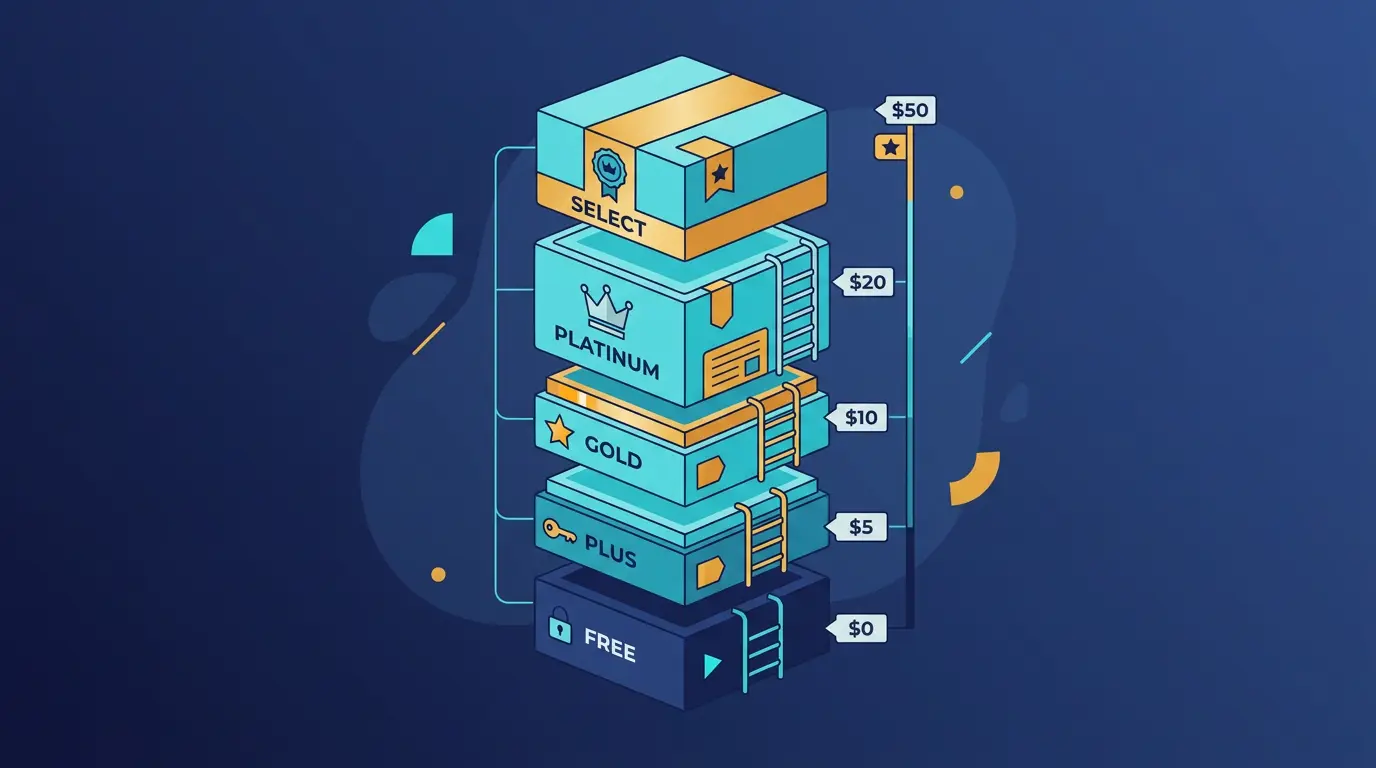
There are subscription tiers. Tinder offers premium subscription tiers, paid levels above the free experience that offer enhanced features, the premium-tier model the monetisation guidance describes. Over its history Tinder has offered a ladder of such tiers under various names, each offering more than the one below.
There are à la carte purchases. Tinder also monetises through one-off in-app purchases of specific features and boosts. Well-known examples include boosts, which enhance a member's visibility for a period, and super likes, a way of signalling stronger interest, the kind of visibility and feature purchases the premium-tier and gamification guidance describe.
Together, the subscription tiers and the à la carte purchases, paid by Tinder's very large user base, are how Tinder earns, and Tinder's scale on this model is what made it the largest contributor in Match Group's portfolio.
As with the other analyses, specific figures, Tinder's exact revenue, the precise performance in any period, change and should be checked against current sources. What is stable is the model: subscription tiers plus à la carte purchases, paid by members.
The notable point, again, is the consistency across the industry. Tinder, Bumble, Match Group: the major players all monetise the same fundamental way. Tinder's distinctiveness, like Bumble's, is not in how it makes money but in its product, the swipe. The monetisation is the industry-standard model; the innovation was the interaction design.
For an operator, the lesson echoes the Bumble analysis: the standard subscription-and-purchases model is, once again, validated at the top of the industry, and the way to build something distinctive is through the product and the experience, not through reinventing monetisation. Tinder reshaped dating with the swipe, and monetised it with the conventional model.
The matching algorithm and its history
Tinder's matching algorithm, the system that decides which people a member is shown, has a history worth understanding, both for what it shows and because it is widely misunderstood.
First, the basic point. Behind the swipe, Tinder has a system that decides the order in which potential matches are presented to a member. The member sees a flow of people, and something decides who appears, and in what order. That something is the matching algorithm, the matching-algorithms guidance in the software content describes the general idea.
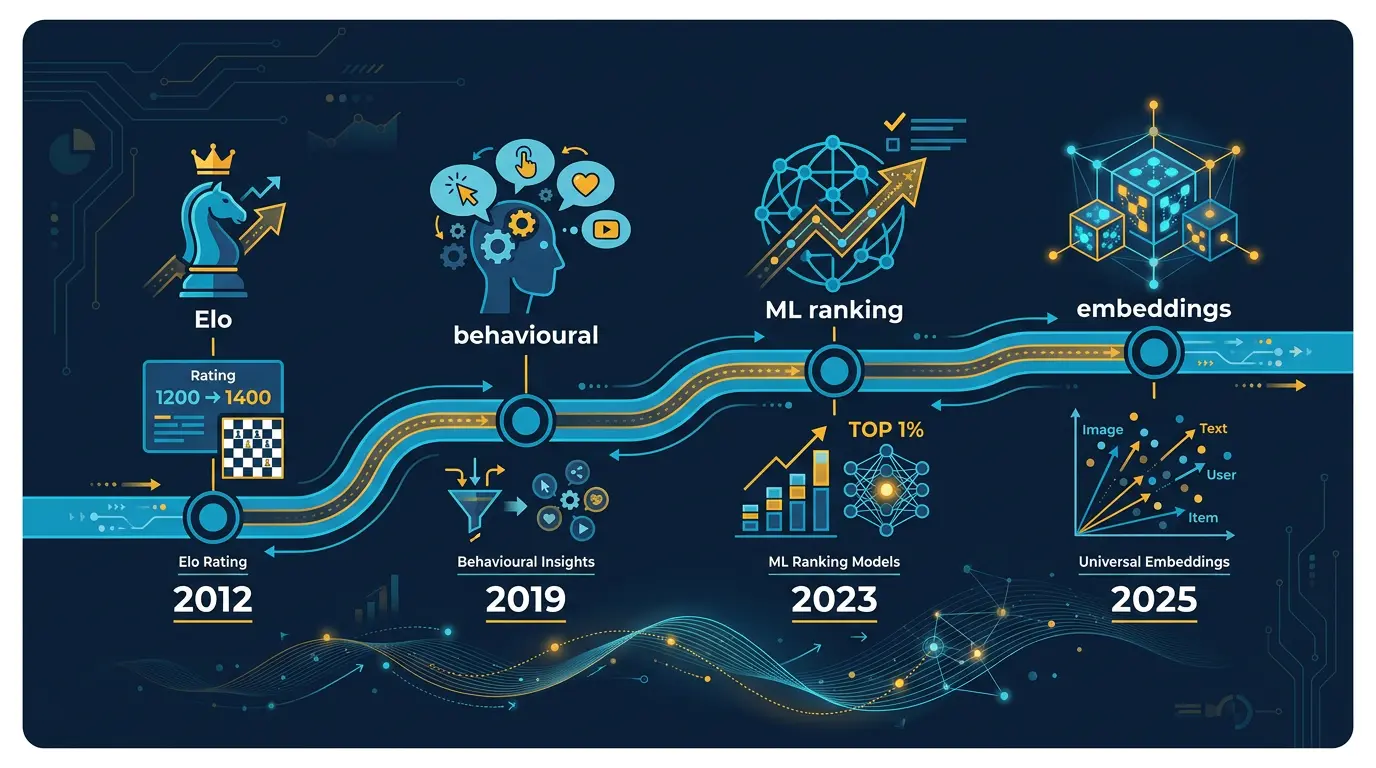
The history is where it gets interesting. In Tinder's earlier history, it was widely understood, and to a degree acknowledged, that Tinder used a ranking approach related to the idea of a desirability score: a system, sometimes described in terms borrowed from the Elo rating used in games and chess, that effectively scored members and influenced who was shown to whom partly on the basis of that ranking. The broad idea was that members of broadly similar ranking would tend to be shown to each other.
Over time, Tinder publicly indicated that it had moved away from that single desirability-score approach, describing its matching as having evolved to a different and more sophisticated basis. The general direction of matching across the industry, as the matching-algorithms guidance notes, has been toward systems that draw on many signals, members' attributes, preferences, and especially their actual behaviour and interactions, rather than a single score.
It is worth being measured here. The precise inner workings of Tinder's current matching algorithm are not fully public, dating companies generally do not disclose the exact mechanics of their algorithms, and an operator should treat any confident, detailed account of exactly how Tinder's algorithm works today with caution. What can be said with confidence is the shape of the history: an earlier approach associated with a desirability-style ranking, a publicly noted move away from that, and an evolution toward more sophisticated, multi-signal, behaviour-informed matching, in line with the industry direction.
For an operator, the algorithm history holds a couple of lessons. One is that matching algorithms evolve; they are not fixed, and a major product has reworked its matching over time. Another is caution about confident claims: much about dating algorithms is not public, and an operator should be sceptical of anyone claiming precise knowledge of how a big app's algorithm works. The honest position is to understand the general direction, not to believe a detailed secret formula.
Tinder within Match Group
Tinder's place within Match Group is worth understanding, and the Match Group analysis already sets out the essentials, which are worth drawing together here.
Tinder is part of Match Group's portfolio, and it has historically been the largest single brand in that portfolio, the brand whose scale made it the dominant contributor to the dominant company in dating.
This gives Tinder a dual significance. As a product, it is the swipe innovator that reshaped the industry. As an asset, it is the central pillar of Match Group's business.
It also means Tinder is involved in the dynamics the Match Group analysis describes. Tinder's central role created a concentration: Match Group's fortunes have been substantially tied to Tinder's, which is both a strength, given Tinder's scale, and a concentration risk. It is part of why the growth of other Match Group brands, Hinge in particular, matters to the company: a portfolio less dependent on one dominant brand is more balanced.
Tinder, as the dominant brand of the dominant company, also faces the industry's central challenge especially sharply: sustaining growth at scale in a mature market. A product as large and as established as Tinder, in a market that has matured, cannot grow simply by the category expanding, and finding further growth is a genuine, ongoing challenge.
For an operator, Tinder's place in Match Group reinforces lessons already drawn: the power, and the concentration risk, of a single dominant brand, and the reality that growth is hard even for the largest product in the industry. Tinder is, simultaneously, the great product innovation of modern dating and a study in the challenges of scale.
Strengths of the model
A fair analysis should set out Tinder's genuine strengths.
The first strength is the swipe itself: a genuinely brilliant, genuinely differentiating interaction design that reshaped an industry. A product founded on an innovation of that magnitude has a powerful core.
The second strength is scale and recognition. Tinder became one of the most recognised dating brands in the world and built a very large user base. That recognition and that scale are major assets.
The third strength is the engagement of the experience. The fast, game-like swipe is genuinely engaging, which supports the usage that the monetisation depends on, though, as the gamification guidance notes, the game-like quality has to be weighed against members' genuine success.
The fourth strength is the proven monetisation model: subscription tiers plus à la carte purchases, the industry-standard model, executed at Tinder's scale.
The fifth strength is its position within Match Group, with the resources, infrastructure and expertise of the dominant company behind it.
For an operator, Tinder's strengths are, above all, a lesson in the strength of the core product. Tinder's central strength is the swipe, the interaction design itself. It is a reminder that the core experience of a dating product is where genuine, durable strength is built.
Challenges and pressures
A fair analysis must equally set out Tinder's genuine challenges.
The central challenge is growth at scale in a mature market, faced especially sharply, as the within-Match-Group section noted, by the dominant product of the dominant company.
A second pressure is competition. Tinder reshaped the industry, but the industry then adapted: swipe-influenced mechanics spread widely, and Tinder competes against Bumble, against other Match Group brands, and against a continuing stream of newer products.
A third pressure, particular to a product so identified with one mechanic, is the long-term question of evolving beyond it. A product built so completely around the swipe faces the question of how it develops and sustains itself over the long term, how it keeps the experience fresh and genuinely valuable, while the swipe remains its identity. This echoes the question the Bumble analysis raised about a company built on one powerful idea.
A fourth pressure is the scrutiny around the swipe experience itself. The fast, game-like nature of swipe dating has drawn genuine discussion, around whether it serves members' genuine goals well, around the experience it produces, around the concerns the gamification guidance raises about engagement versus genuine success. A product so identified with the swipe is exposed to that scrutiny.
A fifth pressure is the industry-wide environment: safety scrutiny, the app store economics, the regulatory landscape.
As ever, how these pressures are playing out at any moment changes and should be checked against current sources. What is stable is that even the great product innovation of modern dating faces real, ongoing challenges.
For an operator, Tinder's challenges reinforce the recurring realism of these industry analyses: growth is hard, the environment is demanding, and a product built on one idea must still work to evolve and sustain itself. Even a brilliant founding innovation is a foundation, not a permanent guarantee.
What operators can learn
Pulling the analysis together, an operator studying Tinder can draw several genuine lessons.
The first lesson is the immense leverage of interaction design. Tinder shows that the design of the core interaction, how members actually browse and connect, can be the single most consequential thing about a dating product. An operator should treat the core experience as genuinely important, not a detail.
The second lesson is the power of simplicity. The swipe's strength was that it was simple, fast and intuitive. An operator should value simplicity and ease in the core experience, rather than assuming more features and more complexity are better.
The third lesson, echoing the Bumble analysis, is that distinctiveness comes from the product, not from reinventing monetisation. Tinder reshaped dating with the swipe and monetised it with the conventional model. An operator's path to a distinctive product is through the experience and the niche fit, on the proven monetisation model.
The fourth lesson is caution about algorithms. Tinder's algorithm history shows that matching evolves and that its exact workings are not public. An operator should be sceptical of confident claims about secret algorithm formulas and should focus on the general principles of good matching rather than chasing a supposed magic formula.
The fifth lesson is realism and proportion about scale. An operator cannot create the next Tinder, and chasing a swipe-killer mega-innovation is not a realistic strategy. The realistic, achievable path, as the niche and guidance describe, is a focused, genuinely good dating service for a particular audience. Tinder is instructive for its principles, the power of core experience, simplicity, product-led distinctiveness, not as a template to copy.
For an operator, the lessons from Tinder are genuine: the core interaction matters enormously, simplicity is powerful, distinctiveness comes from the product, algorithms should be understood in principle not chased as secret formulas, and the realistic path is a focused, good service rather than an attempt to be the next industry-reshaping giant.
Common misconceptions
A few common misconceptions about Tinder are worth correcting.
The first misconception is that Tinder succeeded through a clever monetisation model. It did not; Tinder uses the industry-standard subscription-and-purchases model. Its innovation was the swipe, an interaction design, not a way of making money.
The second misconception is that Tinder's algorithm is a known, precise formula an operator could copy or game. It is not; the exact workings of Tinder's matching are not public, the algorithm has evolved over time, and confident detailed claims about it should be treated with caution.
The third misconception is that an operator should aim to build the next Tinder. Reshaping the industry with a mega-innovation is not a realistic strategy; the realistic path is a focused, good service for a particular niche.
The fourth misconception is that the swipe was successful because it was a gimmick. It was not a gimmick; it was a genuinely excellent interaction design, fast, simple, intuitive, mobile-native, built on mutual interest, which is precisely why it worked.
The fifth misconception is that, because Tinder is a giant, it faces no real challenges. It does: growth at scale, competition, the question of evolving beyond the swipe, scrutiny of the swipe experience, and the industry environment all press on it.
For an operator, seeing past these misconceptions means seeing Tinder accurately: an industry-reshaping product whose innovation was interaction design, monetised conventionally, with an evolved and non-public algorithm, instructive for its principles rather than as a template, and facing real challenges like any major product.
What to read next
For the parent company, read Match Group: business model deep dive. For the main competitor, see Bumble business model and strategic review. For the matching principles behind the swipe, read the matching-algorithms guidance in the software content. And to build a focused dating product of your own, DatingPartners.com can walk through the white label model.
Dating app product history, all in one hub. DatingIndustryInsights.com.
Visit DatingPartners.com →