
Bumble is the clearest example in dating of a major company built on a single distinctive idea. This guide reviews its business model and strategy, and draws out what an operator can learn.
What Bumble is
Bumble is one of the largest companies in online dating, and it occupies a particular place in the industry: it is the most prominent challenger to Match Group's dominance.
Like Match Group, Bumble is a public company, which means its structure, strategy and broad financial shape are disclosed and can be studied. And like Match Group, it is more than a single app: Bumble the company operates the Bumble dating app and also Badoo, a long-established dating app with a large international presence.
But Bumble's place in the industry is different from Match Group's. Where Match Group is the dominant, sprawling portfolio giant, Bumble is the major challenger, smaller than Match Group but large in absolute terms, and built far more around a single, distinctive flagship brand and a single, distinctive idea.
That idea, examined in the next section, is what makes Bumble genuinely interesting to study. Match Group is a study in the portfolio strategy and scale. Bumble is a study in something different: how a major dating company can be built on one clear, differentiating idea and a positioning that flows from it.
Bumble is also notable as a dating company that was founded and led with a distinctive vision, associated with its founder Whitney Wolfe Herd, and built around a purpose, not just a product, in a way that shaped the brand strongly.
For an operator, the starting point is to see Bumble for what it is: one of the largest dating companies, the prime challenger to Match Group, built around a distinctive flagship idea, and therefore a genuinely useful case study in differentiation, the topic the next section turns to.
The founding idea: women make the first move
Bumble's defining feature, the idea at the heart of the company, is simple to state: in opposite-sex matches, women make the first move.
On a conventional dating app, once two people match, either of them can message first. Bumble's distinctive design changed that for opposite-sex matches: after a match, the woman has to send the first message, within a time limit, or the match expires. The man cannot open the conversation; the woman does.
This single design choice is the foundation of the whole company, and it is worth understanding why it was such a powerful idea.
It addressed a real problem. On many dating apps, a common complaint, particularly from women, was the experience after matching: unwanted messages, an overwhelming or unpleasant flow of contact, a dynamic that did not feel good or safe. Bumble's women-first design directly changed that dynamic: the woman controls whether and when a conversation begins, which gives her more control over her own experience.
It created genuine differentiation. In a crowded market of dating apps that were, in their core mechanics, quite similar, Bumble had one clear, easily-explained, genuinely different feature. Anyone could understand, in a sentence, what made Bumble different.
And it became a positioning, not just a feature. The women-first idea was not a small mechanic; it became the basis of Bumble's whole brand identity, an app positioned around women's experience, women's control, and a better, safer dynamic, the topic the positioning section develops.
For an operator, the founding idea of Bumble is the most instructive thing about the company. It shows the power of a single, clear, genuinely differentiating idea that addresses a real problem. Bumble did not out-build the competition with more features; it found one distinctive idea and built a major company on it.
The brands: Bumble and Badoo
Although Bumble is built around its flagship idea, the company operates more than one brand, and an operator should understand the brand picture.
The flagship is the Bumble app itself, the brand built around the women-first idea and the positioning that flows from it. This is the brand most people mean when they say Bumble, and it is the heart of the company.
The company also operates Badoo. Badoo is a long-established dating app with a particularly large presence in international markets, and it predates Bumble; the two became part of the same company through the way the business was built. Badoo is a different brand from Bumble, with its own character and its own audiences, particularly strong in regions where it built up a large user base over a long history.
So Bumble the company is, in a modest way, a multi-brand company: it has the flagship Bumble brand and the substantial Badoo brand, serving somewhat different audiences and markets. This is far from the sprawling portfolio of Match Group, but it is a portfolio of a sort, and it shows the same underlying logic the portfolio guidance describes: different brands reaching different audiences.
The contrast with Match Group is instructive. Match Group is a study in the broad portfolio strategy, many brands across the breadth of the market. Bumble is a study in the focused-flagship strategy, one distinctive flagship brand, with a second substantial brand alongside it. They are two different shapes a major dating company can take.
For an operator, the brand picture of Bumble is worth understanding for that contrast: Bumble shows that a major dating company can be built primarily around one distinctive flagship brand, with a portfolio that is real but far narrower than Match Group's. There is more than one successful shape for a dating company.
How Bumble makes money
Bumble's business model, in terms of how it actually earns, is, like Match Group's, well understood and, in its essentials, the same model this guidance describes throughout.
Bumble makes its money from its users, not from advertising. As with Match Group, the major dating challenger is fundamentally a subscription-and-purchases business, monetising its members directly.
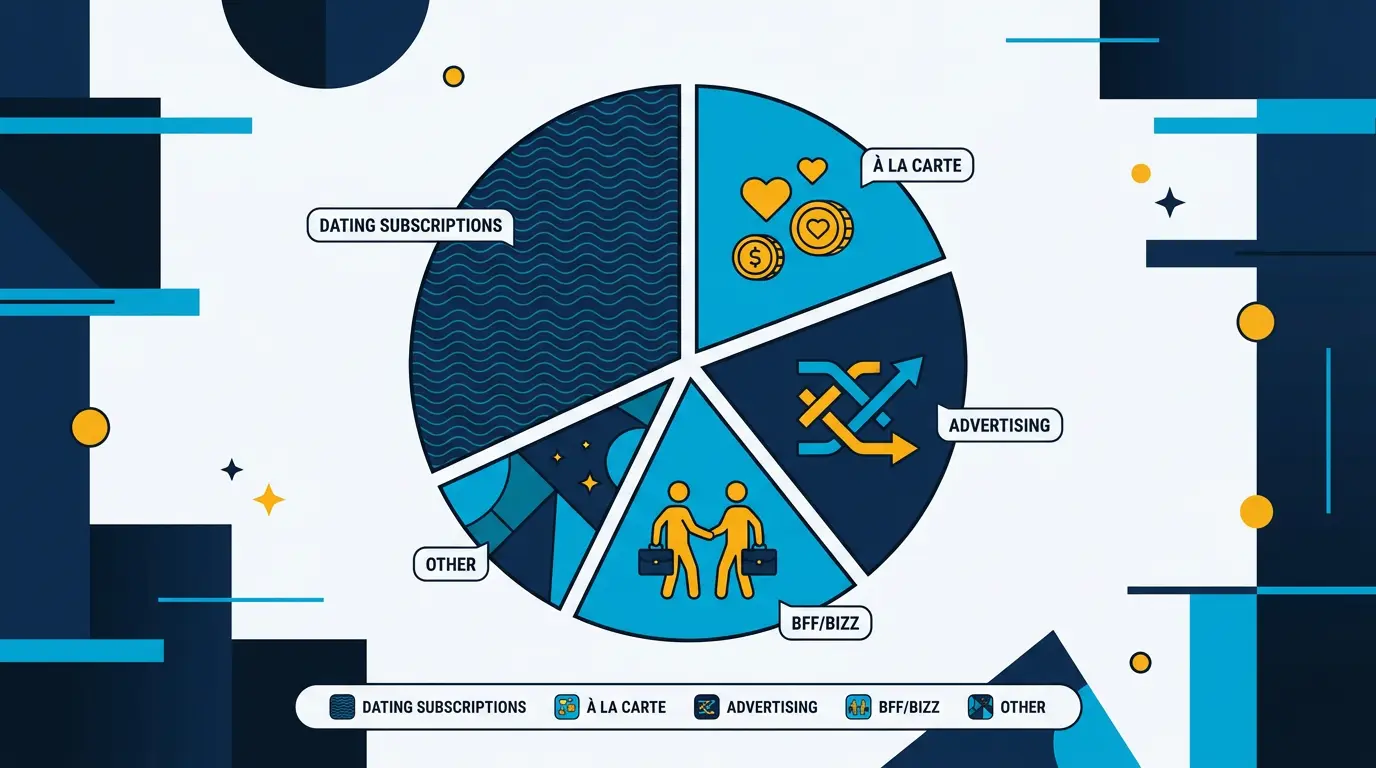
The revenue comes in the familiar two forms. There are subscriptions: members paying recurring subscriptions for premium tiers and premium access, the subscription model the pricing and premium-tier guidance describe. And there are à la carte purchases: one-off in-app purchases of specific features and boosts, the kind of feature purchases the monetisation guidance describes.
Across its brands, the Bumble app and Badoo, this mix of recurring subscriptions and one-off purchases, paid by members, is how the company earns.
As with the Match Group analysis, it is worth being measured about specific figures. Bumble's exact revenue, its split between subscriptions and purchases, its performance in any given period, are things that change and should be checked against current sources rather than a guide. What is stable, and what matters, is the shape: a member-monetised, subscription-and-purchases business.
The notable point here is the similarity. Bumble and Match Group are the two largest companies in dating, they are competitors with very different brands and positioning, and yet they make their money in fundamentally the same way: subscriptions and à la carte purchases paid by members. The distinctive thing about Bumble is not its monetisation model, which is the industry-standard model; it is its product idea and positioning. The monetisation is conventional; the differentiation is in the experience and the brand.
For an operator, the lesson is twofold. First, again, the standard subscription-and-purchases model is validated, used by both giants of the industry. Second, and importantly, Bumble shows that a company can compete and differentiate powerfully without a different monetisation model, by differentiating the product and the positioning instead. Differentiation does not have to mean a novel way of making money.
The strategic positioning
Bumble's strategic positioning is where the founding idea becomes a whole strategy, and it is the most instructive part of the company for an operator to study.
Bumble took the women-first feature and built from it a complete positioning: an app positioned around women's experience, women's control, safety, and a better, more respectful dynamic in dating. The feature was the seed; the positioning is the tree that grew from it.
This positioning did several strategically powerful things. It gave Bumble a clear identity in a crowded market. Where many dating apps struggled to explain how they were different, Bumble had an identity anyone could grasp: the dating app built around women's experience and the women-first idea.
It connected the brand to a purpose. Bumble positioned itself not just as a product but as standing for something, a better, safer, more respectful approach to dating, particularly for women. A brand connected to a genuine purpose can build a stronger, more loyal connection with its audience than a brand that is just a product.
It addressed a genuine audience need. The positioning worked because it spoke to something real: a genuine desire, particularly among many women, for a dating experience with more control and a better dynamic. The positioning was not arbitrary marketing; it answered a real need, which is why it resonated.
And it created a defensible difference. Match Group's scale and portfolio are hard to compete with head-on. Bumble did not try; it competed on a different axis, a distinctive positioning that its scale-based competitor could not simply copy without undermining its own brands.
For an operator, Bumble's positioning is a genuine lesson in strategy. It shows the power of taking a real audience need, answering it with a distinctive idea, and building a whole clear positioning and brand purpose from it. That is, in essence, the niche-and-positioning thinking this guidance recommends, demonstrated at the scale of a major company.
Strengths of the model
A fair review should set out Bumble's genuine strengths, and there are several an operator can learn from.
The first strength is the differentiated positioning itself. In an industry where differentiation is hard, Bumble has a clear, genuine, well-understood difference, and that is a real and valuable asset.
The second strength is brand identity and purpose. Bumble's brand is strong, recognised, and connected to a purpose, which gives it a deeper connection with its audience than a purely functional brand would have.
The third strength is that it answers a real need. The positioning works because it speaks to something genuine in the audience, and a strategy built on a real need is more durable than one built on a gimmick.
The fourth strength is the focused-flagship model. Building primarily around one strong flagship brand, with a substantial second brand alongside, has given Bumble a clear, coherent identity, in contrast to a sprawling portfolio.
The fifth strength is its position as the clear challenger. Being the most prominent alternative to the dominant company is itself a strong position: Bumble is the obvious choice for users and attention seeking something other than the Match Group brands.
For an operator, Bumble's strengths are instructive because they are strengths of strategy and positioning rather than of scale. An operator cannot match Bumble's size, but an operator can absolutely learn from the strategic moves, find a real need, answer it distinctively, build a clear positioning and purpose, that produced those strengths.
Challenges and pressures
A fair review must equally set out Bumble's genuine challenges, which are real and also instructive.
The central challenge is competing and growing at scale in a mature market. Bumble faces the same fundamental industry situation as Match Group, the growth-challenge section of the Match Group analysis describes it: the core market is mature, growth is genuinely hard, and Bumble must work hard to grow its brands and its monetisation in that environment.
A second pressure is competing against Match Group's scale. Bumble is the major challenger, but it is the smaller of the two giants, and competing against a larger, portfolio-based competitor with greater resources is genuinely difficult.
A third pressure, particular to Bumble, is the question of growth beyond the founding idea. A company built so strongly around one distinctive idea faces the question of how it grows and evolves beyond that idea, how it broadens, develops and sustains itself over the long term while keeping the distinctive identity that is its strength. This is a real strategic question for any company built on a single powerful idea.
A fourth pressure is the perennial dating-market dynamics the Match Group analysis describes: fickle attention, the restless nature of a category built on apps people use intensely, and the dating-specific reality that success means members leaving.
A fifth pressure is the industry-wide environment: the scrutiny around safety and experience, the app store economics, and the regulatory landscape, all of which press on Bumble as on any large dating company.
As ever, it is worth being measured about how these pressures are playing out at any given moment, which changes and should be checked against current sources. What is stable is that the major challenger, like the dominant company, faces real, ongoing challenges.
For an operator, Bumble's challenges reinforce the realism the Match Group analysis drew out: growth is hard, the industry environment is demanding, and these difficulties press on the giants, not just on small operators. And Bumble's particular challenge, growing beyond a founding idea, is a useful reminder that even a brilliant distinctive idea is a foundation to build on, not a permanent guarantee.
Bumble compared with Match Group
Setting Bumble and Match Group side by side is genuinely illuminating, because the two largest companies in dating represent two different strategic shapes.
Match Group is the broad-portfolio giant. Its strategy is to cover the breadth of the dating market with a large portfolio of focused brands, grown and acquired, and to win through that breadth, that scale, and the sharing of capability across many brands. Match Group is a study in the portfolio strategy and scale.
Bumble is the focused-flagship challenger. Its strategy is to build primarily around one distinctive flagship brand, with a powerful differentiating idea and a clear positioning, plus a substantial second brand. Bumble is a study in differentiation and positioning.
Yet, revealingly, the two make their money in exactly the same way: subscriptions and à la carte purchases paid by members. The two largest companies in dating, with very different strategic shapes, share the industry-standard monetisation model. The difference between them is not how they monetise but how they compete: Match Group through portfolio breadth and scale, Bumble through distinctive positioning.
Both also face the same fundamental industry challenge: growth at scale in a mature market.
This comparison is instructive because it shows that there is more than one viable strategic shape for a major dating company. An operator might assume that succeeding in dating means becoming Match Group, a broad portfolio at scale. Bumble shows another path: a focused, distinctive, well-positioned flagship. Neither shape is the only way; both are viable, and both rest on the same underlying member-monetised model.
For an operator, the Bumble-versus-Match Group comparison offers a genuine strategic insight: success in dating can take more than one shape, the portfolio-and-scale shape and the distinctive-positioning shape, and an operator thinking about their own strategy can learn from both.
What operators can learn
Pulling the review together, an operator studying Bumble can draw several genuine lessons.
The first lesson is the power of a distinctive idea. Bumble was built on one clear, genuinely differentiating idea that addressed a real need. An operator should take from this the value of finding a genuine point of difference, a real reason their dating service is distinct, rather than launching an undifferentiated product. This connects directly to the niche guidance: a focused, distinctive proposition beats a generic one.
The second lesson is the power of positioning and purpose. Bumble turned a feature into a whole positioning and a brand purpose. An operator should think not just about features but about what their dating brand stands for and is positioned around, because a clear positioning and a genuine purpose build a stronger connection with an audience.
The third lesson is to answer a real need. Bumble's idea worked because it addressed something genuine in the audience. An operator's distinctive idea, and their whole niche choice, should equally answer a real need, not be arbitrary.
The fourth lesson is that differentiation need not mean a different monetisation model. Bumble competes powerfully using the standard subscription-and-purchases model; its difference is in the product and positioning. An operator does not need a novel way of making money; they need a distinctive, well-positioned product on the proven model.
The fifth lesson is that there is more than one shape of success. An operator does not have to aim to become a sprawling portfolio giant. A focused, distinctive, well-positioned brand is a genuine path, and it is one far more achievable at an operator's scale, especially on the model.
For an operator, the lessons from Bumble are genuinely valuable and genuinely applicable: find a distinctive idea that answers a real need, build a clear positioning and purpose from it, and recognise that a focused, well-differentiated brand on the standard model is a real path to success.
Common misconceptions
A few common misconceptions about Bumble are worth correcting.
The first misconception is that Bumble is only the Bumble app. The company also operates Badoo, a substantial, long-established, internationally strong brand, so Bumble the company is, modestly, a multi-brand company.
The second misconception is that Bumble's success comes from a different monetisation model. It does not; Bumble uses the same subscription-and-purchases model as the rest of the industry. Its difference is in product and positioning, not in how it earns.
The third misconception is that the women-first feature was just a gimmick. It was not; it addressed a genuine audience need and became the foundation of a whole strategic positioning and brand purpose. Its power was that it was real.
The fourth misconception is that, because Bumble built on one idea, an operator just needs a gimmick. The lesson is the opposite: Bumble's idea worked because it answered a real need and was built into a genuine positioning. A shallow gimmick that answers no real need does not build a company.
The fifth misconception is that Bumble, as a giant, has nothing to teach a small operator. On the contrary: Bumble's lessons, distinctiveness, positioning, answering a real need, are lessons of strategy, not scale, and they are directly applicable at an operator's level.
For an operator, seeing past these misconceptions means seeing Bumble accurately: a multi-brand company on the standard monetisation model, differentiated by a genuine product idea and positioning that answered a real need, and instructive for its strategy at any scale.
What to read next
For the dominant competitor, read Match Group: business model deep dive. For a brand within Match Group's portfolio, see Hinge growth story and strategy. For applying distinctiveness at operator scale, read how to choose a dating niche. And to build a distinctive, well-positioned dating brand of your own, DatingPartners.com can walk through the white label model.
Dig deeper into dating equities on DatingIndustryInsights.com. Weekly analysis.
Visit DatingPartners.com →