
Match Group is the company that, more than any other, shaped modern online dating. Understanding its business model is genuinely useful for anyone in the industry. This guide analyses it, and draws out what an operator can learn.
What Match Group is
Match Group is the largest company in the online dating industry, and to understand modern dating it helps to understand what Match Group actually is.
Match Group is not a single dating app; it is a company that owns and operates a portfolio of many dating brands. When most people think of online dating, they think of individual apps. Match Group sits behind a large number of those apps, owning them as a parent company. It is, in effect, the dominant corporate force in the industry.
Match Group is a public company, which means a great deal of information about it is disclosed, its structure, its strategy, its broad financial shape, and that disclosure is part of why it is worth studying: it is one of the few parts of the dating industry whose business model can be examined in real detail.
The company's roots run deep into the history of online dating. It grew, over decades, from the early days of the industry into the consolidated giant it is today, partly by building brands and partly by acquiring them, a history the portfolio and the dating-industry-history guidance both touch on.
For anyone in the dating industry, an operator, an affiliate, anyone trying to understand the field, Match Group is worth understanding for a simple reason: it is the company whose strategy and success have most shaped what modern dating is, how it is monetised, and what the competitive landscape looks like. Studying Match Group is, in large part, studying the modern dating industry itself.
For an operator, the starting point is to see Match Group clearly: not as one app but as the dominant company in dating, operating a portfolio of brands, and worth studying because its model and strategy define so much of the industry an operator works within.
The portfolio of brands
The defining feature of Match Group is its portfolio: it operates not one dating brand but many, and an operator should understand the shape and logic of that portfolio.
Match Group's portfolio spans a range of well-known dating brands. It includes Tinder, the swipe-based app that became one of the most recognised dating products in the world. It includes Hinge, a relationship-oriented app that has grown strongly. It includes Match, one of the long-established names in online dating. It includes OkCupid, Plenty of Fish, and a number of other brands, some serving particular audiences, regions or styles of dating.
The crucial point about this portfolio is that the brands are not all the same product. They serve different audiences, occupy different positions, and offer different styles of dating. One brand may be oriented toward casual, fast-paced dating; another toward serious relationships; another toward a particular demographic or approach. The portfolio is, in effect, a set of brands each aimed at a different slice of the overall dating market.
This is the same logic the multi-brand and niche guidance describe, applied at the scale of the largest company in the industry. A single dating brand can only serve one audience well. By operating many brands, Match Group can serve many different dating audiences, each with a product positioned for it, rather than trying to serve everyone with one product.
The portfolio also has a history of being built both ways: some brands grown within the company, some acquired, with Match Group, over its history, having brought a number of dating brands under its ownership.
For an operator, the portfolio is the first thing to understand about Match Group, and it is genuinely instructive: it is the multi-brand strategy, serving many audiences with many brands, executed at the largest scale in the industry, and it is a major part of why Match Group has been so successful.
How Match Group makes money
The core of any business-model analysis is how the company makes money, and Match Group's model is, in its essentials, well understood and worth an operator studying.
Match Group's revenue comes overwhelmingly from its users, the members of its dating apps, rather than from advertising. This is an important point in itself: the dominant company in dating is, fundamentally, a subscription-and-purchases business, not an advertising business. Its members paying for the service is the engine.
The money comes in two main forms. The first is subscriptions: members paying recurring subscriptions for premium access or premium tiers on the apps, the subscription model the pricing and monetisation guidance describe. The second is à la carte purchases: one-off in-app purchases of specific features or boosts, the kind of feature purchases the premium-tier and gamification guidance describe, often things that enhance a member's visibility or give them more of some action.
Together, these recurring subscriptions and one-off purchases, across the whole portfolio of brands, are how Match Group earns. Each brand in the portfolio monetises its own audience through some mix of these, and the company's total revenue is the sum across the portfolio.
It is worth being measured about specific figures. Match Group's exact revenue, its precise split between subscriptions and purchases, its performance in any given period, are things that change and that an operator should check against current sources rather than a guide. What is stable, and what is worth understanding, is the shape of the model: a portfolio of dating brands, monetised through subscriptions and à la carte purchases paid by members.
This model is, in essence, the same model this body of guidance describes for any operator: a dating service monetised through what members pay. Match Group is that model, executed across a large portfolio, at the largest scale in the industry.
For an operator, the lesson is that the dominant company in dating makes its money the same fundamental way an operator's own dating business does, through members paying subscriptions and making purchases, which is a quiet validation of the model the operator is building on.
The portfolio strategy
Beyond the simple fact of the portfolio, there is a strategy behind it, and understanding that strategy is where Match Group becomes genuinely instructive for an operator.
The portfolio strategy is, at its core, the recognition that the dating market is not one market but many. Different people want different things from dating: different intents, from casual to serious; different audiences, by age, by community, by approach. A single dating product cannot serve all of them well, because, as the niche guidance argues, a product focused on one audience serves it better than a generic product serves everyone.
Match Group's strategy responds to this by covering the market with a portfolio rather than a single product. Each brand can be focused, positioned for its particular audience, while the company as a whole reaches across the breadth of the market. The company is not betting everything on one product or one slice of the market; it is present across many slices.
The strategy also lets Match Group share things across the portfolio. The company can apply expertise, capability, infrastructure and learning across its brands, so that running many brands is more efficient than running many entirely separate companies would be. This is the same logic the multi-brand guidance describes for an operator's portfolio, again at the largest scale.
The strategy has a defensive dimension too. A portfolio spreads the company's position across the market, so the company is not wholly dependent on the fortunes of any single brand or any single segment, the risk-spreading the multi-brand guidance describes.
It also has a growth dimension: a portfolio gives the company many brands to grow, many audiences to reach, and the option to add brands, by building or acquiring, to enter new segments.
For an operator, the portfolio strategy is the most instructive thing about Match Group, because it is, in essence, the same multi-brand and niche thinking this guidance recommends, validated at the scale of the industry's dominant company. The largest company in dating succeeds substantially through a portfolio-of-niches strategy.
Tinder's role in the group
Within the portfolio, one brand has historically had an outsized role, and an operator analysing Match Group should understand the position of Tinder.
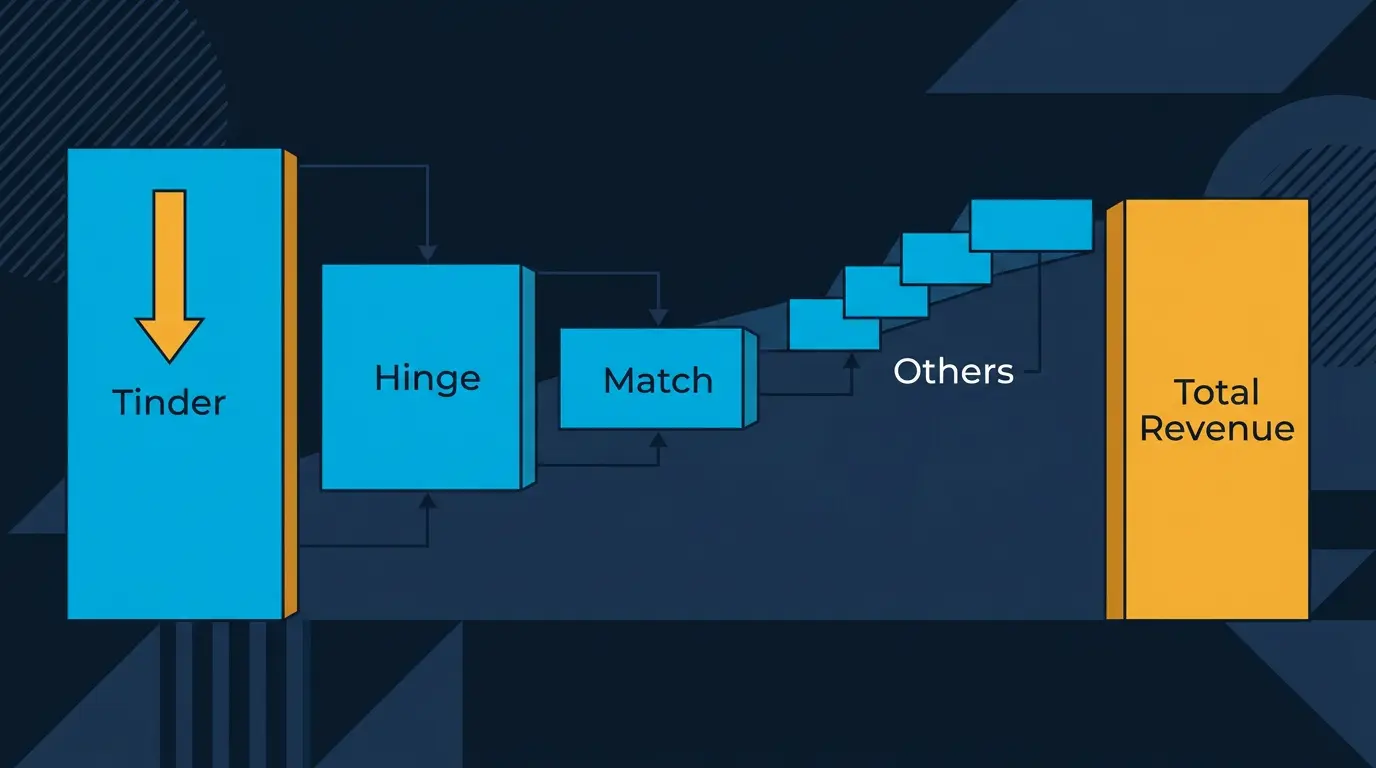
Tinder, the swipe-based dating app, became, after its rise, one of the most recognised and most used dating products in the world. Within Match Group's portfolio, Tinder has historically been the largest single contributor, a brand whose scale and revenue have made it central to the company's overall performance. The tinder-business-model guidance examines Tinder itself in detail.
This central role of one brand is worth understanding for what it shows about portfolio companies. A portfolio spreads a company across many brands, but that does not mean every brand contributes equally. A portfolio can still have a dominant brand, one that is much larger than the others and on which the company's fortunes substantially depend. For much of Match Group's recent history, Tinder has been that brand.
This creates both strength and concentration. The strength is obvious: a brand at Tinder's scale is an enormous asset. The concentration is the other side: when one brand contributes so much, the company's performance is significantly tied to that brand's performance, and any difficulty at the dominant brand matters disproportionately to the whole company. This is a version, at corporate scale, of the over-concentration risk the multi-brand and scaling guidance describe.
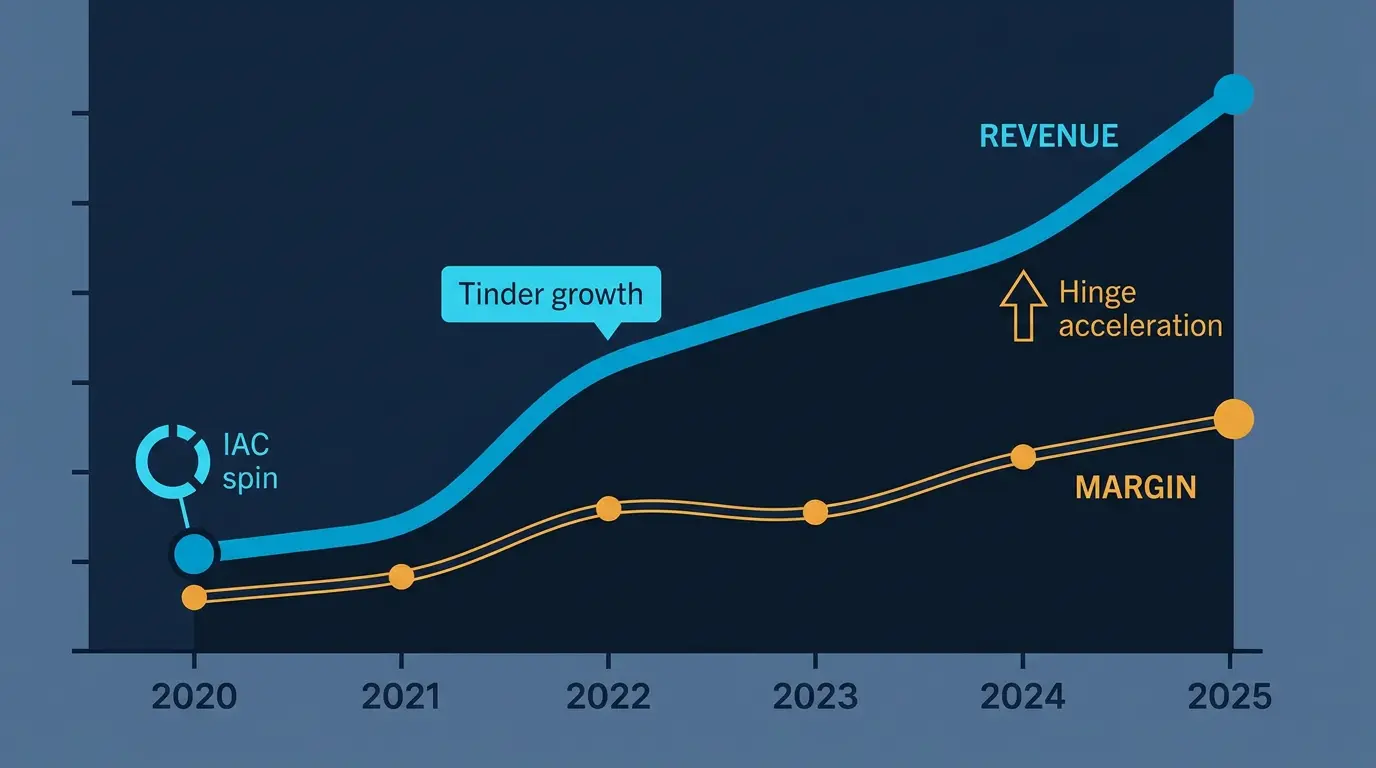
This is part of why the growth of other brands in the portfolio, Hinge in particular having grown strongly, matters to Match Group: a portfolio that is less dependent on a single dominant brand is a more balanced and more resilient portfolio.
For an operator, Tinder's role in Match Group is instructive in a specific way: it shows that even a portfolio strategy can develop a concentration in one dominant brand, and that a healthy portfolio company has reason to want its other brands to grow so the whole is not too dependent on one. The portfolio idea and the balance within the portfolio are both worth attention.
The growth challenge
Every analysis of Match Group eventually arrives at the same central question, and an operator should understand it: the challenge of sustaining growth.
Match Group is the dominant company in a large, established industry. It has, over its history, grown enormously. But a company at that scale, in a market that has matured, faces a genuine and well-recognised challenge: where does further growth come from.
The challenge has a few dimensions. The core online dating market in the most developed regions is mature: a large share of the people who are going to use online dating already do, which means growth can no longer come simply from the category being new and expanding rapidly. Match Group is also already so large and so present across the market that there is less room to grow simply by taking obvious unserved territory. And the company faces the dating-specific dynamic the analytics and monetisation guidance describe, that dating, done well, helps members succeed and leave, so the company is always, in part, losing the members it succeeds for.
Sustaining growth at that scale, in that situation, therefore requires deliberate effort: growing the brands within the portfolio, particularly brands like Hinge with room to grow; monetising the existing audience better through the subscription and purchase model; reaching less-saturated markets and segments; and innovating in the product. None of these is automatic, and all of them are genuinely hard.
It is worth being measured here. How Match Group is performing on growth in any given period, and what specific moves it is making, are things that change and that an operator should check against current sources. What is stable and worth understanding is the structural situation: the dominant company in a mature industry faces a real, ongoing challenge in sustaining growth, and much of its strategy is a response to that challenge.
For an operator, the growth challenge is instructive in a counterintuitive way: it shows that even the largest, most successful company in dating finds growth hard at scale and in a mature market. That is a realistic picture of the industry, and it is part of why, as the next sections discuss, there are genuine lessons for operators in both Match Group's strengths and its difficulties.
Strengths of the model
A fair analysis should set out Match Group's genuine strengths, and there are several an operator can learn from.
The first strength is the portfolio itself. Operating a portfolio of focused brands across the breadth of the dating market is a genuinely strong strategy, for the reasons the portfolio-strategy section gave: it serves many audiences well, spreads risk, shares capability, and offers many avenues for growth.
The second strength is scale. Match Group's size gives it real advantages: the ability to invest, the ability to apply expertise and infrastructure across many brands, a strong position in the industry, and the resources to acquire and to weather difficulty.
The third strength is the brands. Match Group owns some of the most recognised brands in dating, and strong, well-known brands are genuine assets, carrying recognition and trust that are hard and expensive to build.
The fourth strength is the model itself. The subscription-and-purchases model, monetising members directly, is a sound, proven model, the model this whole body of guidance is built around, and Match Group has executed it at scale.
The fifth strength is accumulated expertise. A company that has been at the centre of online dating for as long as Match Group has has accumulated deep expertise in the product, the monetisation, the operations and the market, and that expertise is itself a strength.
For an operator, Match Group's strengths are worth noting because several of them, the portfolio strategy, the focused brands, the sound subscription model, are strengths an operator can pursue in their own way, at their own scale. The operator cannot match Match Group's scale, but the operator can learn from the strategic choices that underlie its strengths.
Challenges and pressures
A fair analysis must equally set out the genuine challenges and pressures Match Group faces, because they are real and they are also instructive.
The central challenge is the growth challenge already described: sustaining growth at scale in a mature market is genuinely hard, and it is the question that hangs over the company.
A second pressure is competition. Match Group is dominant but not unchallenged. Other companies, Bumble most prominently, and a continuing stream of newer entrants, compete for users and attention, and the bumble-business-model and dating-industry-failures guidance touch on the competitive landscape.
A third pressure is the perennial dynamic of the dating market: users can be fickle, attention can shift, and a category built on apps people use intensely and then, ideally, leave is inherently restless. Keeping a large user base engaged and monetised is ongoing work.
A fourth pressure is reputation and trust. The dating industry as a whole faces scrutiny around safety, around the experience it provides, and around how it monetises, the very issues this body of guidance addresses, and a company as prominent as Match Group is especially exposed to that scrutiny.
A fifth pressure is the app store and regulatory environment the iap-apple-google and trust-safety guidance describe: the economics of app store commissions and the tightening regulatory landscape are real factors for any large dating company.
A sixth pressure is the concentration in a dominant brand the Tinder section described.
It is worth being measured, again, about how these pressures are playing out at any given moment, which changes. What is stable is that even the industry's dominant company faces real, ongoing pressures, and that is itself worth an operator understanding.
For an operator, Match Group's challenges are instructive because they show that the difficulties this body of guidance describes, growth, competition, retention, trust, the app store and regulatory environment, are not just small-operator problems. They press on the largest company in the industry too. The challenges are the industry's challenges, and everyone in it, at every scale, works within them.
What operators can learn
Pulling the analysis together, an operator studying Match Group can draw several genuine lessons, and an operator should hold these.
The first lesson is the validation of the portfolio strategy. Match Group's success substantially rests on a portfolio of focused brands serving the breadth of a market that is really many markets. This is exactly the multi-brand and niche thinking this guidance recommends, and seeing the industry's dominant company succeed on it is a genuine validation. An operator pursuing a portfolio of niche brands, in their own way and at their own scale, is following a strategy proven at the top of the industry.
The second lesson is the validation of the subscription-and-purchases model. The dominant company in dating makes its money the same fundamental way an operator does, through members paying. The model the operator is building on is the industry's model.
The third lesson is realism about growth. Even Match Group finds growth hard at scale in a mature market. An operator should take from this a realistic, rather than naive, view of dating as a business: it is a real, sound industry, but growth is genuinely hard, and an operator should not expect easy, automatic growth that even the industry giant cannot achieve.
The fourth lesson is the importance of focus. Match Group succeeds with focused brands, not one generic product. The operator's own path, the niche guidance argues, is focus. The industry's leader does not contradict that; it embodies it.
The fifth lesson is a perspective on scale. An operator cannot become Match Group, and should not try to. But an operator can learn from the strategic principles, portfolio, focus, the sound model, that underlie Match Group's success, and apply them at the operator's own scale. The model, indeed, lets an operator pursue a focused, even multi-brand, dating business without needing Match Group's resources, which is its own kind of answer to the question of how a small operator competes in an industry with a giant in it.
For an operator, the lessons from Match Group are genuine: the portfolio and niche strategy is validated, the subscription model is validated, growth is realistically hard, focus matters, and the strategic principles, not the scale, are what an operator should take.
Common misconceptions
A few common misconceptions about Match Group are worth correcting, because an operator analysing the company should see it clearly.
The first misconception is that Match Group is a single app. It is not; it is a company operating a portfolio of many dating brands. Understanding it as a portfolio company is the starting point of understanding it at all.
The second misconception is that Match Group makes its money from advertising. It does not, in the main; it is fundamentally a subscription-and-purchases business, monetising its members directly.
The third misconception is that, because Match Group is dominant, it does not face real challenges. It does: growth at scale in a mature market, competition, retention, trust and the regulatory environment all press on it genuinely.
The fourth misconception is that an operator should try to emulate Match Group directly. An operator cannot match its scale and should not try; the genuine lesson is in the strategic principles, not in attempting to be a giant.
The fifth misconception is that Match Group's dominance means there is no room for anyone else in dating. The industry's portfolio leader succeeds by serving many niches, and there remain many niches and audiences an operator can serve well, particularly with the white label model that lets a small operator run a focused, even multi-brand, dating business. Dominance at the top does not close the field.
For an operator, seeing past these misconceptions means seeing Match Group accurately: a portfolio company, monetising members directly, facing real challenges, instructive for its strategy rather than its scale, and not a reason to think the industry is closed.
What to read next
For the brands within the portfolio, read Tinder business model and algorithm history and Hinge growth story and strategy. For the main competitor, see Bumble business model and strategic review. For the strategy applied at operator scale, read dating multi-brand portfolio strategy. And to build a focused dating business of your own, DatingPartners.com can walk through the white label model.
Benchmarking your portfolio against Match Group? DatingIndustryInsights has the data.
Visit DatingPartners.com →