
Why Market Sizing Matters
Market sizing is the first step to determining whether a niche dating idea is viable. A niche that looks large enough for a billion-dollar company might actually be too small for a sustainable business. Understanding the true addressable market prevents founders from pursuing ideas that can't possibly work.
Market sizing also informs capital requirements, growth expectations, and monetization strategy. If your addressable market is 50,000 people and you achieve 10% market share, you're building a platform with 5,000 active users. That's a real business, but not a venture-capital scale business. Understanding this upfront prevents chasing impossible growth targets.
Most niche dating founders are chronically optimistic about market size. They identify a demographic and assume high percentages of that demographic are interested in dating. In reality, even within demographics where dating is relevant, conversion to actual platform usage is low.
Example: You're sizing a "dog lover dating" niche. US population: 330 million. Dog owners: 67 million. Dog lovers interested in dating other dog lovers: maybe 20% = 13.4 million. But how many of those 13.4 million will actually sign up for a dog-lover dating platform? Reality: maybe 1-3%. That's 134,000-402,000 potential users. Still large, but not 13.4 million.
This is why disciplined market sizing is critical. It prevents you from over-capitalizing based on inflated TAM estimates.
Step-by-Step Market Sizing Methodology
Here's the framework most investors and experienced founders use:
Step 1: Define Your Target Demographic
Be specific. Not "people interested in dating." Specify age range, gender, geography, and primary niche characteristic.
Example: "Women aged 50-70, US-based, interested in dating other seniors."
Another example: "Men and women aged 25-45, US-based, plus-size, interested in dating other plus-size people."
Specificity matters because you're sizing a discrete group.
Step 2: Size the Total Demographic (Not Yet Adjusted for Dating Interest)
Use Census data or similar sources to determine how many people fit your demographic.
US Census Bureau provides age/gender breakdowns. American Community Survey provides more detailed data (income, education, marital status, geography).
Example Senior Demographic:
- US population: 330 million
- Women aged 50-70: ~20 million (based on age distribution and gender ratio)
- Men aged 50-70: ~18 million
- Total senior demographic (50-70): ~38 million
Be geographic-specific if your platform focuses on certain regions initially.
Step 3: Adjust for Dating Interest
What percentage of your demographic is actively interested in dating? This varies dramatically by niche.
For seniors: approximately 30-40% of 50-70 year olds express interest in dating (it's lower than younger demographics due to existing marriages/partnerships and lower interest in romance). Let's use 35%.
38 million x 35% = 13.3 million seniors interested in dating
For BBW dating: body preference is more niche. Maybe 15-25% of plus-size women identify as interested in dating that emphasizes their body type. Use 20% as estimate.
Adjust based on niche dynamics and user research.
Step 4: Account for Online Dating Willingness
What percentage of those interested in dating are willing to use online dating platforms?
Historically this was lower (people preferred offline meeting). As of 2026, approximately 50-60% of people seeking dates use online platforms to some degree. This has plateaued.
13.3 million seniors x 55% = 7.3 million seniors willing to use online dating
Step 5: Apply Niche Conversion Rate
What percentage of people willing to use online dating will specifically choose your niche platform?
This is the tricky question. Someone willing to use online dating might use mainstream platforms (Match, Hinge, Bumble) instead of a niche platform. Niche adoption is lower than general online dating adoption.
For senior dating: specialized senior platforms might capture 10-25% of seniors doing online dating, depending on how good they are. Use 15%.
7.3 million x 15% = 1.095 million potential senior dating platform users
This is your addressable market estimate.
Step 6: Validate Against Competitor Data
Compare your estimate to what competitors achieve. Senior dating platforms like SeniorMatch, eHarmony (seniors segment), and SeniorFriendlyDating likely serve 100,000-500,000 active monthly users combined. Your estimate of 1.095 million potential users seems reasonable (existing players are capturing 10-50% of addressable market).
If your estimate is 50-200% higher than what competitors serve, you either overestimated or identified a genuine gap.
Calculating Total Addressable Market (TAM)
TAM is the total revenue opportunity if you captured your entire addressable market. This is a useful figure for understanding business scale.
Formula: (Number of Addressable Users) x (Average Revenue Per User per Year)
Senior dating example:
- Addressable market: 1.095 million potential users
- Expected penetration: 5% (you capture 5% of addressable market in 5 years) = 54,750 active users
- Conversion to paying: 40% of active users pay = 21,900 paying users
- Average revenue per paying user per year: $60 (subscription model) = $1,314,000 TAM
This represents annual revenue if you achieve 5% market penetration. This is a real, sustainable small business. Not a venture-scale business, but profitable.
BBW dating example:
- Addressable market: 500,000 potential users (plus-size dating is smaller niche)
- Expected penetration: 8% = 40,000 active users
- Conversion to paying: 35% = 14,000 paying users
- Average revenue per user per year: $80 (higher monetization in niche segments) = $1,120,000 TAM
Similar revenue potential to senior dating, despite smaller market.
The TAM calculation informs whether a niche is viable. If TAM is under $500,000 annually (representing a very small niche), the business is a lifestyle business, not investment-worthy. If TAM is $5-20 million (realistic for many niches), it's a solid venture opportunity.
From TAM to Serviceable Addressable Market (SAM)
TAM is theoretical maximum. SAM is realistic maximum given your go-to-market strategy and constraints.
If you're launching in the US only (not international), your SAM is smaller than global TAM.
If you're marketing primarily through content marketing and community engagement (not paid acquisition at scale), your SAM might be 30-50% of TAM because you can't reach the full addressable market.
Senior dating SAM (US only, content marketing focus):
- TAM: 1.095 million potential users
- SAM: 30% of TAM (you can realistically reach this through content, organic search, community) = 328,500 potential users
- Realistic penetration: 3% = 9,855 active users
- Paying conversion: 40% = 3,942 paying users
- Annual revenue: $236,520
This is your realistic financial target, not the theoretical TAM.
SAM is what you present to investors as "our realistic market opportunity" versus TAM as "the total market if everything goes perfectly."
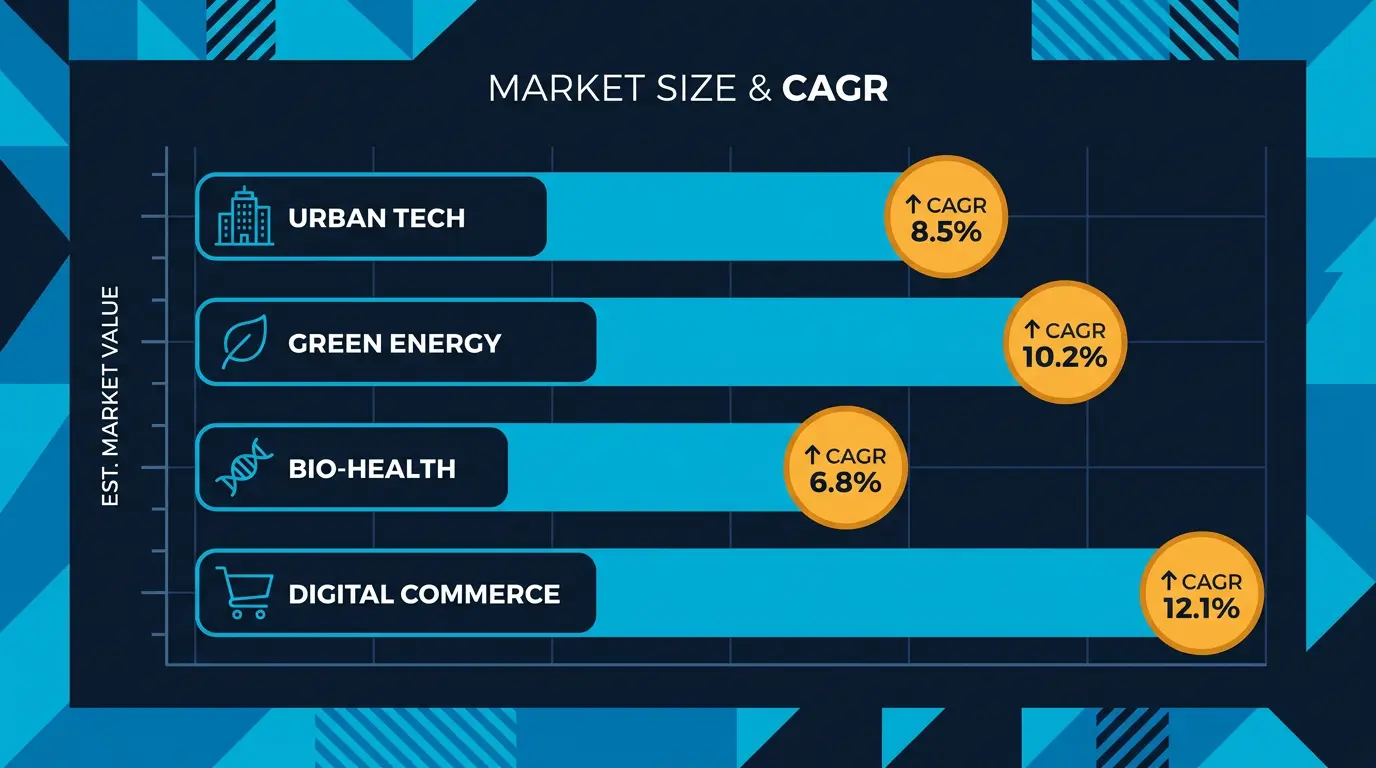
Realistic Conversion Funnels
Understanding conversion rates at each step is critical to calculating real market size.
Standard dating funnel:
- Total addressable demographic: 38 million seniors
- Interested in dating: 35% = 13.3 million
- Open to online dating: 55% = 7.3 million
- Willing to try niche platform: 15% = 1.095 million (TAM)
- Actually sign up: 2-5% = 22,000-55,000 active users
- Become paying members: 30-40% = 6,600-22,000 paying users
- Paying user lifetime value: $60-100 per year
- Annual revenue: $396,000-$2,200,000
Each stage of the funnel has dropout. Most people aware of a niche dating site don't sign up. Most who sign up don't pay. Most who pay use the service for only a few months.
This funnel shows why market sizing is critical. The addressable market (1.095 million) looks large. Actual users who sign up and pay (22,000) are much smaller. But 22,000 paying users generating $1-2 million annual revenue is a real business.
Case Study 1: Senior Dating Market
Target Demographic: Women aged 55-75, US-based, interested in dating men
Demographic Sizing:
- US women aged 55-75: ~22 million
- Interested in dating: 25% (lower than younger because many are in long-term relationships, widowed, or not interested) = 5.5 million
- Open to online dating: 50% = 2.75 million
- Would use specialized senior platform: 20% = 550,000
TAM: 550,000 addressable users
Market Validation:
- SeniorMatch: estimated 150,000-250,000 active monthly users
- eHarmony Senior: estimated 100,000+ active monthly users
- OurTime (Match Group): estimated 200,000+ active monthly users
- Total senior dating market: 450,000-550,000 combined
Your estimate of 550,000 TAM aligns with competitor data. This validates the sizing.
Realistic Business Model:
- Capture 10% of addressable market = 55,000 active users
- Convert 40% to paid = 22,000 paying users
- Average revenue per paying user: $80/year (premium subscription + credits)
- Annual revenue: $1,760,000
This is achievable in 4-5 years with solid execution. Senior dating has strong unit economics because conversion to paid is high (seniors willing to pay for dating services).
Case Study 2: BBW Dating Market
Target Demographic: Women size 18+, US-based, plus-size (BMI 30+), interested in dating
!Market sizing funnel showing total demographic, dating-interested adjustment, online dating willingness, and niche conversion rates yielding addressable market *Market sizing requires layering demographic data with dating interest, online dating willingness, and niche platform conversion to estimate true addressable market*
Demographic Sizing:
- US women with BMI 30+: ~70 million
- Women interested in dating: 40% = 28 million
- Open to online dating: 60% = 16.8 million
- Would use specialized BBW platform: 3-5% (lower percentage because general dating apps serve this demographic adequately) = 504,000-840,000
TAM: 672,000 (using midpoint)
Market Validation:
- BBW dating searches: 50,000-80,000 monthly Google searches
- BBWCupid: estimated 100,000-200,000 active users
- BBWDesire: estimated 75,000-150,000 active users
- General dating apps (Bumble, Hinge) serve BBW audience in addition to niche platforms
- Niche-specific TAM: 500,000-700,000
Your estimate aligns with market data.
Realistic Business Model:
- Capture 5% of addressable market = 33,600 active users (lower penetration because general dating apps compete)
- Convert 35% to paid = 11,760 paying users
- Average revenue per paying user: $90/year
- Annual revenue: $1,058,400
BBW dating has good economics if executed well. Market is large enough for a sustainable business but conversion rates are lower than senior dating because general platforms serve the audience.
Case Study 3: Military Dating Market
Target Demographic: Active duty military and military-connected singles, US-based, interested in dating
Demographic Sizing:
- US active duty military: ~1.3 million
- Military spouses/dependents: ~2.1 million
- Veterans: ~18 million
- Total military-connected singles aged 18-65: ~8 million (conservative, accounting for many being in relationships)
- Interested in dating: 40% = 3.2 million
- Open to online dating: 60% = 1.92 million
- Would use military-specific platform: 25% (military community is tight-knit, specialized platform appeals) = 480,000
TAM: 480,000 addressable users
Market Validation:
- MilitaryCupid: estimated 150,000-300,000 active users
- UniformDating (military segment): estimated 50,000-100,000 active users
- Veterans focused platforms: smaller, 20,000-50,000 active users
- Total military-specific TAM: 220,000-450,000
Your estimate is in reasonable range. Market is somewhat smaller than estimated, suggesting either smaller addressable market or lower penetration.
Realistic Business Model:
- Capture 8% of addressable market = 38,400 active users
- Convert 45% to paid = 17,280 paying users (military has higher paying conversion)
- Average revenue per paying user: $100/year (military demographic has good income)
- Annual revenue: $1,728,000
Military dating is viable. Market is large enough and paying conversion is higher than general dating.
Common Sizing Mistakes
Mistake 1: Conflating Awareness with Addressable Market
Founders often say "There are 5 million people searching for X dating site every month, so addressable market is 5 million." This is wrong.
Google Trends showing 5 million searches for "senior dating" doesn't mean 5 million people are addressable users. Some searchers are researchers, journalists, or competitors. Some are repeat searches from same person. Some are exploratory (just curious, not ready to join).
Use Google Trends as directional data (confirms demand exists), not as market size.
Mistake 2: Assuming 50%+ Penetration is Realistic
Founders often assume they'll capture 20-50% of addressable market. In reality, new entrants typically capture 2-5% in year 1-2, maybe 10% over 5 years if wildly successful.
Established competitors have first-mover advantage, brand recognition, and network effects. Your new platform competes in crowded markets. Realistic penetration estimates are conservative.
Mistake 3: Not Accounting for Free User Base
If you operate on free + premium model, not all signups convert to paid. But founders often count all signups as revenue-generating. Reality is 25-45% of signups become paying members.
If you're sizing market, size addressable users, then apply conservative conversion rates to paying members. That's your actual revenue market.
Mistake 4: Ignoring Geographic Constraints
Most new dating platforms launch in one country (US). TAM for US dating is 50% of global TAM. If you're sizing global TAM when you're launching in US only, you're overestimating by 50%.
Be explicit: "Our initial TAM is US-focused. Global TAM is 2x but we're not addressing it in year 1-2."
Mistake 5: Underestimating Content/Brand Building Timeline
Reaching 5% market penetration takes 3-5 years even with good execution. Most founders underestimate how long it takes to build brand awareness, content authority, and community trust.
Your market sizing should reflect realistic growth timeline, not optimistic "if we execute perfectly" scenarios.
Mistake 6: Not Accounting for Seasonality and Churn
Dating app usage is seasonal. January and February are peak (new year resolutions). Summer is lower. Churn is 40-50% monthly (users achieve goals or get frustrated).
This means even large addressable markets translate to smaller steady-state active user bases because of high turnover.
Mistake 7: Overestimating Niche Willingness to Pay
Founders assume niche audiences are more willing to pay than general audiences. This isn't always true.
If your niche is well-served by free or low-cost mainstream platforms (Bumble, Hinge), conversion to paid niche platform is lower. If your niche is underserved (very specific demographic), conversion is higher.
Key Takeaways
- Market sizing prevents founders from chasing oversized dreams based on inflated TAM. Use data-driven methodology, not intuition.
- Three-step process: size demographic, adjust for dating interest and online dating willingness, apply niche conversion rates. This produces addressable market.
- Use multiple data sources (Census, Google Trends, competitor analysis, user research) to validate estimates. No single source is perfectly accurate.
- TAM is theoretical maximum. SAM is realistic maximum given your constraints. Present SAM to investors, not TAM.
- Realistic conversion from addressable market to paying users: 2-10% depending on niche. Most founders overestimate penetration.
- Common mistakes: confusing search volume with addressable market, assuming 50%+ penetration, ignoring churn and seasonality, not accounting for time to build brand.
- Validate sizing against competitor data. If your estimate is 50-200% larger than competitors serve, investigate whether you've overestimated or identified genuine gap.
- Minimum viable market for sustainable business: 100,000 addressable users generating $500,000+ annual revenue at realistic penetration. Smaller markets are possible as lifestyle businesses.
Internal Links
- /blog/starting-a-dating-business/what-is--dating
- /blog/starting-a-dating-business/how-to-start-a-dating-site
- /blog/starting-a-dating-business/validate-dating-site-idea
- /blog/niche-dating-playbooks/most-profitable-dating-niches
- /blog/starting-a-dating-business/dating-site-business-models-compared
DatingPartners supports every niche above with tuned templates and payments. Talk to us.
Visit DatingPartners.com →