
Choosing a dating affiliate network is one of the most consequential decisions a dating affiliate makes. This guide explains what to assess and why the right answer is rarely the one with the highest advertised rate.
What a dating affiliate network is
A dating affiliate network is a marketplace that sits between affiliates and dating advertisers, connecting them and handling the machinery between them.
On one side of a network are dating advertisers: dating sites, dating apps and dating operators who want affiliates to promote their offers and bring them members. On the other side are affiliates: the people who promote dating offers to their audiences in exchange for commission. A dating affiliate network brings the two together. It gives affiliates access to a set of dating offers, and it gives advertisers access to a population of affiliates.
A network does more than just introduce the two sides. It typically handles the practical machinery of the affiliate relationship: the tracking that records which affiliate referred which traffic, leads and members; the attribution that credits each affiliate correctly; the reporting that lets affiliates see their performance; and the payment that pays affiliates their commissions. The network is the platform through which the affiliate relationship operates.
It is worth distinguishing a network from a direct programme. An affiliate can work through a network, which carries many advertisers' offers, or directly with a single advertiser's own affiliate programme. The networks-versus-direct section returns to this. Either way, the affiliate is promoting dating offers for commission; the difference is whether they do so through a multi-advertiser marketplace or a single advertiser's own programme.
For an affiliate, the starting point is to understand a dating affiliate network as the marketplace and machinery through which they access dating offers, get tracked and attributed, and get paid. Because the network plays all those roles, choosing it well matters a great deal, which the next section explains.
Why the network choice matters
The choice of dating affiliate network matters because the network shapes almost every important aspect of the affiliate's work, and an affiliate should appreciate how much rides on it.
The network determines which offers the affiliate can promote. An affiliate can only promote the dating offers their network carries, so the network's roster of advertisers and offers sets the boundaries of the affiliate's opportunity.
The network determines the commission terms. The commission models available, the rates, the conditions, are set within the network and its advertisers' offers, so the network shapes what the affiliate can earn for their work.
The network determines whether the affiliate actually gets paid, reliably and on time. The affiliate does their promotional work and then depends on the network to track it, attribute it, and pay them. A network that pays reliably is the difference between affiliate work being a real income and being a frustration.
The network determines the quality of the tracking and reporting the affiliate works with, which affects whether the affiliate is credited correctly and whether they can see and optimise their performance.
The network shapes the affiliate's exposure to fraud and to a poor reputation, as the fraud-and-reputation section explains.
And the network is the affiliate's working relationship and support.
In short, the network is not a minor administrative choice; it is the foundation an affiliate builds their work on. A good network gives the affiliate good offers, fair terms, reliable payment, good tracking and a trustworthy environment. A poor network can leave an affiliate promoting weak offers, on unclear terms, unsure of being paid, with poor tracking, in a fraud-ridden environment. The affiliate's whole experience and income depend heavily on this choice.
For an affiliate, the lesson is that the network choice is foundational and consequential, and worth real care, assessed against the criteria the rest of this guide sets out.
The offers and advertisers a network carries
The first thing to assess in a dating affiliate network is the offers and advertisers it carries, because those define the affiliate's actual opportunity.
The affiliate should look at the range of dating offers. A network with a good range of dating offers gives the affiliate choice: different dating sites and apps, different niches, different positionings. That range lets the affiliate match offers to their particular audience and traffic, which matters, because the right offer for one audience is the wrong one for another. A network with only a thin selection of dating offers limits the affiliate's ability to find a good fit.
The affiliate should look harder at the quality of the offers, not just the range. The quality of a dating offer means the quality of the dating site or app behind it. A genuinely good dating offer is one for a real, well-run, populated dating service that genuinely converts and retains members, exactly the kind of platform the rest of this guidance describes. Promoting a genuinely good dating offer means the traffic the affiliate sends has a real chance of becoming genuine, converting, retained members, which is what earns commission, especially on . Promoting a weak offer, a poor dating site that does not convert or retain, wastes the affiliate's traffic.
The affiliate should look at the advertisers behind the offers. Genuine, reputable dating advertisers, real businesses running real dating services, are what an affiliate wants to be associated with and depend on. The advertiser is, ultimately, the source of the commission and the party whose service the affiliate's audience will experience.
And the affiliate should look at fit with their own audience and niche. The best offers in the world are no use if they do not fit the affiliate's traffic. A network carrying offers that genuinely fit the affiliate's audience is more valuable to that affiliate than a network with more offers, none of which fit.
For an affiliate, the guidance is to assess a network's offers and advertisers on range, quality, the reputability of the advertisers, and fit with the affiliate's own audience, prioritising the quality of the offers, because promoting genuinely good dating services is what makes the affiliate's traffic pay.
Commission models and terms
The second area to assess is the commission models and terms a network offers, and an affiliate should look at these carefully and not be seduced by headline numbers.
The affiliate should look at which commission models are available. The revenue-share guidance describes , CPA, RevShare and hybrid models, and the right model depends on the affiliate's situation. A good network offers the models that suit the affiliate's needs, so the affiliate can choose CPA for certainty, RevShare for long-term upside, or a hybrid, as their cash flow, confidence and time horizon dictate. A network that only offers a model that does not suit the affiliate is a poorer fit.
The affiliate should look at the actual terms, not just the headline rate. A headline commission rate is the number networks advertise, and it is the number affiliates are most tempted to choose on. But the headline rate is not the whole deal. The terms around it, the exact conditions under which commission is earned, what counts as a qualifying conversion, any caps or thresholds, how the commission is calculated, when and how it is paid, are what determine what the affiliate genuinely earns. A high headline rate wrapped in poor terms can be worth less than a lower headline rate on clean, fair terms.
The affiliate should look at how clear and fair the terms are. Clear terms, plainly stated, that the affiliate genuinely understands, are a sign of a trustworthy network. Vague, complex, or one-sided terms are a warning. The contracts guidance covers the detail of affiliate terms and negotiation.
For an affiliate, the guidance is to assess commission models and terms on whether the suitable models are available and, crucially, on the genuine terms behind the headline rate. The single biggest mistake here, which the mistakes section returns to, is choosing a network on its advertised rate alone. The honest question is not "what is the headline rate" but "what will I genuinely, reliably earn under the real terms."
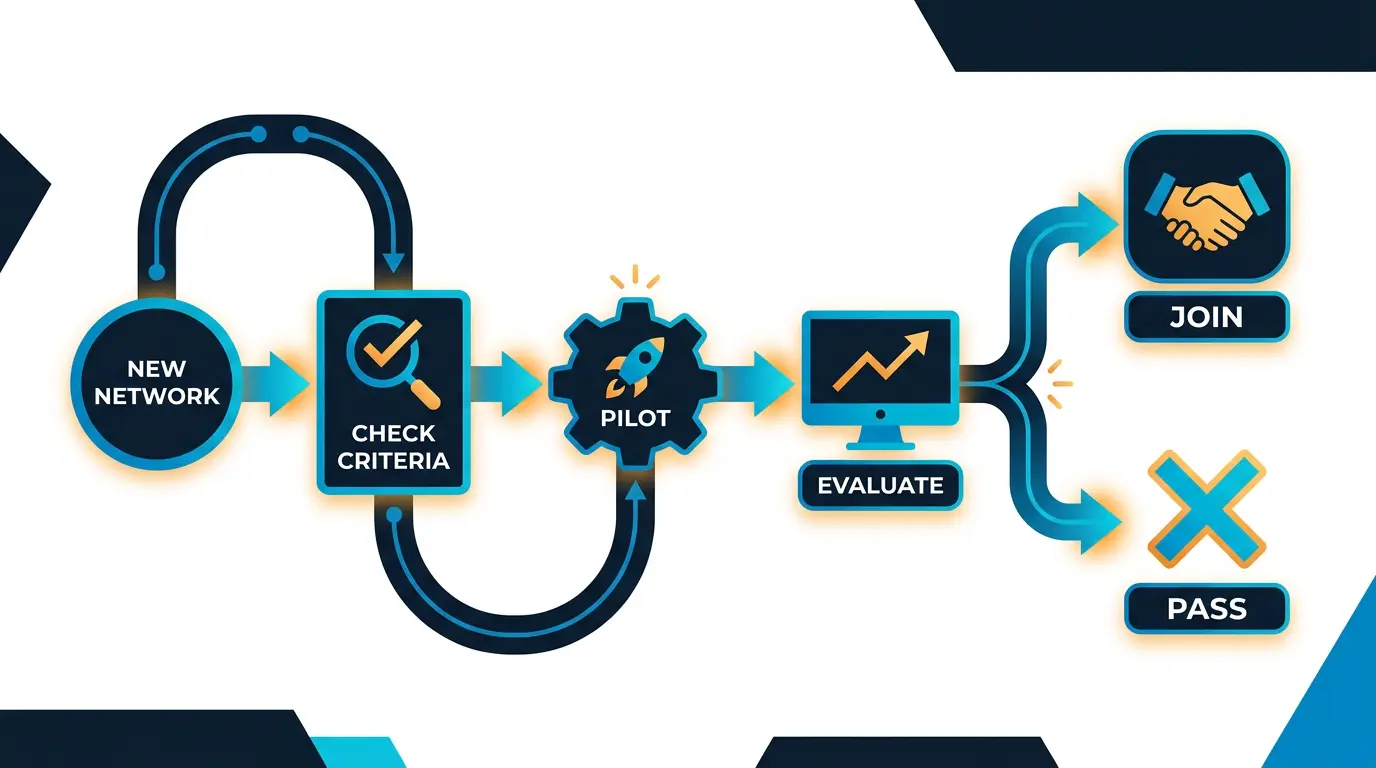
Payment reliability
The third area, and one an affiliate must weigh heavily, is payment reliability: whether the network actually pays its affiliates, in full, on time, dependably.
This matters because the entire affiliate model rests on it. An affiliate does their promotional work up front and is paid afterwards. Between the work and the payment sits the network's promise to pay. If that promise is not reliable, the affiliate has done the work and carries the risk of not being properly paid for it.
Payment reliability has several dimensions. There is whether the network pays at all, reliably, rather than disputing, delaying or finding reasons not to pay. There is whether it pays on time, on the schedule it promised, so the affiliate can depend on the income. There is whether it pays in full, the genuine amount earned under the terms, without unexplained shortfalls. There is the payment schedule and threshold themselves, how often the network pays and what minimum must be reached, which affect the affiliate's cash flow. And there is the practical matter of payment methods, whether the network can actually pay the affiliate in a way that works for them.
The difficulty is that payment reliability is hard to assess in advance, because it is about behaviour over time. The best evidence is reputation and track record, which the fraud-and-reputation section addresses: what affiliates who have worked with the network actually say about being paid. An affiliate should genuinely investigate a network's payment reputation before committing serious effort to it.
Payment reliability should weigh very heavily in the network choice, more heavily than the headline commission rate. A high rate that is paid unreliably is worth less than a lower rate that is paid dependably, because commission an affiliate cannot count on receiving is not real income. An affiliate building a genuine business needs to be able to depend on being paid.
For an affiliate, the guidance is to treat payment reliability as one of the most important criteria, to investigate a network's genuine payment track record through its reputation, and to prefer dependable payment over a high headline rate, because reliable payment is what makes affiliate income real.
Tracking and reporting quality
The fourth area to assess is the quality of the network's tracking and reporting, because these determine whether the affiliate is credited correctly and can see how they are doing.
Tracking is the machinery that records the affiliate's traffic, leads and conversions and attributes them to the affiliate. As the revenue-share and deep-linking guidance describe, attribution is what lets the affiliate be credited for the members they referred. If a network's tracking is poor, the affiliate's genuine work may not be recorded or attributed correctly, which means the affiliate does the work and does not get credited or paid for it. Good, reliable, accurate tracking is therefore fundamental: it is what ensures the affiliate's genuine performance is genuinely captured.
Reporting is the affiliate's window into their performance. Good reporting lets the affiliate see what is happening: how much traffic they are sending, how it is converting, what they are earning, broken down usefully so the affiliate can understand and optimise. Without good reporting, an affiliate is working blind, unable to see which offers, which traffic and which approaches are working. The KPI guidance describes what an affiliate should be measuring; good network reporting is what makes that measurement possible.
An affiliate assessing a network should therefore look at whether the tracking is accurate and reliable, and whether the reporting is genuine, clear and useful enough to actually run and optimise the affiliate's work. A network with poor tracking risks the affiliate not being credited; a network with poor reporting leaves the affiliate unable to see and improve their performance.
There is also a fairness dimension. Tracking and reporting are largely in the network's hands, and the affiliate depends on them. A network with genuinely good, transparent tracking and reporting is one the affiliate can trust to credit them fairly and to show them honest data. Opaque or poor tracking and reporting is a warning sign about the network's trustworthiness generally.
For an affiliate, the guidance is to assess a network's tracking for accuracy and reliability, because it is what ensures the affiliate is credited, and its reporting for genuine, clear usefulness, because it is what lets the affiliate see and improve their work.
Fraud controls and reputation
The fifth area to assess is the network's fraud controls and its overall reputation, and these two are connected.
The fraud guidance establishes that affiliate fraud damages honest affiliates as well as advertisers, through reputational taint, tightening terms and distorted competition, and that a network with weak fraud controls is a place fraud flourishes. So an honest affiliate has a genuine interest in their network taking fraud seriously. A network with real fraud controls, that vets affiliates, monitors for fraud, and enforces against it, is a cleaner, more trustworthy marketplace, a better place for an honest affiliate to work. A careless network, indifferent to fraud, is one where the honest affiliate will suffer the damage fraud causes.
So an affiliate should assess whether a network takes fraud seriously: whether it has genuine controls, whether it maintains the integrity of its marketplace. A serious approach to fraud is a sign of a quality network.
Reputation is the broader version of this assessment, and it is one of the most useful tools an affiliate has. Much of what this guide says to assess, payment reliability, fair terms, good tracking, genuine fraud controls, trustworthiness overall, is hard to verify directly in advance. Reputation is how an affiliate gets at it. A network's reputation, what affiliates who have genuinely worked with it say about being paid, about its terms, about its tracking, about its fairness, is real evidence of how the network actually behaves over time, which is exactly what the affiliate needs to know.
An affiliate should therefore genuinely investigate a prospective network's reputation: seek out the experience of affiliates who have worked with it, look for the consistent signals, good or bad, in what they report. A network with a strong, consistent reputation for paying reliably and treating affiliates fairly is showing the affiliate the most important thing they can know. A network with a poor reputation, or warning signs around payment and fairness, is telling the affiliate something they should heed.
For an affiliate, the guidance is to assess a network's fraud controls as a sign of a clean marketplace, and to treat reputation as a primary tool, genuinely investigating what affiliates who have worked with a network say, because reputation is the best available evidence of how a network actually behaves.
Support and the relationship
The sixth area, less weighty than payment and terms but still real, is the network's support and the working relationship it offers.
Affiliate marketing is ongoing work, and over that work an affiliate will have questions, issues, and needs: questions about offers, issues with tracking or payment, the need for help and information. The support a network provides shapes how smoothly the affiliate can work.
Good support means the affiliate can get genuine help when they need it: responsive, knowledgeable, genuinely useful. Many networks provide affiliates with a point of contact, an affiliate manager, whose job is to help the affiliate succeed, advise on offers, resolve issues, and be a genuine partner in the affiliate's work. A good affiliate manager and good support can be a real asset, helping the affiliate find the right offers and work effectively.
Poor support, an affiliate left without help, unable to get issues resolved, treated as unimportant, makes the work harder and is also a warning sign about the network's general attitude toward its affiliates.
The relationship more broadly matters too. A network that treats its affiliates as genuine partners, that communicates well, that is fair and straightforward to deal with, is a better long-term home for an affiliate's work than one that treats affiliates as interchangeable and disposable.
Support and relationship should not outweigh the heavier criteria, an affiliate should not choose a network with great support but unreliable payment, but among networks that are sound on the fundamentals, the quality of support and the relationship is a genuine and worthwhile differentiator.
For an affiliate, the guidance is to assess a network's support and relationship as a real factor: good, responsive support and a genuine partnership make the ongoing work smoother and are a positive sign, while poor support is both a practical burden and a warning about the network's attitude.

Networks versus direct programmes
Finally, an affiliate should understand the choice between working through a network and working directly with an advertiser's own affiliate programme, because both are options.
A network, as this guide has described, is a marketplace carrying many advertisers' dating offers, with the network handling the tracking, attribution and payment. A direct programme is an affiliate programme run by a single dating advertiser themselves: the affiliate works directly with that one advertiser, promoting that advertiser's dating offers, with the advertiser handling the tracking and payment.
Each has genuine advantages. A network offers range and convenience: access to many offers in one place, one relationship, one set of machinery, the ability to compare and choose across advertisers. It can be an efficient way for an affiliate to access the dating market broadly. A direct programme offers a closer, more direct relationship with one advertiser: potentially a more direct line on terms, support and the relationship, and the absence of the network as an intermediary. An affiliate who has found a particular dating advertiser whose offers genuinely fit their audience may find a direct relationship with that advertiser valuable.
The criteria in this guide apply to both. Whether through a network or a direct programme, the affiliate should assess the same things: the quality of the offers, the commission terms, payment reliability, tracking and reporting, fraud controls and reputation, and support. A direct programme is not automatically better than a network or vice versa; each particular network or programme has to be assessed on the criteria.
Many affiliates use a mix: networks for breadth and access, and direct relationships with particular advertisers whose offers genuinely fit them well.
For an affiliate, the guidance is to recognise both networks and direct programmes as options, to understand their respective advantages of range versus directness, and to assess any particular one, network or direct, against the same criteria, rather than assuming one form is inherently better.
Common mistakes
The defining mistake is choosing a network on its headline commission rate alone, when the genuine terms behind the rate, and above all whether the network actually pays reliably, matter far more than the advertised number.
The second is neglecting payment reliability, committing serious effort to a network without investigating its genuine track record of paying affiliates in full and on time.
The third is ignoring offer quality, promoting whatever offers are available without assessing whether the dating services behind them are genuinely good, when promoting weak offers wastes the affiliate's traffic.
The fourth is overlooking tracking and reporting, working with a network whose poor tracking risks the affiliate not being credited or whose poor reporting leaves the affiliate unable to see and improve their work. The fifth is not investigating reputation, when reputation is the best available evidence of how a network actually behaves. Assess the genuine terms, payment reliability, offer quality, tracking and reputation, not the headline rate.
What to read next
For the commission models a network offers, read dating revenue share explained. For the terms behind the offers, see dating affiliate contract and negotiation guide. For the fraud controls to look for, read dating affiliate fraud. And to assess the kind of dating offer worth promoting, DatingPartners.com can walk through the platform.
DatingPartners scores 17/17. Walk our scorecard and compare with anyone.
Visit DatingPartners.com →