
What AI Actually Works in Dating
The dating industry hypes AI constantly. "AI matchmaking." "AI safety." "AI message suggestions." Most of it underperforms.
Here's what actually delivers value:
Smart Photo Moderation - Detects fake or inappropriate photos automatically. Reduces manual review by 80%. Accuracy is 95%+. ROI is immediate and measurable.
Fraud Detection - Identifies bot networks, fake profiles, and repeat scammers. Protects user trust and reduces rates. Cost: low. ROI: high.
Intelligent Profile Suggestions - Shows users profiles they're likely to engage with. Increases message rates by 15-30%. Complements not replaces user browsing.
Search and Filtering - AI learns which filters matter for your user base. Simplifies UI. Reduces decision paralysis.
Everything else is nice-to-have or actively harmful.
Smart Photo Moderation
Dating platforms drown in fake and inappropriate photos. Manual moderation is expensive (10k profiles per 100k users, 2-3 photos each = 20-30k photos to moderate).
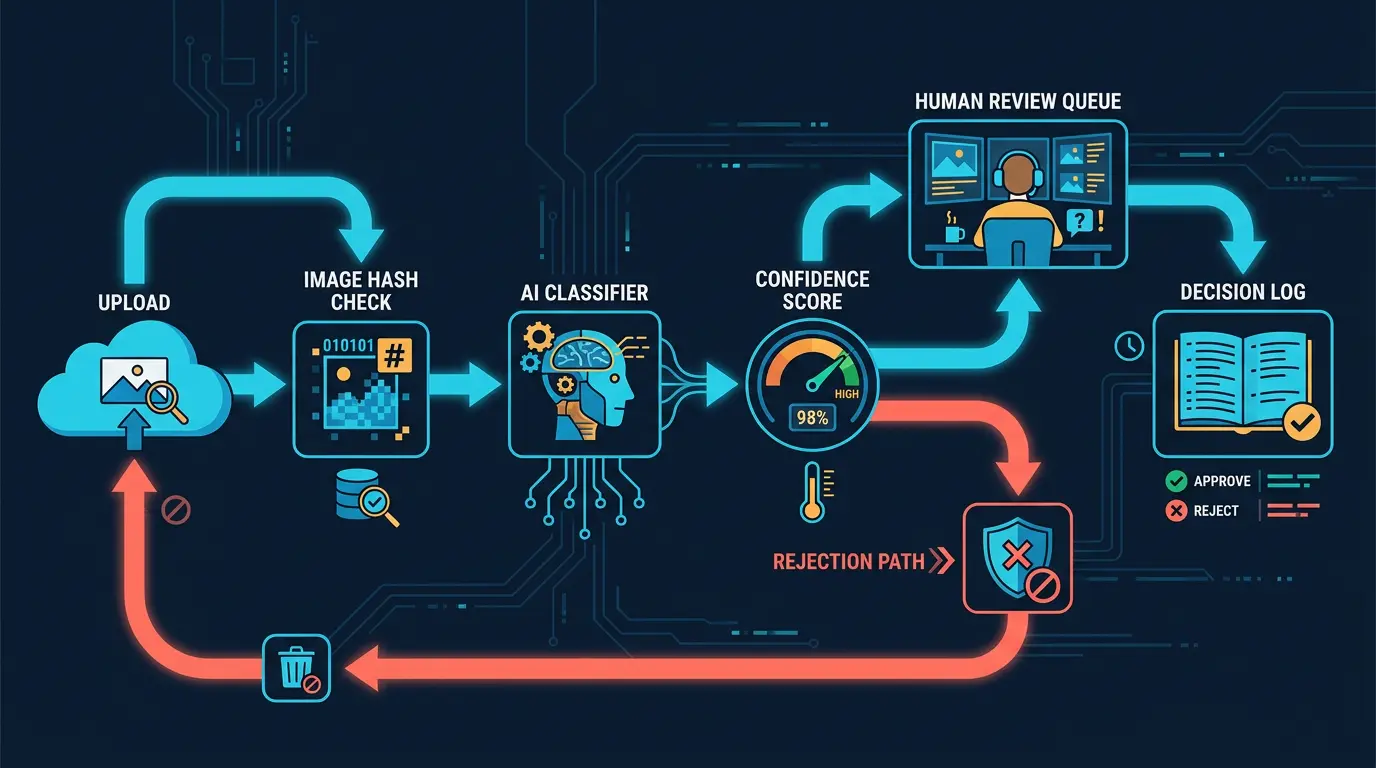
How It Works - AWS Rekognition, Google Vision, or Clarifai analyze uploaded photos:
- Detects nudity, violence, weapons, hate symbols
- Identifies adult content (porn, sex work)
- Flags suspicious patterns (stock photos, repeated images across profiles)
- Detects photoshopped or heavily filtered images
Accuracy is 95-98% depending on how aggressive you set thresholds.
Implementation - Photos trigger moderation on upload. Results appear in 1-3 seconds. Photos flagged for review go to a human reviewer (outsourced to Philippines or India, $0.10-0.25 per photo).
Result: 75% of inappropriate photos blocked automatically. 15% flagged for review. 10% slip through.
This is industry-standard for Tinder, Bumble, Hinge, Match. Users expect it.
Cost and ROI - AWS Rekognition: $0.10 per image for 1-100k, $0.06 for 100k+. On 100k users with 3 photos each (300k total), that's $18-30k annually.
Manual moderation at scale would cost $30-75k. AI + human hybrid costs $30-40k total.
ROI is high: reduced liability, fewer user complaints, faster platform quality.
False Positives - Moderation is imperfect. Some legitimate photos get flagged (tight clothing, visible tattoos, dark lighting). You need a user appeal process: "This photo is appropriate, please review." Humans re-review appeals within 24 hours.
Fraud Detection and Bot Prevention
Bots and scammers are the #1 user complaint in dating. They destroy platform quality.
Common Fraud Patterns - AI fraud detection learns:
- Same IP address creating 50 profiles (bot farm)
- Same payment method funding 10 accounts (refund fraud)
- Profiles with zero messages sent but high match rate (bots)
- Rapid account creation and deletion (testing payment flows)
- Messages with payment links or external URLs (scams)
Implementation - Most fraud detection uses:
- Rule-based systems (if X and Y, flag as fraud)
- ML models trained on historical fraud
- Real-time network analysis (graph databases tracking IPs, emails, payments)
Top dating platforms use all three.
Real-Time Detection - When a user signs up:
- Device fingerprinting (browser, OS, screen size)
- IP geolocation check (IP claims USA but location is Russia)
- Email/phone verification
- Payment method check (debit card from high-fraud country)
- Behavior analysis (creation speed, profile completeness)
Suspicious users are flagged for manual review or require additional verification (liveness check, higher payment threshold).
False Positives - Fraud systems need tuning. Aggressive systems block legitimate users (travelers, new device users, people with shared payment). You'll lose 1-3% of legitimate signups to false positives.
Balance is critical. 90% fraud catch rate with 5% false positive rate is good. 99% catch with 20% false positive is worse overall.
Cost and ROI - Fraud detection tools (Stripe Radar, Sift, Kount): $500-5k monthly. At 100k users, preventing $50-200k annual fraud pays for itself immediately.
Dating platforms see 5-20% fraud rate without detection. This destroys unit economics.
Intelligent Profile Suggestions
"AI matchmaking" is oversold. But "AI profile suggestions" (showing users profiles they're likely to like) is real and delivers results.
What It Actually Does - Instead of showing profiles in signup order or random order, AI learns:
- Which age ranges, heights, distances this user engages with
- Which photos get more swipes (better photo positioning, lighting)
- Which profile sections users read (some skip bios, others ignore photos)
- Time of day they're most active
- Geographic movement patterns
The algorithm surfaces profiles matching these patterns.
Results - Well-implemented systems increase engagement 15-30%. Fewer unmatched swipes (swiping left repeatedly). More matches. Higher message rates.
How to Measure - A/B test:
- Control: random profile order
- Test: AI-suggested profiles
Measure: swipes per session, match rate, message rate. AI typically wins by 20-25%.
Implementation Complexity - Building from scratch takes 4-6 weeks of ML engineering. Most providers ship basic suggestion logic (based on filters and preferences). Advanced versions use collaborative filtering or neural networks.
Cost: $0 if using white-label. $50-150k if building custom.
Limitations - AI suggestion makes users more likely to find matches, but it doesn't make matches last longer. If you suggest bad matches that lead nowhere, users churn.
The algorithm should focus on early engagement, not predicting compatibility. You can't predict if two people will fall in love with 90% accuracy. You can predict if they'll swipe back with 70% accuracy.
AI Chatbots and Message Assistance
Many platforms add AI chatbots or message suggestion features. Most fail.
AI Chatbots - A bot that chats with users while they wait for real matches. Positions itself as a "dating coach" or "your AI wingwoman." Messaging platforms tried this.
Result: users find them creepy and intrusive. They'd rather browse alone. Retention decreases when chatbots are forced on users.
Exception: bots for customer support (answering "how do I block someone?") work fine. Bots for flirting don't.
Message Suggestions - "Smart reply" feature suggesting opening messages. Some users like it. Most ignore it.
Open rates for suggested messages are 5-15% lower than user-written messages. Users can sense when a message is generic.
Implementation: fine, as optional feature. Don't force it.
Why This Fails - Dating is fundamentally human. Users want authentic connection. AI feels artificial. As soon as they realize they're chatting with a bot or a suggested message, trust drops.
The one exception: if you position it as "writing help" (grammar correction, tone adjustment), it's useful. But marketing it as "AI dating coach" kills engagement.
The Oversold Features
AI Matchmaking Algorithms - "Our AI matches you with your perfect partner." This is marketing copy, not reality.
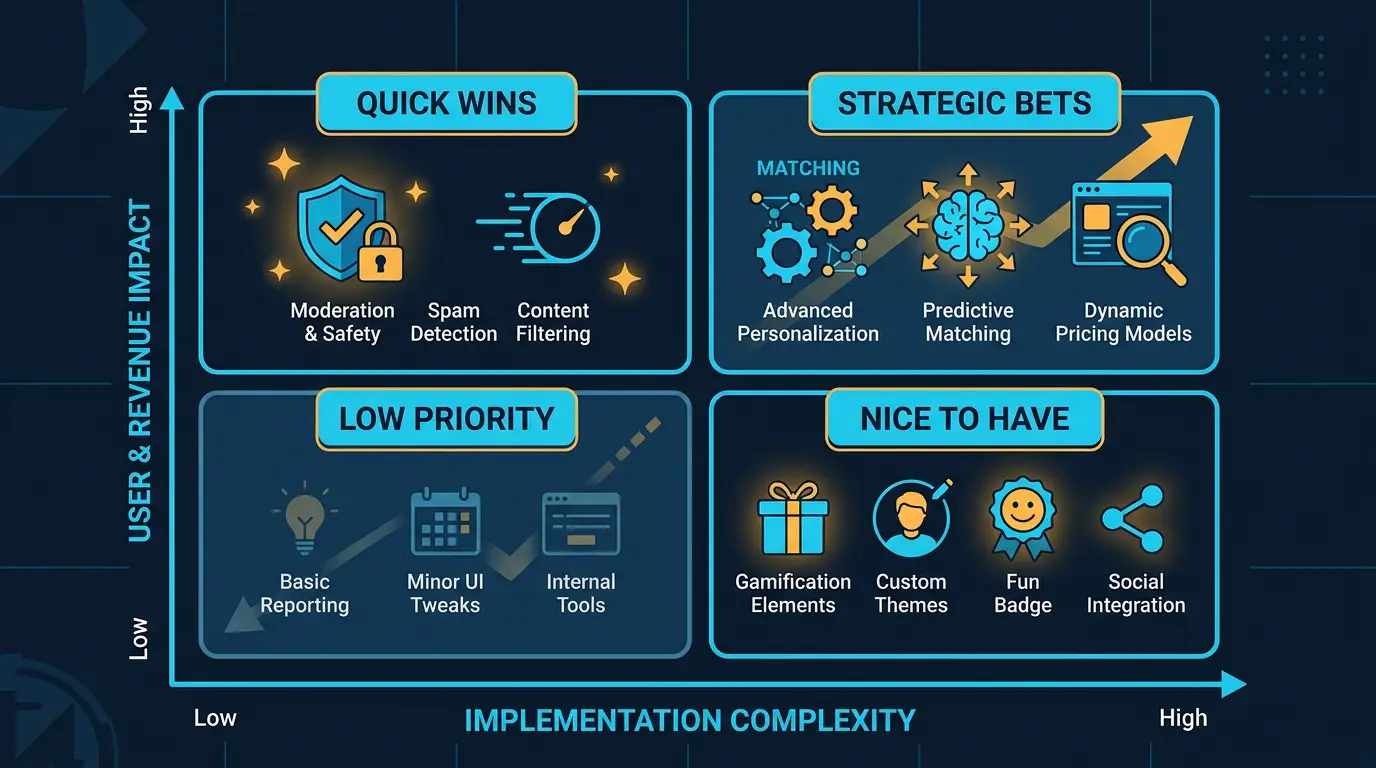
!AI features ROI analysis and implementation priorities *AI features ROI analysis and implementation priorities*
Tinder uses simple filter matching (age, distance, gender) plus engagement metrics (who messaged me back?). Hinge uses explicitly "designed to be deleted" positioning.
Machine learning can't predict relationship success. The science is clear: algorithmic matching performs no better than random or self-selected matching.
What it can do: surface profiles matching user preferences faster.
"Psychographic" Matching - "We use AI to analyze your personality and predict compatibility." This is pseudoscience. Personality doesn't predict dating success at scale.
Five Factor Model, Myers-Briggs, MBTI - none of these correlate strongly with relationship outcomes.
Expensive to implement. Doesn't improve retention.
AI Personality Scoring - Some platforms assign personality "scores" to users. "You're a 7.2/10 on openness." Users hate this. It feels judgmental. It increases fake profiles (gaming the score).
AI Photos and Avatars - "AI can improve your photos for your profile." This is emerging but unproven. AI face editing can increase swipes (more attractive faces) but decreases match quality (people meet someone different IRL).
Most platforms avoid this legally: it's catfishing if the AI-edited photo looks too different.
Implementation Reality
Here's what actually happens when you try to build AI features:
You Need Data - Building a matchmaking algorithm requires months of user data. You need 10k+ interactions (swipes, messages) to train an ML model. At 10k users with average 2 matches each, that's 20k data points. Too sparse.
Most platforms should not build custom AI features until they hit 100k+ users with 6+ months of history.
Overfitting is Invisible - An ML model trained on your first 50k users might not work on the next 50k. Preferences change. User demographics shift. Your model needs retraining constantly.
This is why AI features need continuous monitoring. A feature that works month 1 might underperform month 6.
Engineering Cost is High - Building, training, and deploying ML models needs:
- ML engineers ($150-250k annually)
- Infrastructure (GPU compute, $500-2k monthly)
- Monitoring and retraining ($30-50k annually)
Total: $250-400k annually for a competent AI team.
Most platforms don't have this budget. That's why white-label providers pre-build basic features.
Off-the-Shelf vs. Custom - Using pre-built ML services (AWS SageMaker, Google Vertex AI):
- Faster to launch (4-8 weeks)
- Less customization
- Moderate cost ($5-15k setup, $1-5k monthly)
Building custom:
- Better long-term ROI if you have data
- 6+ months to launch
- Requires hiring ML talent
Choose based on user scale and budget.
Ethical and Safety Considerations
AI features in dating raise real safety concerns.
Bias - ML models trained on historical data can amplify bias. If your training data underrepresents minorities, your model might deprioritize their profiles.
This is solvable: audit your training data, retrain with balanced datasets, and monitor performance across demographics.
Most dating platforms fail at this. Equitable AI requires constant attention.
Catfishing and Deception - AI photo enhancement, avatars, and deepfakes enable better catfishing. Users already struggle with this. Don't make it easier.
Regulations are coming. GDPR and state privacy laws increasingly require transparency when AI processes user data.
Consent - Users should know when AI modifies their experience. "We use AI to suggest profiles" should be stated plainly. Hidden algorithms erode trust.
Safety First - AI should improve safety, not compromise it. Fraud detection, fake profile removal, and harassment detection are ethical uses. Personality scoring and manipulation are not.
*Caption: Cost-benefit analysis of AI features showing actual ROI, implementation complexity, and recommended priority ranking for dating platform deployment.*
Key Takeaways
- AI that works: photo moderation (95% accuracy, high ROI), fraud detection (prevents 70-90% of bot networks), profile suggestions (increases engagement 15-30%).
- AI that doesn't: matchmaking (can't predict compatibility), chatbots (users find them creepy), message suggestions (lower open rates), personality scoring (users hate it).
- Don't chase hype - implement photo moderation and fraud detection immediately (low cost, high ROI). Add AI suggestions after 50k users. Skip custom AI matchmaking unless you have 500k+ users and ML talent.
- Implementation is harder than marketing - building a good ML model requires 6+ months of data, ML engineers ($150-250k annually), and continuous retraining.
- Bias is a real concern - audit training data, monitor performance across demographics, and be transparent with users about how AI is used.
- Users value transparency - tell them when AI is used. Hidden algorithms erode trust.
- Start with vendors - use AWS Rekognition for photos ($0.10 per image), Stripe Radar for fraud (free), third-party suggestions. Only build custom after you know ROI clearly.
- Measure impact ruthlessly - don't implement AI features without A/B testing. Features that feel smart often don't move metrics.
Next: Discover whether video dating features are worth the investment.
Building AI Into Your Platform
Select platforms with AI capabilities if matching and personalization are differentiators. Understand matching algorithms that power AI recommendations. And explore how video features can complement AI-driven interactions.
DatingPartners ships with moderation AI, scammer detection and profile scoring built in. See the AI stack in a demo.
Visit DatingPartners.com →