
"How do I develop a dating app" is really three different questions, because there are three genuinely different paths, and the right one depends entirely on your situation. This guide compares them honestly so you can choose with open eyes rather than discover the trade-offs after committing.
The three development paths
Every dating app reaches the world through one of three routes, and they are not variations of the same thing. They are fundamentally different decisions.
Building from scratch means commissioning or employing engineers to create the app, the back end, the database and everything else as original software you own. Buying means starting from an existing app builder, template or dating script and adapting it, so you are not writing everything but you are still standing up and running your own product. White labelling means licensing a complete, operating dating platform, applying your brand, and running on shared infrastructure.
The differences between them run along four axes that this guide works through: cost, time, control, and access to a . Hold those four in mind, because the right path is simply the one whose trade-offs match what you actually need.
Path one: build from scratch
Building from scratch means you own everything. The code, the design, the matching logic, the data, the infrastructure: all yours, all original, all under your control.
That is the appeal, and for the right operator it is decisive. If your business depends on a genuinely unique product, a novel matching mechanic, a distinctive experience, technology you intend to protect or raise investment against, then you need to control the product, and only building gives you that.
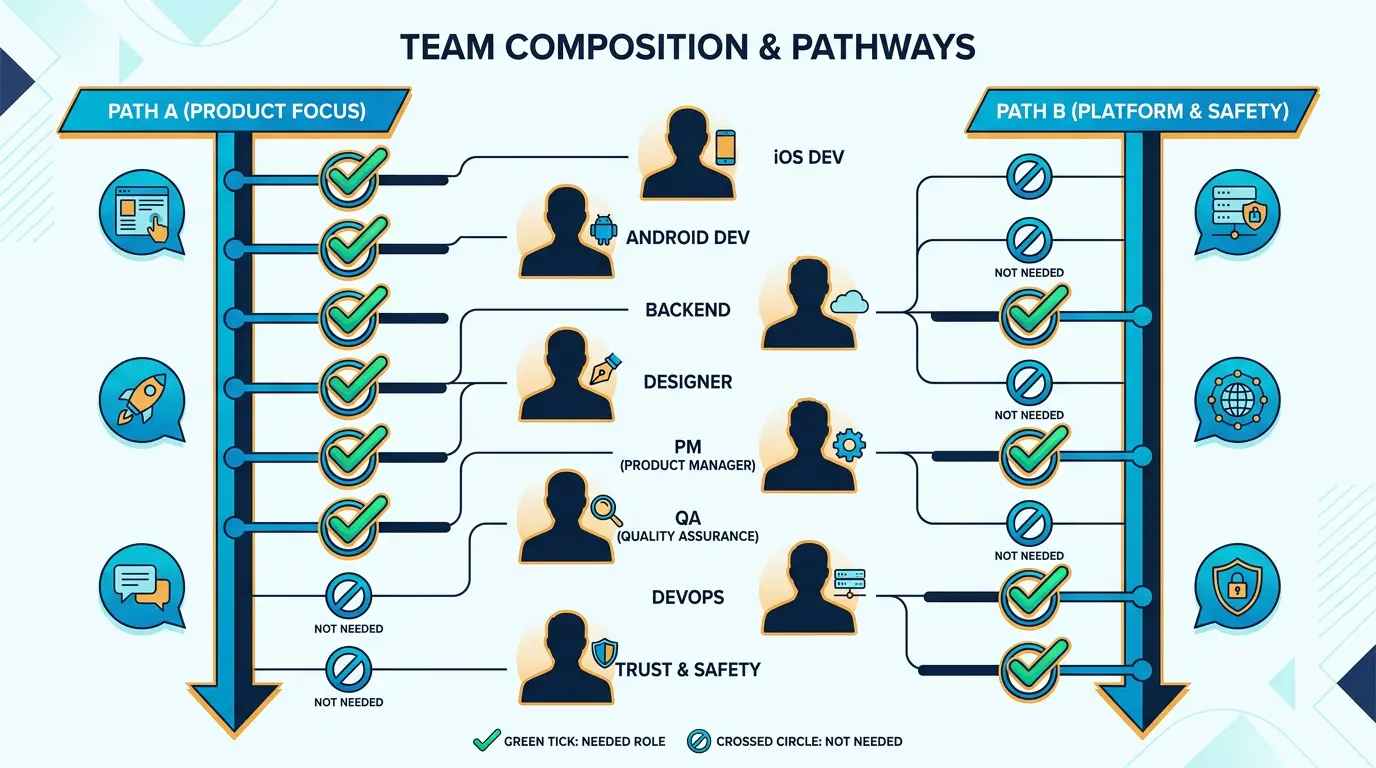
The cost of that control is large and easy to underestimate. You are not building one thing, you are building a platform: the member-facing app on iOS and Android, the back end, the database, the payment system, the moderation tooling, the admin panel, and the compliance framework. It takes twelve to eighteen months and a serious budget, and it produces an empty database that you must then fill from zero. Building from scratch is the right call for a funded team with a genuine technology bet, and the wrong call for almost everyone else.
Path two: buy an app builder or script
The middle path is to start from something that already exists: a no-code or low-code app builder, a template, or a dating script you license and host yourself.
This is faster and cheaper than building from scratch, because you are not writing the foundations. It suits a technically capable operator who wants more control than offers but cannot justify a full custom build. You can shape the product within the limits of the builder or script.
The honest limits are real. An app builder constrains you to what it can do, so a genuinely distinctive product is hard to achieve. A self-hosted dating script means you take on running the infrastructure, the updates, the security and, critically, the moderation and compliance yourself, which is a substantial operational load. And, like building, this path gives you an empty member base on day one. The buy path is a reasonable middle option for a technical operator with a simple product vision, but it carries more operational burden than its low headline cost suggests.
Path three: white label
White labelling means licensing a complete dating platform, including native apps, applying your brand and niche, and operating it. You do not develop the app at all in the engineering sense. You configure and brand an app that already exists, works, and is maintained.
This is the fastest and cheapest route to a live, fully featured dating app. There is usually no setup fee; the provider earns through a revenue share, typically taking 30 to 40 percent and leaving the operator 60 to 70 percent. The provider carries the technology, the payments, the moderation and the compliance.
The decisive advantage, beyond cost and speed, is the shared member database, which means your app shows active members from its first day rather than launching empty. The trade is that you control your brand and niche but not the core product. For an operator whose strength is audience and marketing rather than engineering, that trade is strongly favourable, which is why white label is the route most dating apps actually take.
Cost compared
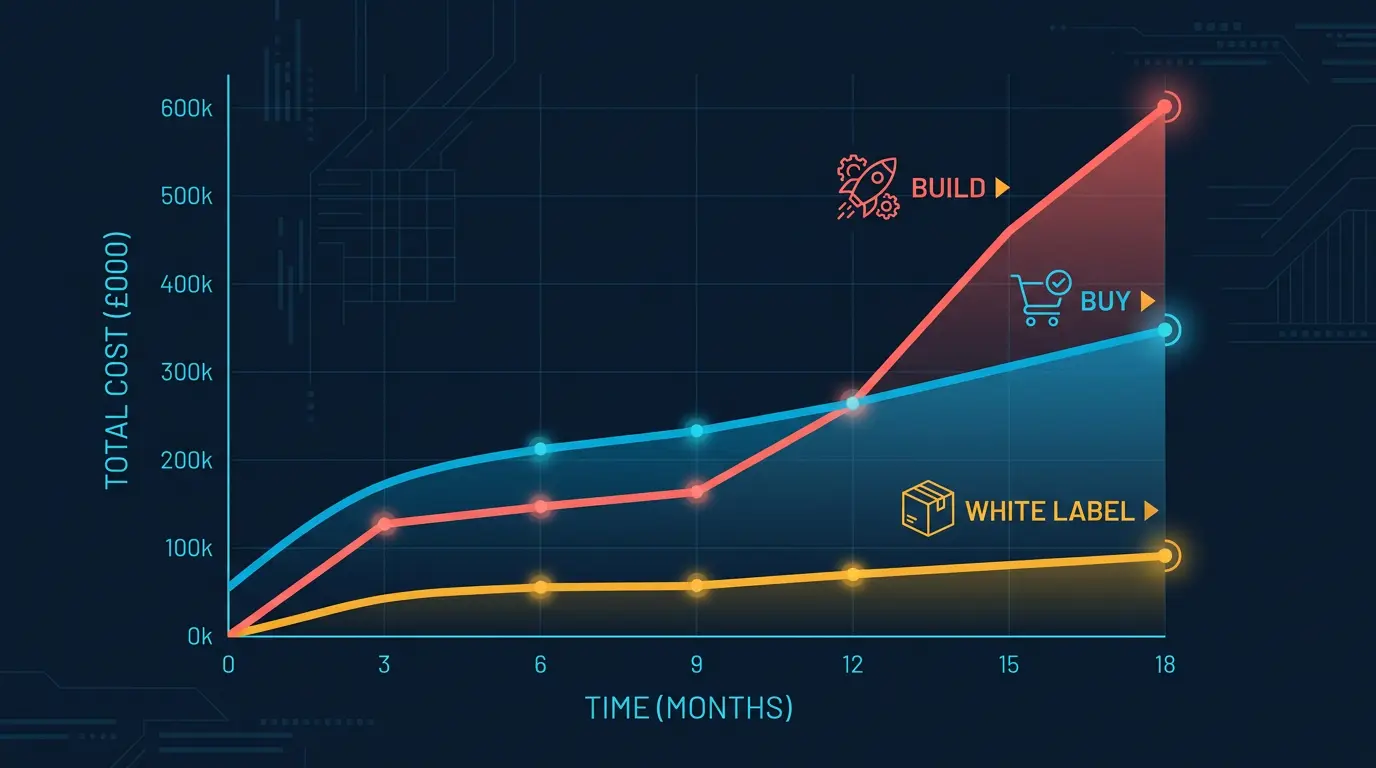
The cost gap between the three paths is an order of magnitude, not a margin.
| Path | Typical upfront cost | Ongoing cost |
|---|---|---|
| Build from scratch | £150,000 to £1,000,000 plus | Engineering team, infrastructure, ops |
| Buy a builder or script | £3,000 to £25,000 | Hosting, maintenance, your own moderation |
| White label | £0 to £8,000 | Revenue share only, paid on earnings |
The figures matter, but so does their shape. Building and buying are front-loaded: you pay heavily before you know whether the niche works. White label converts that into a variable cost you pay only on revenue you have already earned. For a first app, or for testing a niche, that difference is not just financial, it is risk management.
Time compared
The three paths reach a live app on very different timelines.
A custom build takes twelve to eighteen months before launch. An app builder or script route takes one to three months, depending on how much adaptation you do. A white label app can be live in three to six weeks, because you are branding and configuring a product that already exists and is already approved for the app stores.
Time is not a minor factor. A year-and-a-half delay is the difference between testing your idea this year and testing it the year after next, and in a market that moves, that delay has real cost. White label's speed is one of its strongest practical advantages.
Control and ownership compared
This is the axis where the order reverses, and it is the reason custom build exists.
Building from scratch gives total control and full ownership of everything. The buy path gives moderate control, bounded by the builder or script. White label gives control of your brand and niche but not the core product, the matching, the messaging, the feature set, which stay with the provider because the platform is shared across many operators.
If your plan genuinely depends on owning and shaping a unique product, this axis outweighs cost and time, and you should build. If your plan depends on finding an audience and serving it well, you will not use the control a custom build gives you, and paying its cost and time to acquire it is poor judgement.
The member pool factor
There is a fourth axis that operators consistently forget, and it can matter more than the other three: where does your app's membership come from on launch day.
Build and buy both deliver an empty database. Your beautifully developed app, on its first day, has nobody on it, and a dating app with nobody on it is useless. You then face the hardest problem in the industry, filling a member base from zero, and most independent dating apps die at exactly this point.
White label is the only path that solves this. Because your app reads from the provider's , it shows active members from the first day. This is not a minor convenience. It is the difference between an app that is genuinely useful immediately and an app that has to survive a long, brutal cold start. Factor the member pool into the decision as heavily as cost or control.
Ongoing maintenance, the cost everyone forgets
Development cost is what operators compare. Maintenance cost is what catches them out.
A dating app is never finished. Apple and Google update their operating systems every year, security issues emerge, and the app must be kept current or it degrades and eventually breaks. On a custom build, that maintenance is entirely your cost, a permanent engineering commitment. On a self-hosted script, the updates, the security patching and the infrastructure upkeep are yours too. On white label, maintenance is the provider's job and is covered by the revenue share, so it never appears as a separate line for you.
Whenever you compare the three paths, compare their ongoing maintenance burden, not just their upfront cost. It changes the picture significantly, and it changes it in white label's favour.
Which path for which operator
The paths map cleanly onto operator types.
White label is right for the operator whose advantage is audience, niche knowledge and marketing, who wants to launch fast and cheap, and who is happy to compete on brand rather than on proprietary technology. This is the large majority of people developing a dating app.
The buy path is right for a technically capable operator with a simple product vision, who wants more control than white label and can take on the operational burden of running their own product, but cannot justify a full build.
Building from scratch is right for a funded team with a genuine, defensible technology bet, who needs total control, has eighteen months of runway, and intends to compete on the product itself.
Be honest about which of these you are. Most people developing a first dating app are the first type and talk themselves into the third.
How to decide
The decision comes down to a few honest questions. Do you have a unique technology bet at the heart of your plan? If yes, build. If no, building is the wrong use of your money. Can you fund and wait out an eighteen-month project? If no, building is not realistically open to you. Are you technical enough, and willing, to run your own infrastructure, moderation and compliance? If no, the buy path's operational burden will overwhelm you. Is your real advantage audience and marketing? If yes, white label lets you put all your effort exactly there.
For most operators, those answers point clearly to white label. The exceptions are real but rare, and they know who they are because they have funding and a genuine product thesis. Everyone else is choosing between a slow, expensive route to an empty app and a fast, cheap route to a populated one.
Starting on one path, switching later
The three paths are not a one-time, irreversible choice, and understanding how they connect makes the decision less daunting.
The most common and sensible progression is to start on white label and move to a more owned model later, if and when the business justifies it. An operator proves a niche on white label, with real members and real revenue, fast and cheaply. If the niche works and the economics are strong enough, the operator then has a genuine, evidenced case for investing in a custom build, and the white label phase has paid for that investment rather than gambling on it. This is the progression most independent operators should plan for: validate cheaply, then own deliberately.
The reverse progression, starting with a build and later moving to white label, also happens, usually because a custom build proved more expensive and less successful than hoped. It is a retreat rather than a plan, but it is available, and it is better than persisting with a build that is not working.
What matters is that switching is never seamless, and the friction is mostly about members and data. Moving off a white label platform means the members who joined through the shared pool do not straightforwardly come with you, which is exactly why the data-export and data-ownership terms in the contract matter so much. Moving between any two paths means migrating data, rebuilding or relicensing technology, and managing the transition without disrupting the members you already have.
The practical advice is twofold. First, do not treat the initial choice as permanent and agonise over it; treat it as the right choice for now, knowing a later move is possible. Second, before signing anything, check that the path you are choosing does not lock you in unfairly: confirm the data-export rights, understand what you would and would not keep, and make sure the contract allows a future move on reasonable terms. A path chosen with a clear exit understood is a path chosen safely.
Common mistakes
The defining mistake is choosing to build from scratch without a genuine technology bet, drawn by the appeal of "owning it," and spending a year and a large budget to acquire control you will never use.
The second is comparing only upfront cost and ignoring ongoing maintenance, which makes build and self-hosted-script look cheaper than they are.
The third is forgetting the member pool, and developing a perfect app that launches empty into the cold-start problem.
The fourth is underestimating the operational burden of the buy path, where a low licence cost hides the real work of running your own moderation, compliance and infrastructure. The fifth is treating the decision as purely technical when it is really a business decision about cost, risk, speed and where your advantage lies.
What to read next
For the business framing, read white label vs custom dating software. For the app-specific launch process, see how to start a dating app and how to build a dating app MVP. And to compare a white label platform against building, DatingPartners.com can walk through what its platform includes.
Launch in weeks, not years. DatingPartners handles the stack so you focus on the audience. Start free demo.
Visit DatingPartners.com →