
Must-Have Features
These features are non-negotiable. Launch without them and your platform will fail. Members expect these as baseline functionality.
User Profiles
A dating profile includes:
- Profile photo (primary image shown in discovery)
- Multiple photo gallery (3-10 images minimum)
- Bio/about section (500-1,500 characters)
- Age, location, basic info
- Height, body type, ethnicity (optional but common)
- Education, profession, interests
- Dating preference (looking for relationship, casual, etc.)
- Relationship status verification
Profiles must be editable. Users change their mind constantly about photos and bios. Your platform needs version control - you should maintain photo upload history to prevent abuse (someone uploading explicit content, then deleting it to avoid moderation).
Critical specs: Allow at least 10 photos per profile. Compress images automatically (photography is poor quality from mobile). Provide photo cropping tools. Show a "profile completeness" score to encourage users to add all information.
Discovery and Swiping
The discovery interface is where users spend 80% of their time. This is your core product.
Fundamental approach: Show one profile at a time. Users can like, pass, or super-like. The simplest version shows name, age, location, and primary photo. More detailed versions show all profile information.
Technical requirements:
- Load profiles quickly (under 500ms per swipe)
- Show profile information progressively (don't load all 10 photos before the user sees the name)
- Prevent duplicate profiles (never show the same person twice in one session)
- Implement duplicate prevention across devices (same person on iPhone and iPad shouldn't see duplicates)
- Limit swipes per session (prevents "swipe farming" and engagement mechanics)
Smart discovery algorithms increase engagement. Instead of showing profiles randomly, show profiles that match on key criteria. This is the difference between a dating app and a dating platform. Section "Dating Matching Algorithms Explained" covers this in detail.
Minimum viable spec: 100-150 profile swipes per session. Allow super-likes to express higher interest. Show match notifications immediately when two users like each other.
Messaging
Once users match, they need to communicate.
Core messaging features:
- Text-based chat (required)
- Push notifications for new messages
- Read receipts (shows when recipient has read your message)
- Message typing indicators ("typing...")
- Block/unmatch functionality
- Message history (store at least 30 days)
- Link preview (if user shares a URL)
Monetization consideration: Some platforms limit free users to 5-10 matches per day to encourage premium upgrades. Others limit initial message length for free users. These friction points increase conversion but damage user experience.
Spec: Messages must deliver within 2-3 seconds. Push notifications should be sent within 10 seconds of message receipt. Allow users to delete messages from their view (though don't delete from recipient's history). Store all messages for abuse investigation.
Safety and Verification
Trust is critical in dating. Users need to feel safe.
Safety features:
- Profile verification (link to social media, email confirmation)
- Photo verification (AI checks if uploaded photo matches profile selfie)
- Age verification (essential - dating platforms are liable for underage users)
- ID verification (links to Yoti, Jumio, or similar third-party services)
- Report functionality (users can report inappropriate content or behavior)
- Block lists (users can block specific people)
- Moderation team access to reports
Age verification is non-negotiable from a liability perspective. Most platforms use a third-party service like Yoti. Cost: $1-3 per verification. Some users will refuse and churn, so plan for 20-30% verification decline rates.
Photo verification uses machine learning to compare the uploaded profile photo with a submitted selfie. False positive rates are 2-5% (rejecting legitimate users). Budget for manual review of edge cases.
Critical spec: Age verification must happen before profile goes live (not after). Store verification status and date. Update annually (a user verified at 18 is 19 a year later). Don't show unverified profiles in search results.
Payment Processing
Even if your platform is free-to-use, you'll eventually need payments for premium features.
Payment processor integration:
- Credit card processing (Stripe, Square)
- Apple Pay and Google Pay
- Secure payment form (PCI-DSS compliant)
- Subscription management (recurring charges)
- Refund processing
- Receipt generation and email
Launch with at least two payment methods. Users will abandon checkout if their preferred method isn't available.
Apple and Google take 30% of all in-app purchases. Consider collecting payment on web (2.9% + $0.30) and directing users there to avoid the 30% cut.
Technical spec: Store payment information securely. Never store full credit card numbers. Use tokenization so payment processor stores the card, not you. Implement fraud detection. Use 3D Secure for high-value transactions.
Admin Controls
You need backend tools to manage your platform.
Essential admin features:
- User management (deactivate, ban, verify accounts)
- Content moderation (review reported photos, messages)
- Analytics dashboard (see usage metrics)
- Revenue reporting (see payment totals, refunds)
- Email/push notification sending
- Database backup and recovery
- Security logs (who accessed what, when)
Don't build this all at once. Start with user deactivation, basic analytics, and reporting tools. Add sophistication over time.
Critical Feature Specifications
Photo Upload and Storage
- Support JPG, PNG, WebP formats
- Minimum resolution: 400x400 pixels
- Maximum file size: 5MB
- Auto-compress to optimize storage and loading
- Store at least 10 photos per user profile
- Implement CDN delivery (Cloudflare, AWS CloudFront) for fast load times
- Auto-crop photos to consistent aspect ratio (3:4 is common for dating)
- Watermark user photos with username (prevents screenshot stealing)
Cost impact: Photo storage for 100,000 users with 5 photos each = ~500 million images. At typical cloud storage rates (AWS S3), this costs $5,000-$8,000 monthly. Compress aggressively.
Location and Geographic Search
- Capture user location from GPS on mobile
- Allow users to set their location manually (traveling, relocating)
- Show distance between users in discovery ("15 miles away")
- Filter by distance radius (within 1 mile, 5 miles, 25 miles, etc.)
- Implement location-based search efficiently (geospatial indexing in database)
- Never share exact GPS coordinates with other users - show only distance
- Update location in real-time or allow 1-2 hour refresh cycles
Privacy consideration: Real-time location tracking is a safety risk. Most platforms update location when the app opens, not continuously.
Notifications
- Push notifications for new matches
- Push notifications for new messages
- In-app notification badges (red circles on message icons)
- Email notifications for less frequent users (1x daily digest)
- User control over notification preferences (allowing them to mute certain types)
- Time-zone aware notification sending (don't wake users at 3 AM)
Engagement consideration: Notification timing dramatically impacts retention. Sending match notifications at optimal times for each user increases app re-engagement by 20-30%.
Nice-to-Have Features
These features increase engagement and retention but aren't required to launch. Add them after achieving initial traction.
Video Profiles
Allow users to record a 15-30 second video introduction.
Impact: Profiles with video see 3-4x more matches than text-only profiles. Video cuts through fake profiles and misrepresentation.
Complexity: Video encoding is CPU-intensive. Budget $5,000-$15,000 to implement. Users on poor connections may struggle with video uploads.
Best practice: Make video optional. Don't require it, but prominently encourage users to add it.
Video Calling
Built-in video call within the app.
Impact: Reduces friction when users want to verify identity before meeting. Increases conversion from match to first date.
Complexity: High. Video infrastructure (WebRTC) costs money. You're managing peer-to-peer connections, fallback servers for poor connections, and NAT traversal. Solutions like Twilio or Agora handle this (costs $0.01-0.05 per minute).
Technical debt: Video calls create support headaches (connection issues, audio problems). Budget support resources.
Voice Messages
Allow users to record and send audio messages instead of typing.
Impact: Increases engagement for users with poor typing skills or accessibility needs. Humanizes the conversation.
Complexity: Low to moderate. Audio recording and playback are straightforward. Audio files need compression to save storage (similar to photos).
Icebreakers and Conversation Starters
Suggest questions users can ask each other ("What's your favorite travel destination?").
Impact: Reduces "opener fatigue". Users don't have to come up with original messages. Increases match-to-first-message conversion by 15-25%.
Complexity: Low. The feature is just a database of questions with a "Send" button. AI-powered personalized icebreakers (tailored to the profile) require more work.
Implementation: Create 50-100 questions relevant to your niche. Test different questions to see which drive responses.
Gifts and Virtual Gifts
Allow users to send digital gifts (virtual flowers, drinks, etc.) to express interest.
Impact: Another monetization vector. Users spend $0.99-$9.99 on gifts. Adds a playful element to flirting.
Complexity: Low development complexity. High design complexity (what gifts to offer, how many, pricing). Cultural sensitivity needed.
Interests and Matching Tags
Allow users to select interests (hiking, photography, travel) and match on common interests.
Impact: Increases match quality. Users feel better about matches when they share interests.
Complexity: Low. But you need a substantial tag database (500+ tags for broad platform, 50-100 for niche). Let users create custom tags as your platform grows.
Badges and Verification Status
Show visual badges on profiles (verified photo, background-checked, etc.).
Impact: Builds trust. Verified users see 2-3x more matches (assuming verification actually indicates trustworthiness).
Complexity: Depends on what badges mean. Simple badges (verified email) are easy. Complex badges (background check) require integration with third-party services.
Favorites and Bookmarking
Allow users to save profiles to review later.
Impact: Users often find someone interesting but want time to think before matching. Favorites reduce decision paralysis.
Complexity: Very low. Just a "favorite" flag in the database and a "My Favorites" view.
User Preferences and Filtering
Let users specify who they want to see (age range, distance, education level, looking for relationship vs casual).
Impact: Critical for user experience. Users don't want to waste time swiping people who don't fit their criteria.
Complexity: Low to moderate. Simple filtering (age, distance) is straightforward. Complex filtering (specific interests, deal-breakers) requires more database optimization.
Best practice: Pre-filter before showing profiles (don't show profiles outside age range). This improves efficiency and user satisfaction.
Differentiator Features
These features set your platform apart from competitors. Choose 1-3 based on your niche.
Niche-Specific Features
Dating for Christians: Faith-based questions, church attendance frequency, denomination.
Dating for fitness enthusiasts: Gym check-ins, workout frequency, fitness goals.
Dating for dog parents: Dog breed, dog age, pet-friendly preferences.
Impact: Highly targeted niches see 50%+ better engagement because the platform matches their specific needs.
Complexity: Requires niche-specific research and design. Generic features adapted for your niche rarely work well.
Advanced Matching Algorithms
Machine learning algorithms that learn what kind of profiles each user actually engages with and recommend similar profiles.
Impact: Users get better recommendations. Engagement skyrockets (20-40% increase in matches).
Complexity: High. You need data science expertise. Requires 6+ months of user data to build models.
Best practice: Start with simple rules-based matching (same interests, age range, location). Upgrade to machine learning as you accumulate user data.
Personality Quizzes and Compatibility Scoring
Let users answer personality questions (Big Five traits, love language, etc.). Match users with compatible personalities.
Impact: Increases match quality and reduces time-wasters. Users feel matched on deeper level.
Complexity: Moderate. You need psychometric research (don't invent your own personality system). Integrate question-answering with matching algorithm.
Community Features
Groups, discussion forums, event creation, or local meetups.
Impact: Builds community around your platform. Users become invested in the platform beyond just dating.
Complexity: High. Community management is ongoing work. Requires active moderation and community management staff.
AI-Powered Profile Feedback
Show users why they're not getting matches. Machine learning analyzes successful profiles and suggests improvements.
Impact: Increases profile quality. Users stay engaged because platform helps them improve.
Complexity: High. Requires models trained on successful profiles.
Feature Adoption and Engagement Data
Here's how different features correlate with engagement and retention:
| Feature | % of Users Who Try | Impact on Matches | Impact on Retention |
|---|---|---|---|
| Profile photos (5+) | 75% | +300% | +25% |
| Video profiles | 12% | +250% | +18% |
| Video calling | 8% | +80% | +12% |
| Icebreaker questions | 35% | +40% | +8% |
| Virtual gifts | 18% | +15% | +6% |
| Interests/tags | 60% | +80% | +15% |
| Advanced filters | 55% | +45% | +12% |
| Personality quiz | 22% | +120% | +20% |
| Badges/verification | 40% (view), 15% (earn) | +60% | +18% |
Key insight: Photo quality drives everything. Users with 5+ good photos get 3-5x more matches than users with 1-2 photos. Video profiles amplify this effect. Encourage users to upload multiple, high-quality photos in onboarding.
*Caption: Detailed feature adoption analysis showing percentage of users trying features and the corresponding impact on match rates and user retention.*
User Research Findings
Recent user research on dating app expectations (2024-2026):
!Dating site feature adoption and engagement metrics *Dating site feature adoption and engagement metrics*
Top Reasons Users Delete Dating Apps (in order)
- Too many fake profiles / bots (64% of users cite this)
- No quality matches (38%)
- Too much time investment required (32%)
- Overwhelming number of messages (28%)
- Safety concerns (22%)
- Paywall / premium features (15%)
Most Important Features (ranked by % saying "very important")
- Quality photo uploads (94%)
- Reporting/blocking tools (91%)
- Profile verification (87%)
- Age verification (85%)
- Search/filter options (81%)
- Messaging system (79%)
- Matching algorithm quality (72%)
- Video profiles (38%)
Feature Usage in First 7 Days
- 85% of users complete basic profile
- 68% upload 3+ photos
- 52% use discovery/swiping
- 41% get at least one match
- 28% send first message
- 12% have video chat
- 8% meet in person
New user retention is heavily correlated with getting a match in the first 7 days. Platforms with 50%+ match rate in week 1 see 30-40% 30-day retention. Platforms with <20% match rate see 5-10% retention.
Build Order and Priority
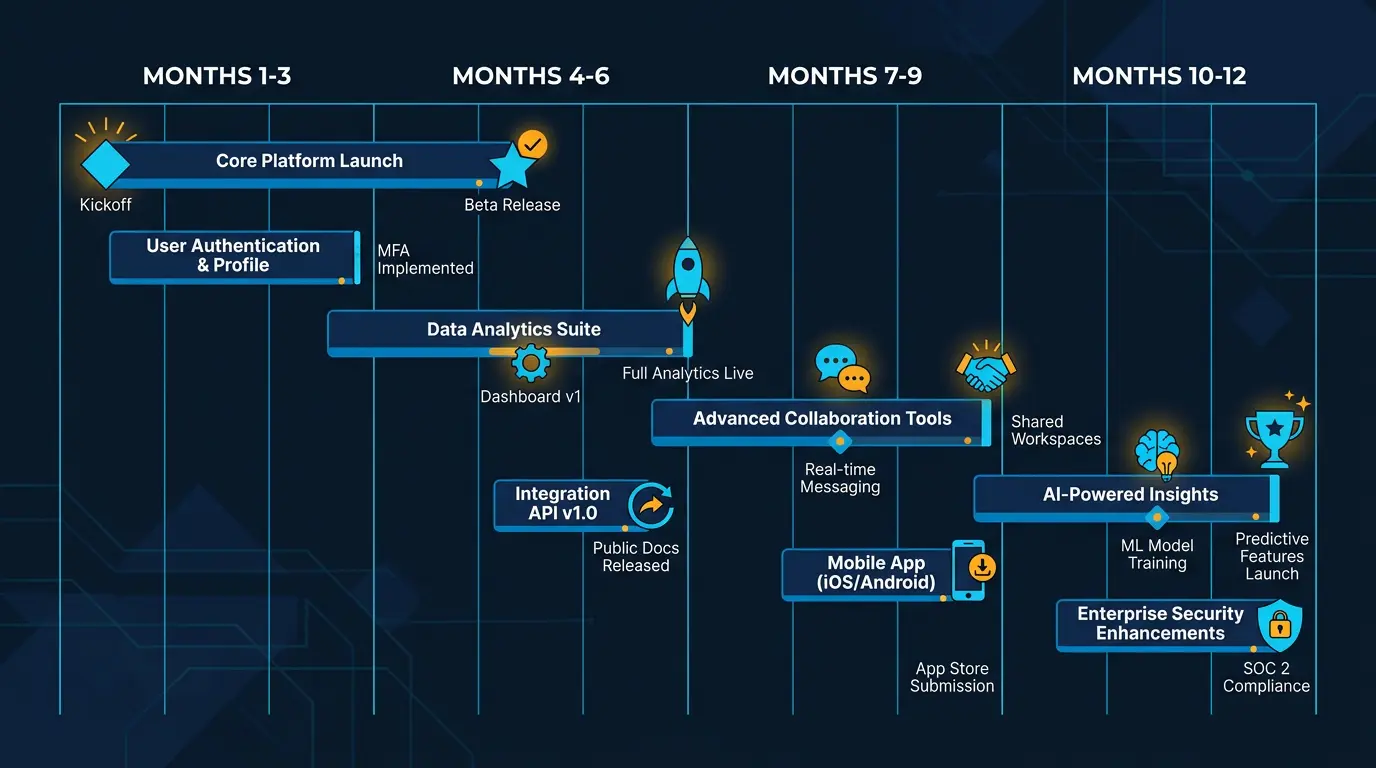
If you're launching a new dating platform, build in this order:
Phase 1: Core Product (Weeks 1-8)
- User signup and authentication
- Profile creation and photo uploads
- Discovery/swiping interface
- Matching (when two users like each other)
- Messaging between matched users
- Basic admin panel (user management)
Goal: Get to a minimum viable product with functioning matches and messaging. Launch with at least 100 profiles (you may need to seed the platform with real users or bot accounts initially).
Phase 2: Safety and Compliance (Weeks 9-12)
- Age verification integration (Yoti)
- Reporting and moderation tools
- Block/unmatch functionality
- Spam detection
- Privacy policy and terms of service
- GDPR / data protection compliance
Don't skip this phase. You're liable for illegal content and underage users.
Phase 3: Payment (Weeks 13-16)
- Payment processor integration (Stripe)
- Premium features (unlimited messages, super-likes, etc.)
- Subscription management
- Receipt generation and tracking
- Refund processing
You likely won't be profitable without premium features. Most dating platforms rely on them.
Phase 4: Growth and Engagement (Weeks 17-24)
- Push notifications
- User referral program
- In-app analytics
- Email marketing integration
- App Store optimization
- User acquisition campaigns
Phase 5: Retention Features (Weeks 25-32)
- Video profiles
- Icebreaker questions
- Personality quiz or compatibility matching
- Interests/tags system
- Advanced filtering
- Favorites/bookmarking
Phase 6: Community and Differentiation (Months 9+)
- Features specific to your niche
- Community features (groups, events, forums)
- Advanced matching algorithms
- Video calling
- Specialized badge system
Key Takeaways
- Profile quality, photo uploads, and matching are the foundation. Nothing else matters if these aren't excellent.
- Safety features (verification, reporting, blocking) are mandatory, not optional. Users expect them and you're liable without them.
- Messaging, discovery, and notifications drive daily engagement. Invest heavily in these core features.
- Video profiles increase matches 2.5-4x but only 12% of users use them initially. Add in phase 4-5, not phase 1.
- Most users (64%) leave because of fake profiles. Implement photo verification and bot detection from day one.
- New users who get a match in day 1 have 50% higher 30-day retention. Optimize onboarding to drive early matches.
- Payment processing and premium features are essential for profitability. Don't launch free-only.
- Advanced matching algorithms and community features are differentiators, not core requirements. Build them after nailing basic features.
- Launch with 6 core features, then add one new feature every 2-3 weeks. Resist the temptation to over-build at launch.
- Niche-specific features outperform generic features. If you're targeting Christians, dog parents, or fitness enthusiasts, build features for them specifically.
Building Your Feature Set
Once you've identified which features matter, choose the right platform that supports them. Learn about platform-specific features like messaging. And explore matching algorithms that will keep users engaged.
See our guide on Dating Matching Algorithms Explained for details on how to build matching systems that drive engagement.
Every feature on this checklist is already live in DatingPartners. Skip 12 months of dev and launch now.
Visit DatingPartners.com →