
The Subscription Model
Subscription is the simplest and most predictable revenue model. Users pay a flat monthly or annual fee for access.
How it works:
- Users pay once monthly or annually
- Recurring revenue is predictable and valued by investors
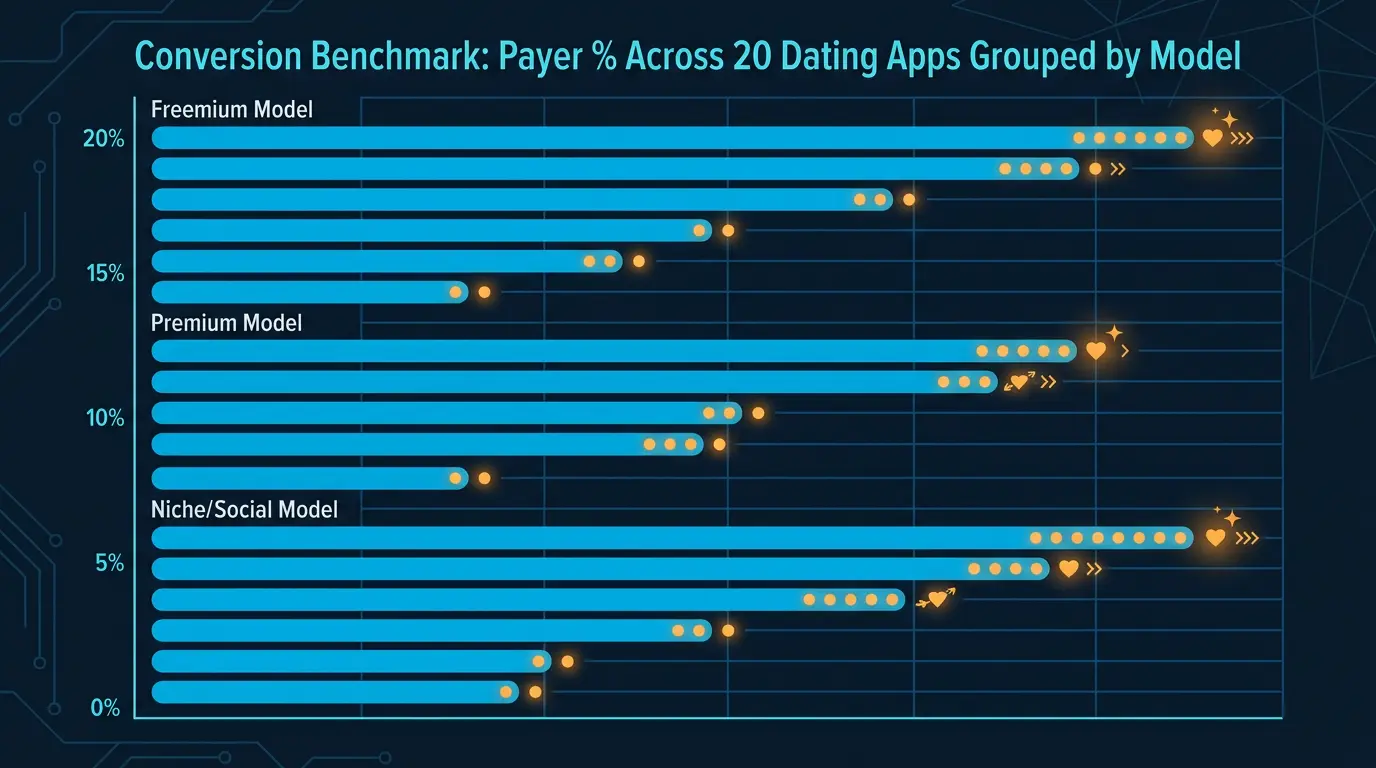
- Conversion from free trial to paid is 10-25%
- Churn (cancellation) is typically 5-15% monthly
- (average revenue per user) is consistent
Advantages:
- Predictable MRR (monthly recurring revenue)
- Simple for users to understand
- Easy to communicate value
- Good unit economics at small scale
- No need for complex systems (no credits to manage, no per-action billing)
Disadvantages:
- Lower total user base (higher paywall friction)
- 1-5% of users typically convert at small scale
- Can't capture impulse spending
- Users shop around to compare prices
- Requires ongoing retention focus (high churn sensitivity)
Best for: Niche platforms, serious dating markets, platforms targeting specific demographics. If your differentiation is quality over quantity, subscription works perfectly. Learn more about dating site subscription pricing strategy to optimise your pricing.
Revenue example: 50,000 active users, 5% conversion to 29.99 subscription, 10% monthly churn:
- 2,500 paying users
- 2,250 active by month 2 (after churn)
- Revenue: 74,975 dollars monthly (declining over time as churn compounds)
The Freemium Model
Freemium lets everyone use basic features free, with premium paid features optional. Think Tinder.
How it works:
- Core features (browsing, matching, basic messages) free
- Premium features (unlimited messages, advanced filters, no ads) paid
- Most users never convert to paid
- Revenue comes from small percentage of engaged users
- Requires massive scale to be profitable
Advantages:
- Large user base (low friction to join)
- Viral potential (free access spreads word of mouth)
- Multiple monetisation channels (ads, premium, affiliate)
- High engagement potential (if execution is good)
- Easier to reach global scale quickly
Disadvantages:
- Needs 500K+ users minimum to generate meaningful revenue
- Most users never convert (1-3% typical)
- Scaling costs (servers, support, operations) grow with user base
- Ads degrade user experience
- Requires product sophistication to balance free/paid
Best for: Large platforms aiming for massive scale, platforms with network effects that benefit from size, platforms with multiple revenue streams to diversify. To understand whether freemium fits your strategy, review our full breakdown of how dating sites make money.
Revenue example: 1,000,000 active users, 2% conversion to premium at 19.99, 8% see ads at 5 dollars ARPU:
- Premium revenue: 200,000 users at 19.99 = 3,998,000 dollars monthly
- Ad revenue: 800,000 free users at 5 dollars = 4,000,000 dollars monthly
- Total: 7,998,000 dollars monthly
But this took 18-24 months to reach and required venture capital. Freemium needs scale before profitability.
The Credits Model
Credits are in-app currency purchased with real money, spent on features and boosts.
How it works:
- Users buy credit bundles (100 credits for 9.99, 500 for 39.99, etc.)
- Credits spent on features like boosts, super likes, unlocking messages
- Pricing psychology makes spending feel abstract
- Gamification drives usage and repeat purchases
- "Free credits daily" creates habit loops
Advantages:
- Psychological distance from real money (less price-sensitive)
- Captures impulse spending
- Gamification increases spending per user
- Works well for highly engaged users
- Can combine with subscription for hybrid revenue
Disadvantages:
- Requires strong engagement to convert
- More complex systems and operations
- User experience can feel nickel-and-diming
- Churn is still high if engagement drops
- Less predictable revenue than subscription
Best for: Engagement-heavy platforms (apps with 20+ minute daily sessions), platforms with strong viral/network effects, markets where impulse spending is culturally normal.
Revenue example: 100,000 active users, 15% purchase credits monthly, average 25 dollars per purchase:
- 15,000 users purchasing = 375,000 dollars monthly
- This grows as engagement improves (better retention, more purchases per user)
Direct Financial Comparison
Let's compare the three models at the same scale with realistic assumptions:
!Key concept for article 03 *Visual breakdown of freemium vs subscription vs credits: which dating model makes more?*
50,000 Active Users Scenario
| Model | Key Metrics | Monthly Revenue | Notes |
|---|---|---|---|
| Subscription | 5% paid @ 29.99, 10% churn | 74,975 | Declining over time due to churn |
| Freemium | 1% premium, 15% ad audience | 14,950 | Growth potential, multiple streams |
|---|---|---|---|
| Credits | 10% purchase @ 25 | 125,000 | Requires strong engagement |
| Hybrid (Sub+Credits) | 5% sub @ 29.99, 5% credits @ 15 | 112,475 | Best overall for this scale |
Winner at 50K scale: Hybrid model (Subscription + Credits)
500,000 Active Users Scenario
| Model | Key Metrics | Monthly Revenue | Notes |
|---|---|---|---|
| Subscription | 5% paid @ 29.99, 10% churn | 749,750 | Stable, predictable |
| Freemium | 2% premium, 25% ad audience | 2,997,500 | Ad revenue becomes significant |
| Credits | 12% purchase @ 30 | 1,800,000 | Engagement pays off at scale |
| Hybrid (Free+Premium+Credits) | 1.5% premium @ 24.99, 10% credits @ 20 | 1,499,500 | Balanced approach |
Winner at 500K scale: Freemium + Premium Features
5,000,000 Active Users Scenario
| Model | Key Metrics | Monthly Revenue | Notes |
|---|---|---|---|
| Subscription | 5% paid @ 29.99, 10% churn | 7,497,500 | Maximum with this model |
| Freemium | 2.5% premium, 40% ad audience | 29,987,500 | Ads dominate at massive scale |
| Credits | 15% purchase @ 35 | 26,250,000 | Best engagement monetisation |
| Hybrid | 1.5% premium, 8% credits, ads | 37,500,000+ | Tinder approach |
Winner at 5M scale: Freemium + Premium + Credits + Ads
Revenue Projections at Scale
Here's how revenue grows differently by model:
| User Base | Subscription ARPU | Freemium ARPU | Credits ARPU | Hybrid ARPU |
|---|---|---|---|---|
| 10K | 0.75 | 0.10 | 0.50 | 1.25 |
| 50K | 1.50 | 0.30 | 2.50 | 2.25 |
| 100K | 1.50 | 0.60 | 3.00 | 2.50 |
| 500K | 1.50 | 3.00 | 3.60 | 3.50 |
| 1M | 1.50 | 6.00 | 4.50 | 6.50 |
| 5M | 1.50 | 12.00 | 5.25 | 10.50 |
Key insight: ARPU (average revenue per user) from subscription stays flat, while freemium and credits ARPU grow with scale because larger user bases support more advertising, stronger engagement, and more network effects. Hybrid models combine benefits.
Hybrid Models
Most successful platforms use hybrid models combining 2-3 approaches.
Hybrid 1: Subscription + Premium Features (Best for 10K-500K users)
- Base subscription gets you unlimited messaging and basic features
- Premium features (boosts, super likes, verified badge) sold à la carte
- Increases ARPU 30-50%
- Example: Match, eHarmony
Hybrid 2: Freemium + Premium + Credits (Best for 500K+ users)
- Free tier captures users and builds engagement
- Premium subscription for no ads and advanced filters
- Credits for impulse features (boosts, super likes)
- Ads on free tier
- Example: Tinder, Bumble (in some markets)
Hybrid 3: Freemium + Credits Only (Best for casual, engagement-heavy platforms)
- Free core experience
- Credits for any enhanced features
- No subscription tier
- Example: Plenty of Fish historically
Hybrid 4: Subscription + Credits with Soft Freemium (Less common but effective)
- Free trial or limited free access
- Subscription for unlimited access
- Credits for premium features (boosts, messaging unlocks)
- No ads (privacy angle)
- Example: Some niche platforms targeting professionals
Revenue impact of hybrids: Hybrid models consistently generate 30-50% more revenue than single models at the same user scale. The combination captures different customer types:
- Price-conscious users: Free or base subscription
- High-engagement users: Credits/impulse spending
- Feature-focused users: Premium tier
- Brand-conscious users: Ad-free premium
User Experience Impact
Subscription-only experience:
- Clean, simple interface
- No ads, no paywalls between features
- Users feel like paying customers
- Churn risk if features don't match expectations
- Better for upscale markets
!User Experience Impact data breakdown for Freemium vs Subscription vs Credits *Detailed breakdown of the data presented above*
Freemium experience:
- Ads present for non-paying users
- Some features locked behind paywall
- Feels free but with friction points
- Better for casual, high-volume markets
- Requires constant A/B testing to optimise paywall placement
Credits-only experience:
- Temptation throughout the app
- Psychological friction reduced (currency rather than money)
- Habit-forming loops (daily free credits)
- Can feel "nickel-and-diming" if not designed carefully
- Best for highly engaged, returning users
Hybrid experience:
- Clear tiers and options
- Multiple paths to monetisation
- Requires excellent UX to avoid confusion
- Different users experience different funnels
- Demands more sophisticated product management
Implementation Complexity
Subscription: 3-4 weeks to implement
- Payment processing (Stripe integration)
- Recurring billing and churn handling
- Simple feature gating
- Trial management
- Basic analytics
Freemium: 2-3 months to implement
- Advertising network integration (optional)
- Complex feature gating and paywalls
- Multiple user tiers with different experiences
- A/B testing framework
- Attribution analytics
Credits: 4-6 weeks to implement
- Credit purchase flows and payment processing
- Credit spending systems
- In-app currency mechanics
- Daily bonus/earn systems
- Analytics tracking spending patterns
Hybrid (Subscription + Premium Features): 6-8 weeks
- Combine subscription + credits systems
- Feature gating logic for multiple tiers
- Upsell flows from subscription to premium features
- Churn prevention with feature bundles
- Complex pricing and promotion logic
Implementation complexity ranking:
- Subscription (simplest)
- Credits
- Freemium
- Hybrid models (most complex)
Switching Costs
Changing revenue models after launch is expensive and risky.
Subscription to Freemium: Hard (30-50% user churn likely)
- Existing paid users feel betrayed if you introduce free tier
- New free users won't convert as readily once they've used it free
- Revenue typically drops 20-40% initially
- Takes 12-18 months to recover
Subscription to Credits: Hard
- Subscription users are accustomed to "pay once per month"
- Switching to à la carte spending feels unpredictable
- Churn spikes unless transitioned carefully
- Example: OkCupid tried this and revenue dropped significantly
Freemium to Subscription: Extremely hard
- Free users don't want to start paying
- Existing paying users become resentful of paywall
- Network effects collapse as free users churn
- Tinder can't switch away from freemium without destroying the platform
Credits to Subscription: Medium difficulty
- Users are already spending, easier to reframe as subscription
- Revenue usually stays flat or slightly decreases
- Retention improves (predictable spending)
- Example: Some casual platforms have done this successfully
Lesson: Choose your model carefully at launch. It's nearly impossible to switch without significant revenue loss.
Key Takeaways
- Subscription generates most revenue per paying user but requires smaller user base for profitability.
- Freemium requires 500K+ users to generate meaningful revenue but offers growth upside.
- Credits capture impulse spending and work best for engagement-heavy platforms.
- Hybrid models (subscription + premium features, or freemium + credits) outperform single models by 30-50%.
- Model choice depends on target market, niche focus, and user scale aspirations.
- Changing models after launch is expensive and risky - choose carefully upfront.
- Subscription stays flat at 1.50 ARPU, while freemium and credits ARPU grow as you scale.
- For platforms under 500K users, subscription + premium features wins.
- For platforms 500K-5M, freemium + credits beats pure subscription.
- For platforms over 5M, massive freemium + all monetisation streams dominates.
DatingPartners supports freemium, paid and hybrid out of the box. Choose your model.
Visit DatingPartners.com →