
Cookie compliance is often treated as a banner you click past. For a dating site it is more serious than that, because the data involved is unusually sensitive. This guide explains the rules, the dating-specific sensitivity, and the part of it an operator owns directly.
What this guide covers
This guide covers how a dating business should handle cookies and tracking technologies in a way that complies with the law, and it is worth marking out the territory at the start because it spans two areas.
The first area is the dating service itself: the branded dating site or app that members log into and use. Cookies and tracking on the service are largely a platform matter, handled by the provider as part of running the platform.
The second area is the operator's own marketing footprint: the landing pages, the marketing site, the pages that advertising drives traffic to, and the advertising and analytics trackers the operator places on them. This is the operator's own territory, and the cookie compliance there is the operator's responsibility.
This guide treats both, because an operator needs to understand the rules in general to judge the provider's handling of the service, and needs to understand them specifically because the operator's own marketing pages are theirs to get right.
The guide is about ePrivacy and cookie rules in particular, the rules about storing information on and tracking devices. It connects closely to the broader data-protection picture, GDPR, the privacy policy, but cookies have their own specific layer of rules, and that layer is the focus here.
For an operator, the headline to carry into the rest of the guide is that cookie compliance is partly the provider's and partly the operator's, and the operator must know enough to handle their part and check the provider's.
What cookies and tracking are
Before the rules, a plain explanation of what is actually being regulated.
A cookie is a small piece of information that a website stores on a visitor's device, usually their browser, so that it can be read back later. Cookies do useful and necessary things: they let a site remember that a member is logged in, remember settings, keep a session working. They also do tracking things: they let a site, or third parties, recognise a device across visits and across sites, build a picture of behaviour, and target advertising.
Cookies are the best-known mechanism, but they are not the only one. The rules cover a wider family of tracking technologies: pixels and tags placed by advertising and analytics services, device identifiers, and other techniques for storing information on or recognising a device. When this guide says "cookies and tracking," it means this whole family.
The crucial distinction, which the rules turn on, is between technologies that are strictly necessary for the service the visitor asked for, and technologies that are not. A cookie that keeps a logged-in member logged in is strictly necessary; the service simply cannot work without it. A tracking pixel that follows a visitor around the web to target advertising is not necessary for the visitor to use the site; it serves the operator's marketing.
That distinction, necessary versus non-necessary, is the hinge of cookie compliance, as the next sections explain. For an operator, understanding that not all cookies are equal under the rules is the foundation of everything that follows.
The ePrivacy rules
The specific rules governing cookies and tracking come from a layer of law often referred to, in Europe and the UK, as the ePrivacy rules, and they work alongside the broader data-protection law.
The core principle of the ePrivacy rules, as applied to cookies, is straightforward: a website may not store information on, or gain access to information already on, a visitor's device unless either that storage or access is strictly necessary to provide the service the visitor has asked for, or the visitor has given their consent.
In plain terms: essential cookies, the strictly necessary ones, may be used without consent, because the service cannot function without them. Non-essential cookies and trackers, analytics, advertising, and the rest, may not be used until the visitor has genuinely consented.
This sits alongside data-protection law. Where cookies and trackers process personal data, and many do, GDPR also applies, governing that processing. The ePrivacy rules govern the act of storing and accessing information on the device; data-protection law governs what is then done with any personal data. A dating operator has to satisfy both.
The detail of the ePrivacy regime has been evolving, and the exact rules vary by jurisdiction, with comparable but not identical rules in different markets. The stable core, though, is the consent requirement for non-essential cookies, and that core is what an operator should build their practice around.
For an operator, the practical message is that non-essential cookies and trackers, including the advertising and analytics tools an operator most wants to use, require genuine consent before they run, and "genuine" is doing real work in that sentence, as the next sections explain.
Consent and the cookie banner
The mechanism most people associate with cookie compliance is the cookie banner, and it is worth being clear about what a banner must actually do, because most banners do it badly.
The cookie banner is the interface through which a site seeks consent for non-essential cookies. For that consent to be valid, it has to meet the standard that data-protection law sets for consent generally, and that standard is demanding.
Consent must be freely given. The visitor must have a real choice. A banner that only offers "accept," with no genuine way to decline, is not offering a free choice and does not obtain valid consent.
Consent must be informed. The visitor must be told, in clear terms, what cookies and trackers are in question and what they do, before they consent. Burying that in dense text nobody reads does not inform.
Consent must be specific and granular. The visitor should be able to consent to some purposes and not others, rather than being forced into an all-or-nothing choice.
Consent must be unambiguous and active. It requires a clear affirmative action. Pre-ticked boxes, or treating continued use of the site as consent, do not count. Silence is not consent.
And consent must be as easy to withdraw as to give. A visitor who consented must be able to change their mind easily later.
A great many cookie banners fail this standard, with prominent "accept" buttons and hidden or awkward "reject" paths. Regulators have made clear that this kind of design, often called a deceptive or manipulative pattern, does not produce valid consent. For an operator, a compliant banner is one that genuinely offers accept and reject with equal ease, informs honestly, and respects the visitor's choice.
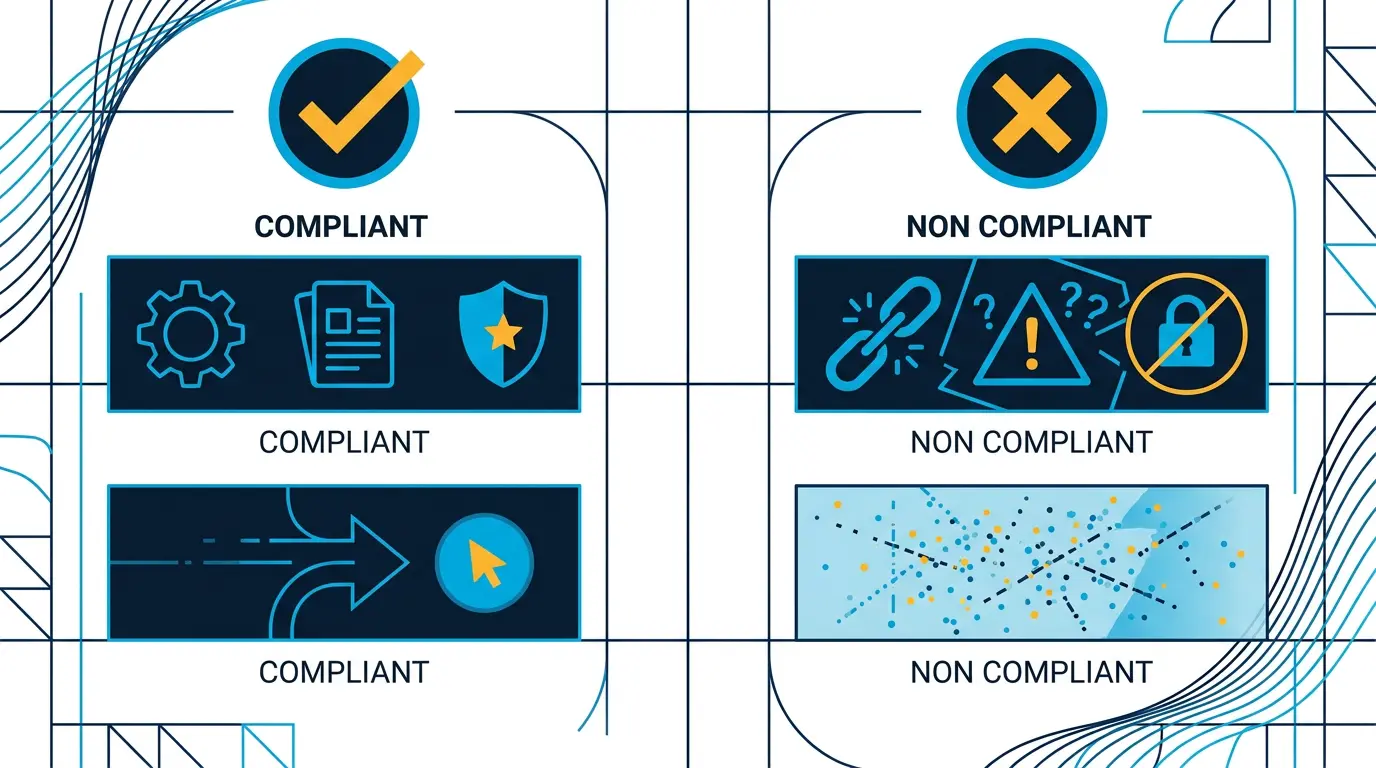
Types of cookies and tracking on a dating site
It helps an operator to have a picture of the kinds of cookies and trackers a dating business actually involves, because the compliance treatment differs by type.
There are strictly necessary cookies: the ones that make the service work, keeping a member logged in, maintaining the session, remembering essential settings, supporting security. These are exempt from the consent requirement, because the service the visitor asked for cannot run without them.
There are functional or preference cookies: ones that remember non-essential choices to improve the experience. Depending on how essential they really are, these often fall on the consent-required side.
There are analytics cookies and trackers: ones that measure how visitors use the site. These are valuable to an operator, but they are generally not strictly necessary, so they generally require consent.
There are advertising and marketing trackers: pixels and tags from advertising platforms that enable conversion tracking, retargeting and audience building. These are the most clearly non-essential, the most privacy-intrusive, and they unambiguously require consent.
And there are third-party trackers generally: anything placed by an outside service that recognises or tracks the visitor.
A dating business will involve cookies and trackers from across this range. The dating service itself needs its necessary cookies and may use analytics. The operator's marketing pages will typically carry analytics and, importantly, advertising trackers. Knowing which type is which is what tells an operator which need consent and which do not.
The sensitivity problem in dating
There is a dimension of cookie compliance that is sharper for dating than for most other categories, and an operator must understand it: the sensitivity of the data involved.
Consider what a tracker reveals when it fires on a dating site or a dating landing page. It reveals that a particular device, and behind it a particular person, is visiting a dating service. That fact alone is sensitive. It can imply that the person is single, or looking, and depending on the niche it can imply far more: a tracker on a faith-based dating site, an LGBTQ+ dating site, or a dating service for any specific community can, by the simple fact of firing, reveal information about that person that touches on protected and highly sensitive characteristics.
This is not a hypothetical concern. Data-protection law treats certain categories of data as special and warranting heightened protection precisely because their exposure can cause real harm, and information about a person's sex life, sexual orientation, religious beliefs and similar attributes is in that special category. A tracking pixel that effectively communicates "this person uses a dating service for this community" to a third-party advertising platform is handling data of exactly that sensitive kind.
The practical consequence is that an operator must be especially careful with advertising and analytics trackers on dating pages. The casual approach of dropping every available marketing tracker onto a landing page, acceptable to some operators in low-sensitivity categories, is genuinely risky in dating. The consent has to be real, the trackers chosen with care, and the sensitivity of what is being revealed kept front of mind.
For an operator, the lesson is that dating is not an ordinary category for cookie purposes. The data is sensitive, and the compliance, and the care, must reflect that.
Doing consent properly
Pulling the rules together, here is what doing cookie consent properly looks like in practice for a dating business.
It means no non-essential cookies or trackers fire before consent. The advertising pixels, the analytics, the third-party trackers must wait until the visitor has genuinely consented. A site that loads all its trackers on arrival and then shows a banner has already broken the rule.
It means a genuine banner: clear information about what the cookies and trackers do, an honest choice with accept and reject equally easy, granular options where appropriate, and no deceptive design.
It means respecting the choice: if a visitor rejects non-essential cookies, those cookies and trackers genuinely do not run, not just visually but actually.
It means easy withdrawal: a visitor can change their cookie choices later without hunting.
It means a cookie policy or notice that accurately lists and explains the cookies and trackers in use, kept current as trackers change.
It means consistency with the privacy policy, which should also reflect the tracking the business does.
And, for dating specifically, it means extra restraint: choosing trackers carefully given the sensitivity, and not treating the visitor's data casually.
This is more disciplined than the click-through-banner approach many sites take, but it is what the rules actually require, and for dating, where the data is sensitive and the regulatory attention is real, the disciplined approach is also the safe one. For an operator, doing consent properly is a matter of setting up the marketing pages correctly once and then maintaining that discipline.
Advertising trackers and the operator
The advertising trackers deserve particular attention, because they are where an operator's marketing ambitions meet cookie compliance most directly, and where operators most often go wrong.
When an operator advertises their dating site, they naturally want to measure and optimise: to know which ads led to signups, to retarget visitors who did not convert, to build audiences. The advertising platforms provide trackers, pixels and tags, that enable all of this, and an operator placing those trackers on their landing pages is doing something completely normal in digital marketing.
But those advertising trackers are non-essential, they are privacy-intrusive, and on a dating page they handle sensitive data. So they sit at the strictest end of the cookie rules. They require genuine consent before they fire. They cannot be quietly loaded on arrival. And given the sensitivity, an operator should think carefully about which trackers they place and what those trackers reveal.
There is a real tension here, and an operator should face it honestly. Cookie compliance, done properly, means some visitors will reject the advertising trackers, and the operator's measurement and retargeting will be less complete than if every tracker fired on everyone. That is the intended effect of the law. The answer is not to evade the rules with deceptive banners or trackers that fire before consent, which is both unlawful and, given the sensitivity of dating data, genuinely risky. The answer is to work within the rules: a clean consent setup, careful tracker choice, and acceptance that measurement operates on consented data.
For an operator, the advertising trackers are the part of cookie compliance that is most clearly theirs to own, on their own marketing pages, and the part most worth getting right deliberately rather than by reflex.

What the operator owns and what white label handles
As with advertising compliance, cookie compliance splits between the provider and the operator, and an operator should be clear about the line.
On the dating service itself, the branded site or app the member logs into, the white label provider handles the cookies and tracking as part of running the platform. The provider is responsible for the service's necessary cookies, for whatever consent mechanism the service uses, and for the service's compliance. The operator should confirm the provider handles this properly, and that the cookie and privacy information on the branded service is accurate, but the operator does not engineer it.
On the operator's own marketing footprint, the landing pages, the marketing site, the pages advertising drives to, and the analytics and advertising trackers on them, the compliance is the operator's. If the operator builds landing pages, runs their own marketing site, or places advertising and analytics trackers, the operator owns the cookie consent there, the banner, the honouring of choices, the cookie notice.
This split mirrors the advertising-compliance split: the provider handles the platform, the operator handles their own marketing. And the practical guidance is the same. The operator should: confirm the provider handles cookies properly on the service; and take direct, deliberate care of cookie compliance on their own marketing pages, with a genuine consent banner, careful tracker choice given the dating sensitivity, honoured choices, and an accurate cookie notice.
For an operator, the bottom line is that cookie compliance is not entirely something to delegate. The marketing-side cookies are the operator's, they handle sensitive data, and they deserve the operator's deliberate attention.
Common mistakes
The defining mistake is assuming cookie compliance is entirely the provider's job, when the operator's own marketing pages, landing pages and advertising trackers are the operator's direct responsibility.
The second is the deceptive banner: a prominent accept button with a hidden or awkward reject path, which regulators have made clear does not produce valid consent.
The third is firing non-essential trackers on arrival, before consent, so the rule is broken before the banner even appears.
The fourth, and most dating-specific, is treating dating pages as an ordinary category and dropping advertising trackers on casually, when the fact of visiting a dating service, especially a niche one, is sensitive data warranting real care. The fifth is letting the cookie notice fall out of date so it no longer matches the trackers actually in use. Set up genuine consent once, choose trackers carefully, and maintain it.
What to read next
For the broader data-protection picture, read GDPR for dating sites and dating terms of service and privacy policy essentials. For the advertising side, see dating advertising compliance. And to confirm how a platform handles cookies on the service, DatingPartners.com can walk through it.
DatingPartners ships CMP ready with TCF 2.2 and Consent Mode v2. Flip the switch.
Visit DatingPartners.com →