
When an operator chooses a provider, they are taking a great deal on trust. Auditing and certification are how some of that trust can be replaced with evidence. This guide explains what audits and certifications are, which matter for dating, and how an operator should use them.
What auditing and certification mean
The two words are often used loosely, so it is worth defining them precisely, because the distinction matters.
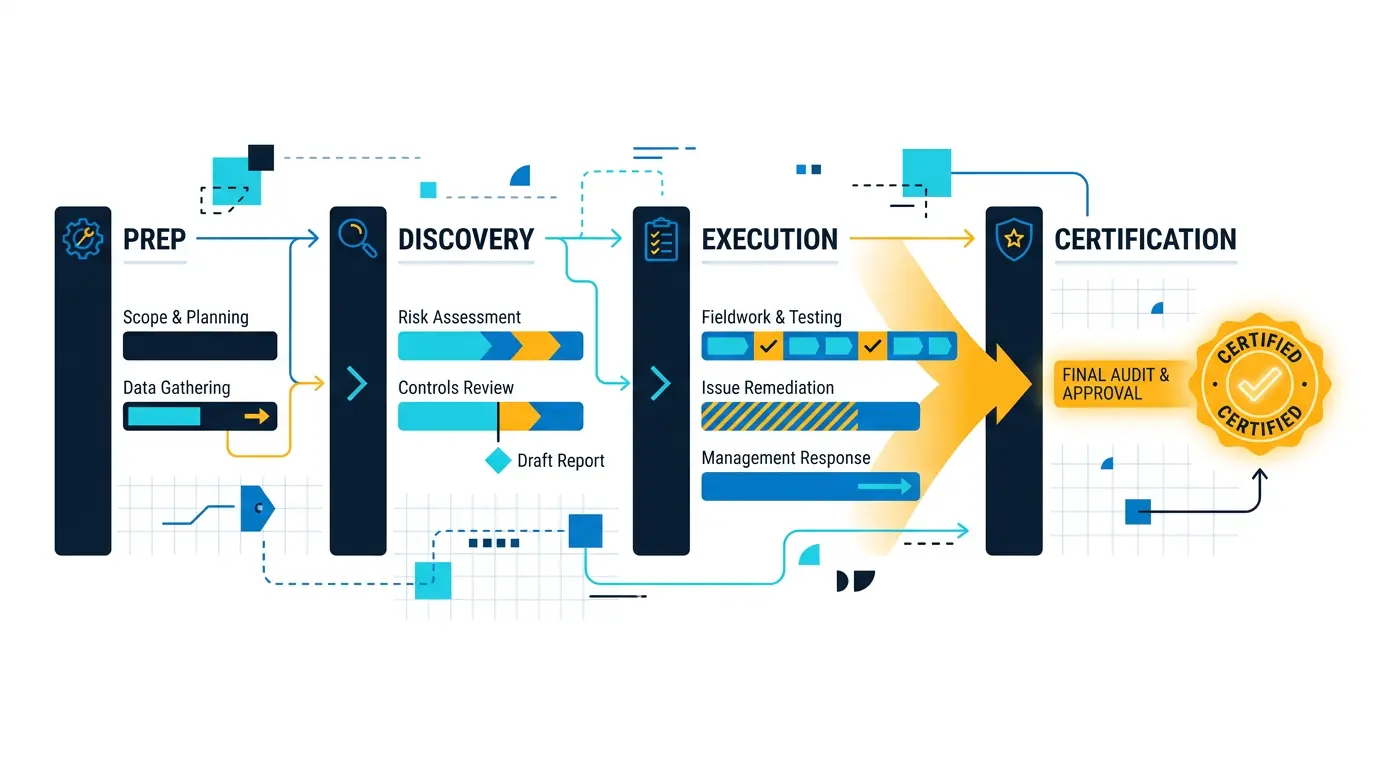
An audit is an examination. An independent, qualified outside party examines a platform, or an organisation, against a defined standard, and assesses whether it genuinely meets that standard. The auditor looks at evidence, tests controls, and reaches a judgement. The point of an audit is that it is independent: it is not the platform marking its own homework, but an outside expert checking.
A certification is the formal outcome. When an audit against a recognised standard is passed, the platform may be granted a certification, a formal, documented confirmation that, as assessed, it meets that standard. The certification is the thing the platform can then point to as evidence.
There is a spectrum here. At one end is the platform simply asserting something: "we take security seriously." That is a claim with nothing behind it. In the middle is internal review: the platform checks itself, which is better than nothing but is still self-assessment. At the strong end is independent audit and certification: an outside expert has examined the platform against a recognised standard and confirmed it measures up.
The value of audit and certification is that they convert assertion into evidence. Anyone can claim to be secure or compliant. A certification means someone qualified, with no incentive to flatter, looked and agreed.
For an operator, understanding this spectrum is the foundation. When assessing a provider, the question is not just "do they say they are secure and compliant" but "is there independent verification behind the claim." Audit and certification are how that verification is provided.
Why they matter for dating
Auditing and certification matter for any serious platform, but for dating the case is particularly strong, and an operator should understand why.
The first reason is the sensitivity of the data. As the data-retention, schema and bug-bounty guidance all stress, a dating platform holds an extraordinary concentration of sensitive personal information. A platform handling data that sensitive should be held to a high standard of security and data protection, and independent verification that it actually meets that standard is correspondingly valuable.
The second reason is the trust dynamic. Members hand a dating platform their photographs, their identities, their intimate communications, and increasingly their physical safety. They are trusting heavily. Independent certification is a way that trust can be grounded in something more solid than the platform's own marketing.
The third reason is the white label structure. An operator running a white label dating site is, in effect, trusting the provider's platform with the operator's members and the operator's brand. The operator cannot inspect the provider's code, infrastructure or internal processes directly. Audits and certifications are one of the few ways an operator can get independent assurance about a platform they cannot examine themselves. They are a tool built precisely for the situation an operator is in.
The fourth reason is regulation. As online safety and data-protection regulation matures, independent verification, auditing, certification, conformance assessment, is becoming a more prominent part of the compliance landscape, including in specific areas such as age assurance.
For an operator, the combined message is that audit and certification are not a bureaucratic detail. They are one of the main instruments through which an operator can replace blind trust in a provider with grounded confidence. That makes them worth understanding properly.
Information security auditing and certification
The first area where auditing and certification matter for a dating platform is information security, and it is probably the most important.
Information security is about how well a platform protects its systems and data from unauthorised access, breach and loss. Given what a dating platform holds, this is fundamental. The bug-bounty guidance covers the testing side of security; auditing and certification cover whether the platform's overall security management meets a recognised standard.
There are established, internationally recognised information security standards against which an organisation can be audited and certified. The best known is the family of standards covering information security management, where an organisation's information security management system is audited by an accredited body and, if it measures up, certified. There are also assurance frameworks, common particularly for service providers, where an independent auditor examines and reports on the controls a service organisation has in place around security and related areas.
The detail of which standard or framework is which is less important for an operator than the underlying point: there exist recognised, independent ways to verify that a platform's information security is managed to a real standard, and a security-serious provider will have pursued one or more of them.
For an operator, information security certification is one of the first things to ask a provider about. A provider that holds a recognised information security certification has had its security management independently examined and confirmed. A provider that holds none, and offers only its own assurances, is asking the operator to trust sensitive member data to a security posture that no independent party has verified. That is a meaningful difference, and an operator should weigh it.
Data protection auditing
The second area is data protection, and it overlaps with security but is distinct.
Where information security is about protecting data from breach, data protection is about handling personal data lawfully and properly: the principles, the lawful bases, the rights, the retention, the transparency that the GDPR and related guidance describe. A platform can be reasonably secure and still handle personal data in ways that are not compliant, so data protection deserves its own attention.
Data protection auditing is the examination of how an organisation handles personal data against the requirements of data-protection law and good practice. It looks at whether the data-protection principles are genuinely applied, whether there is a lawful basis for processing, whether retention is sound, whether data-subject rights can be honoured, whether the documentation, the privacy policy, the data processing agreements, the records, is in order.
Some of this is internal: a well-run organisation audits its own data-protection practice regularly. Some can be external: independent assessment, and in some contexts certification schemes, exist for data-protection practice. And there is the role of the data-protection function itself, the people responsible inside the organisation for data-protection compliance, whose work includes this kind of review.
For a dating platform, given the sensitivity of the data, data-protection auditing is genuinely important. For an operator, the relevant question to a provider is not only "are you secure" but "how is your data-protection compliance assured, internally and independently." A provider that can describe a real data-protection auditing practice, and ideally point to independent assessment, is showing maturity. This connects directly to the data processing agreement the operator signs: the operator's own data-protection position rests partly on the provider's, and auditing is how the provider's can be verified.
Trust, safety and age assurance auditing
A third area, newer and growing in importance, is the auditing of trust and safety practices and, in particular, age assurance.
As online safety regulation has matured, the idea that platforms should not only have safety systems but should be able to demonstrate, to an independent standard, that those systems work has gained ground. The trust-and-safety tooling and transparency-reporting guidance describe the systems and the reporting; auditing is the further step of independent verification that the safety practice meets a standard.
Age assurance is the clearest current example. Keeping minors off an adult dating service is a legal obligation, and regulators increasingly expect age assurance methods to be not just present but effective, and effectiveness is something that can be independently assessed. There are emerging standards and certification approaches specifically for age assurance and age verification, where an independent body assesses whether a method genuinely does what it claims. A dating platform using an age assurance approach that has been independently assessed is on stronger ground than one relying on an unverified method.
More broadly, independent assessment, auditing and conformance checking are becoming a more prominent part of how trust and safety is held to account, alongside transparency reporting and regulatory oversight.
For an operator, the practical point is that trust-and-safety and age-assurance auditing is an area to watch and to ask about. A provider that engages with independent assessment of its safety practices, and particularly with recognised age assurance assessment, is a provider treating these obligations with the seriousness regulators increasingly expect. As this area matures, an operator should expect it to become a more standard part of assessing a platform.
Payment and other relevant standards
Beyond security, data protection and safety, a dating platform touches other standards an operator should be aware of, with payments the most prominent.
Any platform handling card payments is subject to , the card industry's data security standard, which is itself a standard with its own compliance and assessment regime. The payment-systems guidance covers this. For a white label operator where the provider is the merchant of record and handles payments, PCI DSS compliance sits with the provider's payment stack, but it is a fair thing to confirm: a platform processing payments should be PCI DSS compliant, and that compliance is assessed, not merely claimed.
Depending on the platform and the services it uses, other standards and assessments may be relevant: standards relating to particular technologies, to accessibility, to specific aspects of how the service operates. An operator does not need to become an expert in every standard. The useful instinct is simply to recognise that, across security, data protection, safety, payments and more, there exist independent standards and assessments, and that a mature provider will have engaged with the ones relevant to running a dating platform.
For an operator, the point is breadth of awareness rather than depth. The question to hold in mind when assessing a provider is "across the areas that matter for a dating platform, what independent standards and assessments has this provider engaged with," and to treat a provider with a genuine portfolio of relevant certifications and assessments as more credible than one with none.
What a certification actually tells you
It is important for an operator to understand both the value and the limits of a certification, because a certification can be over-read as well as under-read.
What a certification does tell you is real. It tells you that an independent, qualified party examined the platform or organisation against a defined standard and judged that it met that standard, as assessed, at the time of assessment. That is genuine evidence, far stronger than an unverified claim, and it indicates an organisation that takes the relevant area seriously enough to subject itself to outside scrutiny.
What a certification does not tell you is everything. A certification is against a particular standard, so it speaks to what that standard covers and not to what it does not. It reflects the position at the time of assessment, which is why certifications are renewed and re-audited periodically; an old certification is weaker evidence than a current one. It is a judgement that a standard was met, not a guarantee that nothing can ever go wrong. And the rigour of certifications varies: a certification from a recognised standard assessed by an accredited body means more than a vague badge from an unrecognised scheme.
So the right way to read a certification is as strong, but bounded, evidence. It substantially raises confidence in the area it covers. It does not replace the operator's own judgement, and it does not cover areas outside its scope.
For an operator, the practical guidance is to value certifications genuinely, to check that they are current, recognised and relevant, and to understand what each one actually covers, rather than treating any badge as a blanket guarantee or, at the other extreme, dismissing certifications as meaningless. They are evidence: read them as evidence.
Using audits and certifications when choosing a provider
The real point of this guide, for an operator, is practical: how to actually use auditing and certification when choosing a white label provider.
The first step is to ask. An operator assessing a provider should directly ask what independent audits and certifications the provider holds, across information security, data protection, payments and, increasingly, trust and safety and age assurance. This is a completely reasonable question, and a good provider will answer it readily and specifically.
The second step is to weigh the answer. A provider with a genuine portfolio of current, recognised certifications relevant to running a dating platform is providing independent evidence of its seriousness. A provider that holds none, and offers only its own assurances, is asking for trust without evidence. That is a real and weighable difference.
The third step is to read the certifications properly: confirm they are current, from recognised standards and accredited bodies, and relevant to what matters for a dating platform, rather than being impressive-sounding but unrelated or out of date.
The fourth step is to use certifications alongside, not instead of, the other things this pillar advises an operator to confirm: the trust and safety tooling and team, the moderation, the verification, the security testing, the compliance framework. Certifications are one important input. They complement the operator's own questioning; they do not replace it.
And the fifth step is to keep it in proportion. An operator is not a compliance auditor and does not need to verify a provider to that depth. The operator's job is to ask the right questions, weigh the answers sensibly, and prefer a provider whose claims are backed by independent evidence over one whose claims are not.
For an operator, that is the whole practical use of this topic: ask, weigh, read properly, combine with other checks, keep proportion. Done that way, auditing and certification become a genuine tool for choosing a provider well.
What white label handles for you
On a white label platform, the audits and certifications belong to the provider, because the provider is the party that builds and runs the platform, and an operator should understand what that means for them.
The provider is the organisation that pursues, undergoes and holds the certifications: the information security certification, the data-protection assurance, the payment compliance, the trust-and-safety and age-assurance assessments. The provider bears the cost and effort of being audited. An operator on white label does not undergo these audits for the platform, because the operator does not run the platform; it would not be meaningful for the operator to be audited on infrastructure and systems they do not control.
This is, like the rest of white label, a genuine benefit. Pursuing and maintaining a portfolio of certifications is expensive, specialist, ongoing work. An independent operator running their own platform would have to do all of it themselves. On white label it is done once, by the provider, and every operator on the platform benefits from running on a platform that has been independently verified.
But the operator carries a branded dating site and the trust of its members, and the operator's own compliance position, particularly through the data processing agreement, rests partly on the provider's. So the operator should engage with the provider's certifications rather than ignoring them.
What the operator should do is exactly the using-them process above: ask the provider what it holds, weigh it, read it properly, combine it with the operator's other checks, and prefer a provider whose seriousness is independently evidenced. The provider holds the certifications; the operator's job is to ask for them and to understand what they mean. An operator who does that is choosing a provider on evidence, which is precisely what auditing and certification exist to make possible.
Common mistakes
The defining mistake an operator can make is never asking a provider what independent audits and certifications it holds, and so choosing a platform for sensitive member data on the strength of the provider's own unverified assurances.
The second is over-reading certifications, treating any badge as a blanket guarantee, when a certification is bounded evidence about a particular standard at a particular time.
The third is under-reading them, dismissing certifications as meaningless bureaucracy, when independent verification is genuinely stronger evidence than an unverified claim.
The fourth is not checking that certifications are current, recognised and relevant, and so being reassured by a badge that is out of date, from an unrecognised scheme, or unrelated to what matters for a dating platform. The fifth is treating certifications as a substitute for the operator's other checks on safety, moderation and compliance, rather than as one important input among them. Ask, weigh, read properly, keep proportion.
What to read next
For the practices certifications verify, read the dating trust and safety tooling stack, GDPR for dating sites and dating bug bounty and vulnerability disclosure. For choosing a provider overall, see how to choose a white label dating provider. And to review a platform's certifications, DatingPartners.com can walk through them.
DatingPartners maintains SOC 2 and ISO 27001. Inherit trust with the platform." --- **End of Pillar 7 — Trust, Safety and Regulation (24 articles)** Pillar 7 is the defensive moat pillar: regulatory deep dives, safety architecture, operational playbooks. CTAs tilt toward DatingPartners (infrastructure), Smooch (UK verified model) and DatingIndustryExpert.com (advisory). Bylines split between Hayley Birkin (operator) and Kim Harris (policy).
Visit DatingPartners.com →