
Open Source Dating Scripts Landscape
There's a vibrant community of open source dating software on GitHub. Most are built on popular PHP frameworks (Laravel) or Node.js (Express). They're positioned as "free" alternatives to paid platforms.
The appeal is obvious: why pay $20-50k for a white-label solution when you can download a free script?
The answer: the free script is only free if your time has no value.
Popular Open Source Options
PHP/Laravel Scripts
Most mature open source dating scripts are Laravel (a PHP framework).
Flirt - Laravel-based, ~5k GitHub stars. Features: profiles, browsing, matching, messaging, payment integration (Stripe).
- Stars: 5k
- Last updated: 2024
- Active contributors: 2-3
- Maturity: moderate
Pros: reasonable feature set, Laravel is stable. Cons: documentation is sparse, payment integration is buggy, no mobile app.
DatingAppScripts - PHP Laravel, ~2k stars. Similar features to Flirt.
- Stars: 2k
- Last updated: 2023
- Active contributors: 1
- Maturity: low
Cons: single developer, months between updates, community support is minimal.
Node.js Scripts
Tinder Clone (various repos) - Node.js/Express, MongoDB. Many forks exist (100-500 stars each).
- Stars: varies (100-500 per fork)
- Last updated: 2023-2024
- Active contributors: 0-2
- Maturity: low
Pros: modern stack, JavaScript everywhere. Cons: immature, incomplete features, no production hardening.
Niche and Inactive Scripts
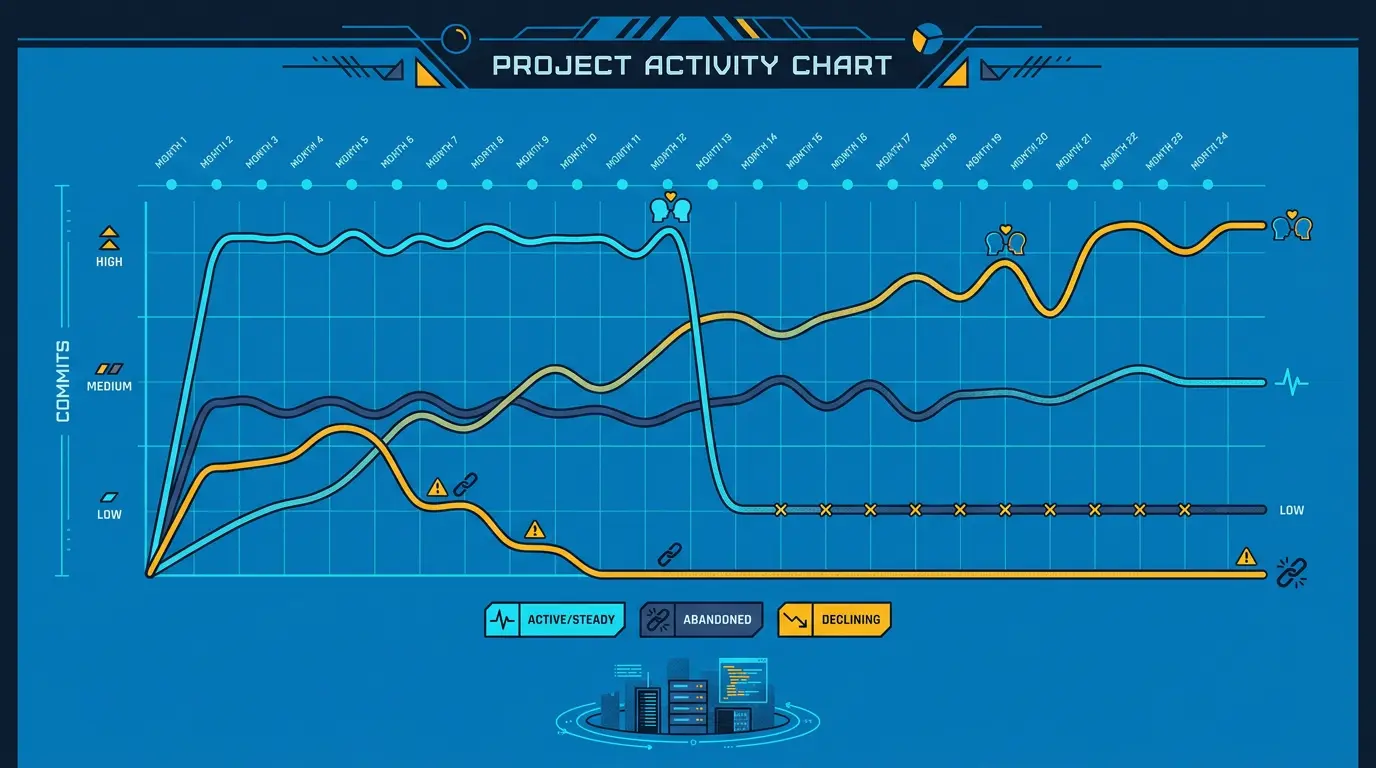
Most "dating platform" scripts on GitHub are abandoned. You'll find repos last updated in 2019 with no responses to issues. This is a red flag.
If you choose an inactive script, you're taking on all maintenance yourself immediately.
Hidden Costs of Open Source
Here's what open source advocates don't tell you:
Cost 1: Deployment and Infrastructure (8-16 weeks, $30-60k)
A GitHub script is source code. It's not a running platform.
You need to:
- Set up servers (AWS, DigitalOcean, Linode): $500-2k monthly
- Deploy code (continuous integration, testing): 4-6 weeks engineering
- Set up databases (PostgreSQL, MySQL): included in server cost
- Configure backups and disaster recovery: 1-2 weeks engineering
- Set up monitoring and alerts: 1 week engineering
- Set up SSL, security headers, firewalls: 1 week engineering
Total: 8-16 weeks, $40-80k in engineering + $500-2k monthly infrastructure.
A white-label platform is pre-deployed and running. You sign up and launch in 2 weeks.
Cost 2: Customization (8-12 weeks, $40-80k)
The open source script is a starting point, not a finished product.
You'll need to customize:
- Theme and branding ($3-5k, 1-2 weeks)
- Payment flow and pricing ($5-10k, 2-3 weeks)
- Email templates ($2-3k, 1 week)
- Moderation tools ($10-20k, 3-4 weeks)
- Admin dashboard features ($5-10k, 2-3 weeks)
- Mobile app (wrap it or build custom): see article 18 for costs
Most of this work isn't documented. You'll read code to understand how to customize.
Cost 3: Security Hardening (4-8 weeks, $20-40k)
Open source dating scripts are targeted by attackers. They're free, so many people deploy them. Attackers scan GitHub for dating platforms and exploit known vulnerabilities.
You need:
- Security audit ($10-15k, 1-2 weeks)
- SQL injection testing ($2-3k)
- Payment PCI compliance ($5-10k, 2-3 weeks)
- Authentication hardening ($3-5k, 1 week)
- Rate limiting and DDoS protection ($2-3k)
Ignore this and your platform gets breached within months. Real story: a popular open source script had an SQL injection vulnerability. 50+ deployments were hacked in 3 months. User data stolen. Platform owners faced lawsuits.
Cost 4: Dependency Management (ongoing, $5-10k annually)
The script depends on libraries (Composer packages, npm modules). These get updated constantly.
PHP libraries: 50-100 dependencies. Each needs updating. Node libraries: 100-300 dependencies. Each needs updating.
You need:
- Monthly dependency updates ($500-1k)
- Testing after updates ($500-1k)
- Handling breaking changes ($1-3k)
Most open source developers forget this. Their script stops working after 12-18 months when dependencies are abandoned or unmaintained.
Cost 5: Bug Fixes and Feature Gaps (8-12 weeks, $40-80k)
The open source script has bugs. Some are minor. Some break core features.
Common issues:
- Messaging system loses messages (database corruption)
- Payment processing fails on subscriptions (billing loop)
- Profile photos don't display on mobile (API issue)
- Search filters are slow with 10k+ profiles (n+1 queries)
- Matching algorithm doesn't work (no algorithm, just random)
You'll need developers to fix these. Time varies: minor bugs (1-3 days), major bugs (1-2 weeks).
Cost 6: PHP Upgrades (2-4 weeks every 3 years, $10-20k)
PHP releases new versions regularly. Old versions are deprecated and lose security support.
When your script runs PHP 7.2 (released 2017, deprecated 2020), you need to upgrade.
Upgrading often breaks the script. You need experienced PHP developers ($120-180k annually) to fix incompatibilities.
Cost 7: Hosting and DevOps (12-24 months, $60-120k)
Running a dating platform requires:
- Server monitoring ($200-500 monthly)
- Database backups ($100-300 monthly)
- CDN for images ($200-500 monthly)
- Email infrastructure ($300-500 monthly)
- Support for infrastructure issues ($500-1k monthly)
Total: $1500-3000 monthly = $18-36k annually.
Over 2-3 years, that's $36-108k.
Security and Compliance Issues
This is the biggest risk with open source.
Security Vulnerabilities - Open source scripts attract attention from attackers. If a vulnerability exists, it affects 100+ deployments simultaneously.
Examples from real dating scripts:
- SQL injection in search: "WHERE age > ?" without parameterization. Attacker extracted all user data.
- Authentication bypass: JWT tokens not validated. Anyone could forge a token and access any account.
- Payment API key exposed: API keys hardcoded in config files that get committed to GitHub.
Fixes take weeks. Most platform owners are unaware of vulnerabilities until they're hacked.
PCI Compliance - If you process payment cards, you need Level 1 certification. This costs $10-20k and requires annual audits.
Open source scripts rarely achieve PCI compliance. Most store credit card data (violating PCI). This is catastrophic legally.
White-label providers handle PCI for you.
GDPR and Privacy - If you have EU users, you need GDPR compliance. This requires:
- Data processing agreements
- Privacy policies aligned with law
- Right to export user data
- Right to delete user data
Open source scripts don't include this. You'll need legal review ($5-10k) and development time ($5-10k) to comply.
Terms of Service and Liability - Open source scripts come with MIT or similar licenses. They explicitly disclaim liability.
If your platform is hacked because of a script vulnerability, you can't sue the author. You're liable to your users.
Maintenance Burden
Once deployed, open source scripts require constant care.
Weekly: Dependency Updates - New versions of libraries release weekly. You need to:
- Review changelog
- Test compatibility
- Deploy update
- Monitor for issues
This is 1-3 hours weekly if you're experienced, 4-8 hours if you're learning.
Monthly: Security Patches - Critical security updates come monthly. You need to apply them immediately.
If you're not monitoring, you might not know about patches for weeks.
Quarterly: Feature Updates and Refactoring - Core framework updates (Laravel 11.1 to 11.2, etc.) require testing.
Most team members ignore this. The script slowly falls behind. After 18 months, it's 3-4 major versions behind, and upgrading is painful.
Annually: Major Version Upgrades - PHP 8.1 to 8.2 to 8.3. Laravel 10 to 11 to 12. These require significant work.
Upgrading PHP and Laravel together takes 4-6 weeks and costs $20-40k in engineering.
Ongoing: Bug Reports and Fixes - Users report bugs. You need to reproduce, fix, test, and deploy.
Minor bugs (1-2 days). Major bugs (1-2 weeks).
Total Maintenance Burden - 40-60 hours monthly for a moderately-used platform. That's 1.5 FTE (full-time equivalent) developer.
At $100k annually, that's $100k annually just for maintenance.
Customization Reality
Many people choose open source expecting to customize it easily. Reality is harder.
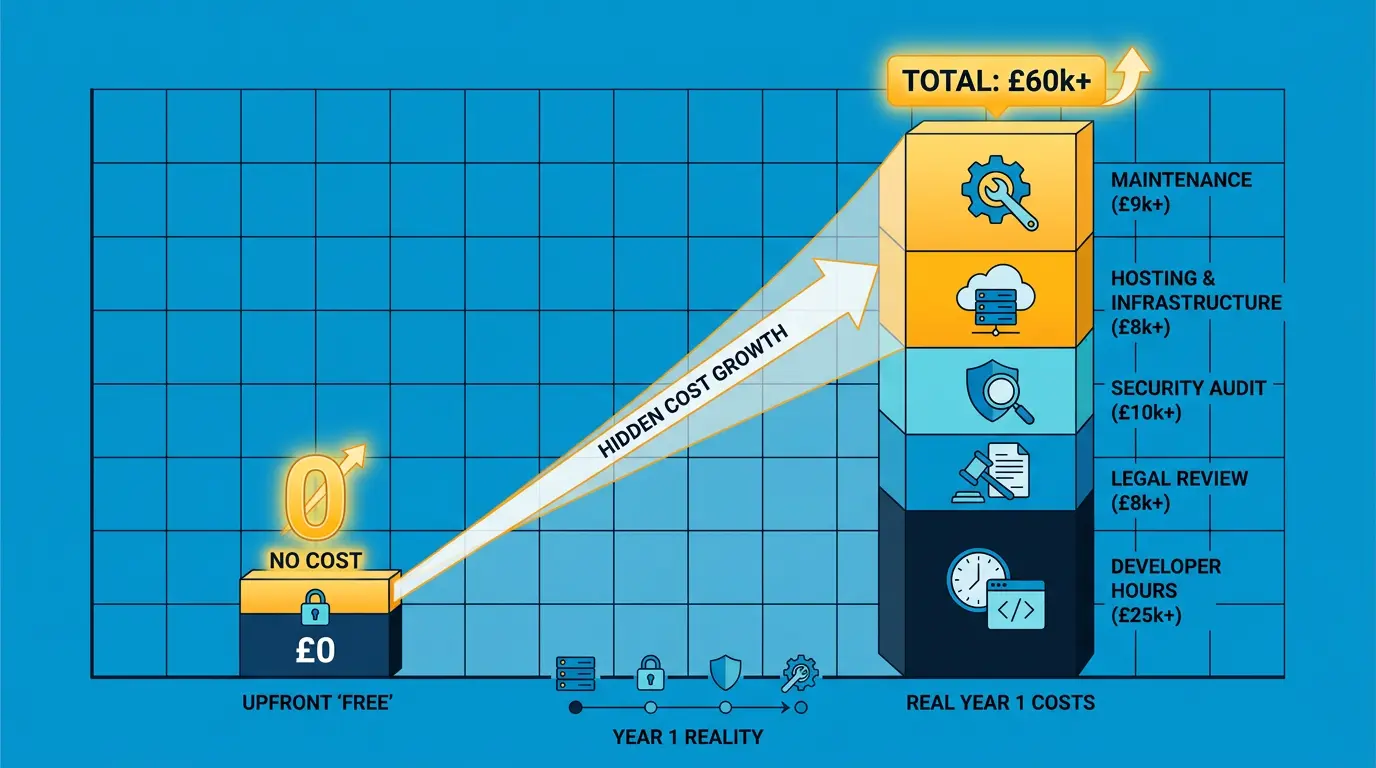
!Open source vs white-label total cost of ownership analysis *Open source vs white-label total cost of ownership analysis*
The Code is Hard to Understand - Open source developers write code for other developers. Documentation is sparse.
If you're not fluent in Laravel or Node.js, understanding the codebase takes 2-4 weeks.
Features Are Tightly Coupled - Removing or changing a feature often breaks others.
Example: you want to remove the "favorites" feature. It's used in notifications, emails, matching suggestions, and profile calculations. Removing it requires changes across 8-10 files. One mistake breaks matching.
Database Schema is Complex - Dating scripts need complex schemas (users, matches, messages, blocks, reports). Changing it risks data corruption.
Adding a feature often requires database migrations. Migrations are risky in production. One mistake and user data is lost.
Testing is Minimal - Most open source scripts have low test coverage. Changing code without automated tests means manual testing 100+ scenarios. Impossible to do thoroughly.
Customization Time Estimates (from experienced developers):
| Change | Effort | Time | Cost |
|---|---|---|---|
| Tweak theme colors | Minimal | 2-4 hours | $200-400 |
| Add custom fields to profile | Low | 1-2 days | $800-1,600 |
| Change matching algorithm | Medium | 2-3 days | $1,600-2,400 |
| Add video calling | High | 3-4 weeks | $12-16k |
| Add moderation tools | High | 4-6 weeks | $16-24k |
| Change payment flow | Very High | 3-4 weeks | $12-16k |
Customization Total - For a functional dating platform, expect $30-50k in customization. This is equal to white-label licensing upfront cost, but you only get it after 8-12 weeks.
When Open Source Makes Sense
Open source dating scripts are right in specific situations:
Scenario 1: You Have a Technical Co-Founder
If your co-founder is an experienced full-stack engineer comfortable with PHP/Node.js, deployment, DevOps, and security, open source might work.
They can:
- Deploy and configure infrastructure ($10-20k, 4-6 weeks)
- Customize features ($20-30k, 8-12 weeks)
- Handle maintenance and security ($50-80k over 2 years)
Total: $80-130k over 2 years. Total time: 6-9 months to launch.
White-label equivalent: $20-50k upfront licensing, $0 maintenance, 2-3 weeks to launch.
Open source is cheaper if you factor only external costs. It's more expensive if you factor your co-founder's opportunity cost.
Scenario 2: Niche Vertical with Unique Requirements
If you're building a dating platform for a very specific niche (farmers, sailors, fitness enthusiasts) with unique matching logic, open source might justify the effort.
You can customize the matching algorithm without dealing with a white-label provider's limitations.
But even here, you're taking on massive risk. Misconfigured matching logic and you lose your entire user base.
Scenario 3: Massive Scale (1M+ Users)
At extreme scale (1M+ active users), custom infrastructure and optimization are justified.
You might fork an open source script and use its architecture as a starting point, but you'll rewrite 80% of the code.
This is not "using open source." This is building custom.
Scenario 4: Personal Learning Project
Building a dating platform from an open source script is an excellent way to learn web development, DevOps, and product design.
Don't expect to launch a competitive product. Expect to spend 6-12 months learning and burning $30-50k.
If that's the goal, it's great. If the goal is launching a revenue-generating platform, it's a waste.
Open Source vs. White-Label Cost Comparison
Here's a realistic 24-month comparison:
Open Source Script
| Item | Cost | Timeline |
|---|---|---|
| Initial deployment and infrastructure | $40-80k | Weeks 1-12 |
| Customization to MVP | $30-50k | Weeks 8-24 |
| Security hardening | $20-40k | Weeks 12-20 |
| First year maintenance (updates, bugs) | $40-60k | Ongoing |
| Second year maintenance | $30-50k | Ongoing |
| Hosting and infrastructure (2 years) | $36-72k | Ongoing |
| Total | $196-352k | 24 months |
| Time to launch | 6-9 months | - |
White-Label Platform
| Item | Cost | Timeline |
|---|---|---|
| Licensing (annual) | $20-50k | Year 1 |
| Customization (light) | $10-20k | Weeks 1-4 |
| Additional customization (optional) | $10-30k | Ongoing |
| Licensing (annual, year 2) | $20-50k | Year 2 |
| Hosting (white-label manages it) | $0 | N/A |
| Support and maintenance | $0 | N/A |
| Total | $60-150k | 24 months |
| Time to launch | 2-4 weeks | - |
The Difference
- Open source is 2-3x more expensive in total cost of ownership
- Open source takes 6-9 months to launch vs. 2-4 weeks
Comparing Open Source vs White-Label
Weigh all platform options against open source. Consider development costs carefully. And evaluate platform evaluation criteria to make the right choice.
- Open source requires ongoing technical co-founder time
- White-label is cheaper, faster, and requires less technical burden
The white-label choice is almost always better unless:
- You have a technical co-founder (free labor factor)
- You need extreme customization (specific matching algorithm)
- You're at 1M+ users (custom infrastructure justified)
*Caption: Long-term cost comparison showing open-source hidden costs, maintenance burden, white-label advantages, and breakeven analysis over 5 years.*
Key Takeaways
- Open source dating scripts look free but cost $200-350k over 2 years - vs. $60-150k for white-label.
- Deployment alone costs $40-80k and takes 8-12 weeks - white-label is 2-4 weeks.
- Security and compliance are massive risks - you're liable for breaches, not the script author.
- Maintenance burden is relentless - security updates, dependency updates, PHP upgrades, feature requests.
- Customization is extensive and expensive - $30-50k to build an MVP that matches white-label features.
- Only choose open source if you have a technical co-founder - they'll need to commit 6-12 months.
- Hidden costs compound - infrastructure ($500-2k/month), hosting ($1500-3k/month), support.
- Time to market is 3-6x slower - 6-9 months vs. 2-4 weeks with white-label.
- Script abandonment is common - many projects have no updates for 18+ months. You'll maintain solo.
- White-label is almost always the right choice - cheaper, faster, and removes technical burden.
Next: Learn how to evaluate and compare white-label dating providers with a practical scorecard.
Skip the security audit nightmare. DatingPartners is fully maintained, audited and production grade. Start here.
Visit DatingPartners.com →